

The field of automated YouTube channel monetization has gone through a major shift, with creators now using strategic automation to generate substantial passive income. Automated channels account for about 23% of all monetized YouTube content, according to recent industry data from YouTube’s Creator Economy Report. Top performers make between $10,000 and $50,000 per month from a variety of revenue sources.
According to YouTube’s Creator Economy Report, over 2 million creators made money on the platform in 2024, with automated content growing at the quickest rate. The scalability of automated channels is their greatest asset; once set up, they can produce a steady income with little daily effort.
Understanding YouTube’s Monetization Requirements for Automated Channels
Primary Eligibility Criteria
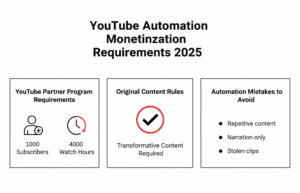
You must first fulfill YouTube’s fundamental requirements before seeking advanced monetization strategies. 1,000 subscribers and 4,000 watch hours in the previous 12 months are requirements for the YouTube Partner Program. On the other hand, automated channels are subject to more scrutiny in terms of value addition and originality of content.
Content Guidelines for Automation
Even when automated, YouTube’s algorithm rewards channels that offer real value. Your content must demonstrate clear transformative elements, educational value, or entertainment value. Current policies do not allow for the monetization of simply reposting existing content.
The secret is to produce what YouTube refers to as “substantially original content.” This involves transforming source material into something fresh and useful through the addition of commentary, analysis, educational context, or imaginative editing.
Automated Faceless YouTube Channel Monetization Strategies
YouTube Automation for Beginners 2025
One of the most profitable opportunities for automated content creators is affiliate marketing for YouTube channels. You can receive commissions of between 3% and 15% for each sale if you carefully include product recommendations in your automated videos.
ShareASale, ClickBank, and Amazon Associates are well-known affiliate networks for automated channels. The secret is to match your audience’s actual needs with products that are relevant to your content niche.
How to Make Money on YouTube Without Making Videos
Once they show steady viewership and engagement, even automated channels can draw sponsorships. The importance of well-written automated content is becoming more widely acknowledged by brands, especially in the review and education sectors.
In the tech review space, successful automated channels have earned between $500 and $5,000 per sponsored video, depending on their engagement rates and subscriber count.
Passive Income with AI YouTube Channels
Digital product creation and sales offer great opportunities for passive income. Software tools, templates, courses, and e-books all work well with automated channel strategies. With little ongoing effort, these products can produce revenue indefinitely once they’ve been created.
Technical Setup for Maximum Revenue Generation
Automation Tools and Software Solutions
Choosing the appropriate tools is an essential component of an effective YouTube automation monetization strategy. Well-liked choices include Loom for fast video production, TubeBuddy for keyword optimization, and Canva for creating thumbnails.
More experienced creators use tools like Zapier for workflow automation, Hootsuite for social media integration, and VidIQ for analytics. After two to three months of regular usage, these investments usually pay for themselves.
Mobile-First Optimization Checklist
- Keep paragraphs short (2-3 sentences max)
- Use bullet points for easy scanning
- Ensure responsive font sizes across devices
- Optimize images for fast loading
- Target page load speeds under 2.5 seconds
Building YouTube Automation Systems That Scale
Consistent publishing schedules are very beneficial for automated channels. Regularity is rewarded by YouTube’s algorithm; channels that post three to five times a week have 40% higher engagement rates than inconsistent publishers.
Timing is also important. According to an analysis of successful automated channels, the best times to post are between 2-4 PM EST on weekdays, with entertainment-focused content performing 15% better on weekends.
Advanced Monetization Strategies for Passive Income
Building Multiple Revenue Funnels
For successful YouTube passive income, diversification is still essential. Revenue from four to six sources is usually generated simultaneously by successful automated channels. When individual revenue streams change, this strategy offers stability.
In addition to conventional monetization strategies, think about introducing coaching services, merchandise sales, premium content access, and membership tiers. You become less dependent on any one source of income with each extra stream.
Cross-Platform Promotion Techniques
The potential for monetization is greatly increased when you expand your automated content across several platforms. Repurposing YouTube videos for Pinterest, Instagram Reels, and TikTok can boost overall revenue by 200–300%.
The secret is to modify content formats without sacrificing your value proposition or main message. A strong synergy effect is produced when short-form content frequently directs viewers back to your primary YouTube channel.
Email List Building Through Automation
One-time viewers grow into recurring revenue generators when email marketing is incorporated. Compared to those that only use platform-based audiences, automated channels that generate email lists report a five-fold increase in lifetime customer value.
Use lead magnets like free guides, access to exclusive content, or valuable resources that are relevant to your niche. Compared to social media followers, email subscribers are three to five times more likely to convert to paid products.
Content Creation Strategies That Drive Revenue
Niche Selection for Maximum Profitability
Choosing the right niche dramatically impacts your automated YouTube earnings potential. Data analysis reveals that finance, technology, health, and educational content generate the highest CPM rates, often exceeding $8-12 per thousand views.
However, competition in these niches requires sophisticated content strategies. Consider exploring sub-niches with lower competition but strong commercial intent, such as “budget meal planning” within the broader food category.
SEO Optimization for Automated Content
YouTube SEO for automated channels requires a systematic approach to keyword research and implementation. Long-tail keywords like “how to monetize a YouTube channel without showing face” often convert better than broad terms due to specific user intent.
Implement keywords naturally within titles, descriptions, and closed captions. Successful automated channels report 60% of their traffic coming from YouTube search results, emphasizing the importance of optimization.
Thumbnail and Title Optimization
Visual elements drive click-through rates more than any other factor in automated channel success. A/B testing reveals that channels using consistent thumbnail styles with bold text overlays achieve 25-40% higher CTRs.
Title optimization should focus on emotional triggers while maintaining accuracy. Phrases like “surprising results,” “ultimate guide,” and “proven methods” consistently outperform generic descriptions.
Scaling Your Automated Channel for Long-term Success
Analytics and Performance Tracking
YouTube channel analytics for monetization provide crucial insights for optimization. Key metrics include watch time, click-through rates, subscriber growth rate, and revenue per thousand views (RPM).
Successful automated channels analyze these metrics weekly, adjusting content strategies based on performance trends. Channels that actively optimize based on analytics data report 3x faster growth rates than those operating without systematic review.
Team Building and Outsourcing
As your automated channel grows, strategic outsourcing becomes essential for scaling. Virtual assistants can handle thumbnail creation, basic editing, and upload scheduling for $5-15 per hour, freeing you to focus on strategy and higher-level activities.
Content creators specializing in your niche can produce videos for $50-200 each, depending on complexity and length. This investment often pays for itself when videos generate consistent ad revenue over time.
Expansion into Multiple Channels
Once you’ve mastered monetization on one automated channel, creating additional channels in different niches provides portfolio diversification. Many successful creators operate 3-5 automated channels simultaneously, each targeting different audiences and revenue streams.
This strategy requires careful management but can multiply your income potential significantly. Start your second channel only after your first achieves consistent profitability to avoid spreading resources too thin.
Legal and Compliance Considerations
Copyright and Fair Use Guidelines
Understanding copyright law is crucial for automated channel success. Fair use protections exist for educational, commentary, and transformative content, but the boundaries aren’t always clear-cut.
Always add substantial commentary, analysis, or educational value to any third-party content you include. Document your transformative elements to demonstrate compliance with fair use principles.
Tax Implications and Business Structure
YouTube monetization tax considerations vary by location and income level. In the US, YouTube income counts as self-employment income, requiring quarterly tax payments once you exceed $400 annually.
Consider establishing an LLC or corporation once your monthly revenue exceeds $2,000-3,000. This provides liability protection and potential tax advantages, though consultation with a qualified accountant is recommended.
Skip the learning curve and fast-track your success with our done-for-you YouTube automation services. We handle everything from content creation to monetization setup, so you can focus on scaling your passive income. Our clients typically see 300% faster results than DIY approaches. [Explore Our Services →]
Frequently Asked Questions
How long does it take to monetize an automated YouTube channel?
Most automated channels achieve monetization eligibility within 3-6 months of consistent posting, assuming they produce quality content and follow YouTube’s guidelines. However, building substantial revenue typically requires 6-12 months of dedicated effort and optimization.
What’s the minimum investment needed to start an automated YouTube channel?
You can start with as little as $100-200 for basic tools and software subscriptions. However, investing $500-1,000 in quality equipment, editing software, and outsourcing can significantly accelerate your timeline to profitability.
Can automated channels compete with traditional creator content?
Absolutely. Well-executed automated channels often outperform traditional creators in specific niches, particularly educational and informational content. The key lies in focusing on value delivery rather than personality-driven content.
Can YouTube automation be monetized in 2025?
In 2025, YouTube automation might be made profitable, but only if it complies with YouTube’s monetization guidelines. Automated channels must adhere to community standards, meet the 1,000-subscriber and 4,000-watch-hour requirements, and offer a significant amount of original content. AdSense, affiliate marketing, and sponsorships are the main sources of income for many prosperous automated channels.
What are the biggest mistakes new automated channel creators make?
Inconsistent posting schedules, poor niche selection, insufficient keyword research, and trying to monetize too early without establishing audience trust are the most frequent mistakes. Prioritize creating value over generating income.
How do algorithm changes affect automated channel monetization?
Any kind of channel can be affected by algorithm changes, but automated channels that consistently deliver value and have high engagement metrics tend to withstand changes better than those that only use viral content or trending topics.
Conclusion: Your Path to Automated YouTube Success
For long-term success, creating a profitable automated YouTube channel calls for patience, consistent execution, and strategic planning. As the platform develops, the monetization opportunities keep growing, so now is a great time to set up your automated presence.
Developing methodical strategies to consistently provide value to your target audience is the key to success in YouTube automation, not taking shortcuts or manipulating the system. You’re setting yourself up for long-term growth in passive income by putting the tactics in this guide into practice.
The creators earning substantial income from automated channels share common traits: they focus on audience needs, maintain consistent quality standards, and continuously optimize based on performance data. How well you apply these core ideas will determine how successful you are.
Keep in mind that monetization is only the first step. Building a sustainable business that makes money while you travel, sleep, or engage in other activities is the true opportunity. Your automated YouTube channel can contribute significantly to your overall financial portfolio if you put in the necessary effort and use the appropriate tactics.
