
Is E-commerce Automation Still Profitable in 2026? (Data & Reality Check)
Everyone loves the idea of automated income. Build an online store, let the tech do the heavy lifting, and collect checks while you sleep.
Sounds perfect, right?
Except it rarely works that way.
Plenty of people jumped into e-commerce automation between 2022 and 2024, thinking they’d found easy money. Instead, they ran into rising ad costs, tighter marketplace rules, brutal competition, and flooded niches. What looked like a goldmine turned into a money pit.
So here’s the real question: Is e-commerce automation profitable in 2026, or did that ship sail?
The honest answer isn’t simple. It depends on your budget, your patience, and whether you understand what actually works versus what gets hyped on YouTube.
This article cuts through the noise. Real numbers, real timelines, real talk about ecommerce automation profitability, what still works, what doesn’t, and who should even bother trying.
Is E-commerce Automation Still Profitable in 2026? (Short Answer)
Yes, but not for everyone.
E-commerce automation profitability means running an online store that actually makes money after paying for inventory, platform fees, ads, tools, and everything else. In 2026, that’s still possible, but harder than it used to be.
The businesses making it work aren’t looking for shortcuts. They have realistic expectations, enough money to get started properly, solid systems, and the patience to stick it out. Industry data and platform reports suggest that well-run automation businesses can reach healthy profit margins over time, but results vary widely based on execution and market conditions.
But profitability isn’t automatic. You need:
- Real startup money (anywhere from $5,000-$15,000 for basic DIY setups, though $10,000-$25,000 gives you breathing room; managed services typically start at $25,000-$75,000 depending on what’s included)
- Platform know-how to stay on the right side of marketplace rules
- Decent systems using reliable automation tools with actual oversight
- Smart product choices in niches that aren’t completely saturated
- Some branding instead of just flipping generic products
Skip any of those, and you’re probably toast within a year. Understanding how e-commerce automation 2026 actually works matters more than jumping in with both feet.
The Current State of E-commerce Automation in 2026
The e-commerce automation game has changed. The wild-west days of 2020-2022 are over. Now it’s more competitive, more regulated, and frankly, more boring.
Here’s what’s different:
Marketplaces are packed. Amazon, Walmart, and Etsy are all crowded. More sellers fighting over the same customers means higher ad costs and tougher competition. Standing out isn’t optional anymore.
Everyone has AI tools now. Automated inventory tracking, price adjustments, chatbots, that stuff used to give you an edge. Now it’s just table stakes. AI adoption in retail has exploded over the past few years, so the advantage has disappeared. When everyone has the same tools, nobody has an advantage.
Platforms crack down harder. With Amazon’s brand requirements, Walmart’s seller checks, and increased scrutiny of dropshipping, the loose rules that allowed people to get away with sketchy tactics are gone. Playing by the rules costs more but matters more.
Customers expect more. Fast shipping, easy returns, helpful support. If your automation sacrifices customer experience to save a few bucks, you’ll get buried in bad reviews. Modern buyers actually prefer AI-powered customer service when it’s done right, fast responses that still feel human.
The sellers winning right now treat automation like a real business tool, not a magic button. They use technology for the routine, repetitive tasks while keeping humans in charge of strategy, quality checks, and customer relationships.
What Changed Since 2024-2025?
The past 18 months brought some major shifts that changed the profitability of e-commerce automation profitability for everyone.
Ad costs kept climbing. Amazon PPC and similar platforms saw steady increases in competitive categories, which means in real life: bigger ad budgets just to maintain the same visibility you had before.
Marketplace fees changed. Amazon added new inbound placement fees in 2024, making FBA more complex and expensive. Walmart made seller approval tougher, shutting out casual operators.
AI became standard. ChatGPT, Claude, and similar tools made it easy for anyone to write decent product listings. That’s great for newbies, but it also means everyone’s listings look the same. Standing out takes more than clean copy and nice photos now.
Supply chains settled down. After years of chaos, shipping got more predictable. Good news for planning, bad news if you were profiting from navigating the mess better than others.
Brands fought back. Major brands cracked down on unauthorized resellers. The arbitrage tactics that worked in 2023 began to lead to account suspensions and blocked inventory in 2025-2026.
None of this killed the automation business. It just raised the bar. Strategy and execution quality matter more than moving fast or going big. The broader trends in AI automation and marketplace dynamics keep reshaping what works.
The Data Behind E-commerce Automation Profitability
Let’s talk real numbers instead of hype.
Take a typical Amazon FBA business doing $50,000 monthly in sales. In simple terms, the money usually gets split like this:
- Product costs: Usually the biggest chunk, often nearly half the revenue
- Amazon fees: Another significant portion for storage, fulfillment, and selling privileges
- Advertising: Can eat up a quarter of revenue in competitive niches
- Storage and shipping: Smaller but steady costs
- Software and tools: Monthly subscriptions add up
- Returns and refunds: The cost of doing business online
After all that, successful sellers typically keep somewhere between a tenth and a quarter of revenue as actual profit. At $50K in sales, that could mean anywhere from $5,000-$12,500 monthly, depending on how efficiently things run.
Walmart tends to have slightly better economics because fees are lower, but the ad platform isn’t as developed. Shopify businesses face different math, lower marketplace fees, but way higher costs to drive traffic.
E-commerce automation ROI looks different depending on the model:
- Retail arbitrage: Decent margins but hard to scale beyond a certain point
- Private label: Better margins possible, but needs bigger upfront money
- Wholesale: Lower margins but steadier, more predictable
- Dropshipping: Varies wildly, heavily dependent on supplier reliability
The businesses hitting stronger margins usually run for at least a year, have some brand recognition, and constantly optimize. Most beginners don’t see strong margins right away. Early months are about learning, testing, and fixing mistakes. The sellers who last long enough usually improve margins gradually, not overnight.
Which E-commerce Automation Models Still Make Money?
Not every automation approach delivers the same results. Some adapted better than others.
Amazon FBA Automation
Still the biggest opportunity because of platform size and built-in customer trust. Private label brands with unique products do best. Arbitrage has gotten brutal, with too many brand restrictions and account risks.
Profitability timeline: Most sellers need 6-12 months to see positive cash flow, then another 6-12 months to build real profits.
Starting budget: Ranges from $10,000-$30,000 depending on product category and how much inventory you stock. More money gives you more room to test and adjust.
Walmart Marketplace Automation
Growing fast with less competition than Amazon. Lower fees mean better margins on similar products. Downside: the ad platform isn’t as sophisticated, and getting organic visibility takes longer.
Profitability timeline: Some sellers break even faster here, often within 4-9 months.
Starting budget: Entry points vary from $8,000-$25,000 based on products and ad strategy.
Shopify Automation
Requires actual marketing skills since traffic isn’t built-in. The sellers succeeding here combine automation with content marketing, email sequences, and social media.
Profitability timeline: Highly variable, anywhere from 6-15 months depending on marketing effectiveness.
Starting budget: Ranges from $5,000-$20,000 depending on fulfillment method. Dropshipping starts cheaper but usually needs more ad spend.
Etsy Automation
Works well for handmade items, vintage stuff, print-on-demand, and digital products. Lower barrier to entry, but also lower order values. Popular categories are oversaturated.
Profitability timeline: 3-8 months in established niches if you find the right products.
Starting budget: Many sellers start with $1,500 to $8,000. Print-on-demand needs less upfront inventory investment.
Multi-Platform Automation
Running on multiple marketplaces spreads risk and reaches more customers. But it’s complicated and needs solid inventory systems.
Best for businesses already successful on one platform looking to expand, not for beginners spreading themselves too thin.
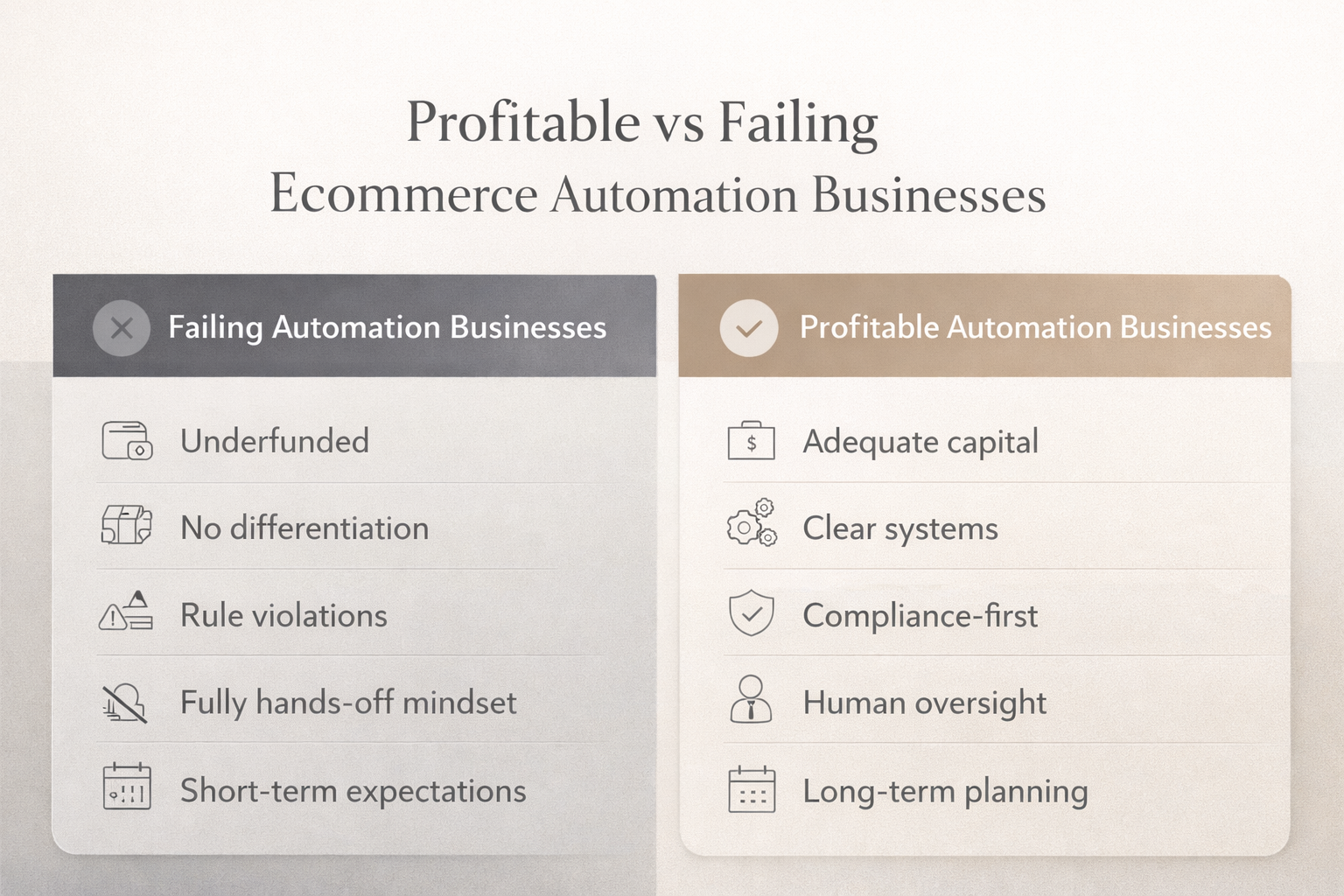
Why Most E-Commerce Automation Businesses Fail
Understanding why others crash helps you avoid the same mistakes that kill ecommerce automation profitability.
Not Enough Money
This kills more businesses than anything else. People start with a few thousand dollars, thinking they’ll make it back fast. When products flop, ads drain the budget, or cash flow gaps appear, they’re done.
Successful operations need several months of runway. That means enough money to cover inventory, platform fees, ads, and your bills without counting on profits that might not show up for a while.
Selling the Same Stuff as Everyone Else
When 50 other sellers have identical products, it becomes a race to the bottom on price. Your margins evaporate. Without something different, better bundles, superior listings, unique packaging, and actual product improvements, you’re just grinding for pennies.
Ignoring the Rules
Platform violations can end your business overnight. Common killers: selling knockoffs, violating brand policies, gaming reviews, and running multiple accounts.
Marketplace rules change constantly. If you’re not paying attention and adjusting, you’re building on shaky ground. Even Google’s guidelines on automated content matter if you’re driving traffic beyond marketplaces.
Trusting Automation Too Much
Fully automated everything sounds great until it breaks. Auto-repricing triggers price wars. Auto-responses miss customer nuances. Auto-inventory doesn’t catch quality problems from suppliers.
Profitable automation uses tech for boring tasks while keeping humans on strategy, quality control, and relationships.
Bad Cash Flow Planning
E-commerce needs money upfront for inventory, while revenue comes later. Amazon pays every two weeks. Payment processors hold funds. Poor planning creates situations where you’re profitable on paper but can’t afford next month’s stock.
Expecting Fast Money
Thinking you’ll be profitable in 30-60 days sets you up for disappointment and early quitting. Most successful operations take months to consistently profit, sometimes over a year, depending on the model and how many mistakes are made along the way.
Chasing Trends Instead of Building Systems
Jumping from hot product to hot product might score occasional wins, but it doesn’t build sustainable automation business profitability. Long-term winners develop systems for finding products, managing suppliers, optimizing listings, and keeping customers coming back.
Automation Services vs DIY Automation: Profit & Risk Comparison
Big decision: use a managed service or build it yourself?
DIY Automation
Cost: Lower upfront investment, typically $5,000- $25,000, depending on the platform and products. You’re paying for inventory, tools, and ads instead of service fees.
Control: Complete. You pick products, set prices, choose suppliers, and make every decision.
Time: Significant, especially while learning. Expect 20-40 hours weekly for the first 6-12 months.
Risk: High learning curve. First-timers make expensive mistakes with products, ads, and platform rules. But you gain knowledge that compounds over time.
Timeline: Most disciplined operators break even within 6-12 months, then build toward meaningful profits over the next year.
Best for: People with time to learn, comfortable with tech, patient enough to work through problems. Also ideal if you want to build something you can eventually sell.
Managed Automation Services
Cost: Higher upfront investment, often $20,000-$100,000+, depending on provider, platform, and package. Plus ongoing fees, usually a percentage of revenue or fixed monthly costs.
Control: Limited. Service providers make most decisions. You might get input on strategy, but daily operations are out of your hands.
Time: Minimal ongoing involvement, which appeals to busy professionals or passive investors.
Risk: Service quality varies wildly. Some deliver results, others take your money and disappear. Even reputable services can’t guarantee success; market conditions matter.
Timeline: Often takes over a year before recovering your initial investment, then ongoing profits minus management fees.
Best for: People with capital but no time, those wanting passive involvement, or entrepreneurs wanting e-commerce exposure without learning the details.
The Middle Path: Hybrid Models
Some businesses start DIY to learn the basics, then hire virtual assistants or specialists for specific tasks, customer service, listing creation, and ad management. This balances cost, control, and time better than going all-in either direction.
The choice between automation services vs DIY comes down to your budget, available time, tech comfort, and whether you want to build a business or make a passive investment. For those wanting guidance without full handover, exploring professional automation consultation can provide support while maintaining control.
Why Automation Without Branding Stops Being Profitable
Pure automation with zero branding, no identity, no customer relationships, and no differentiation loses ecommerce automation profitability over time.
Here’s why:
Generic products lead to price wars. When competitors sell identical items, price is the only factor. Margins compress until there’s nothing left.
Algorithms favor brands. Amazon’s algorithm gives advantages to products with strong conversion rates, good reviews, and brand recognition. Generic products without brand equity struggle for visibility without constantly increasing ad spend.
Customer loyalty pays off. Branded businesses get repeat purchases, lowering customer acquisition costs. Automation businesses competing only on price must constantly find new customers at full marketing cost.
Branding enables premium pricing. Recognizable brands can often charge more than generic alternatives. That pricing power translates directly to better margins and e-commerce automation ROI.
Brands resist copycats. Unbranded products are easy to knock off. Branded products with registered trademarks, unique packaging, and market presence create barriers to competition.
Building a brand doesn’t require a massive budget. Start with:
- Registered business names and trademarks
- Consistent packaging and visual identity
- Quality listings with professional photos
- Responsive customer service that builds reputation
- Gradual accumulation of positive reviews
- Simple content marketing through social media or basic websites
Even modest branding significantly improves long-term profitability versus completely generic operations.
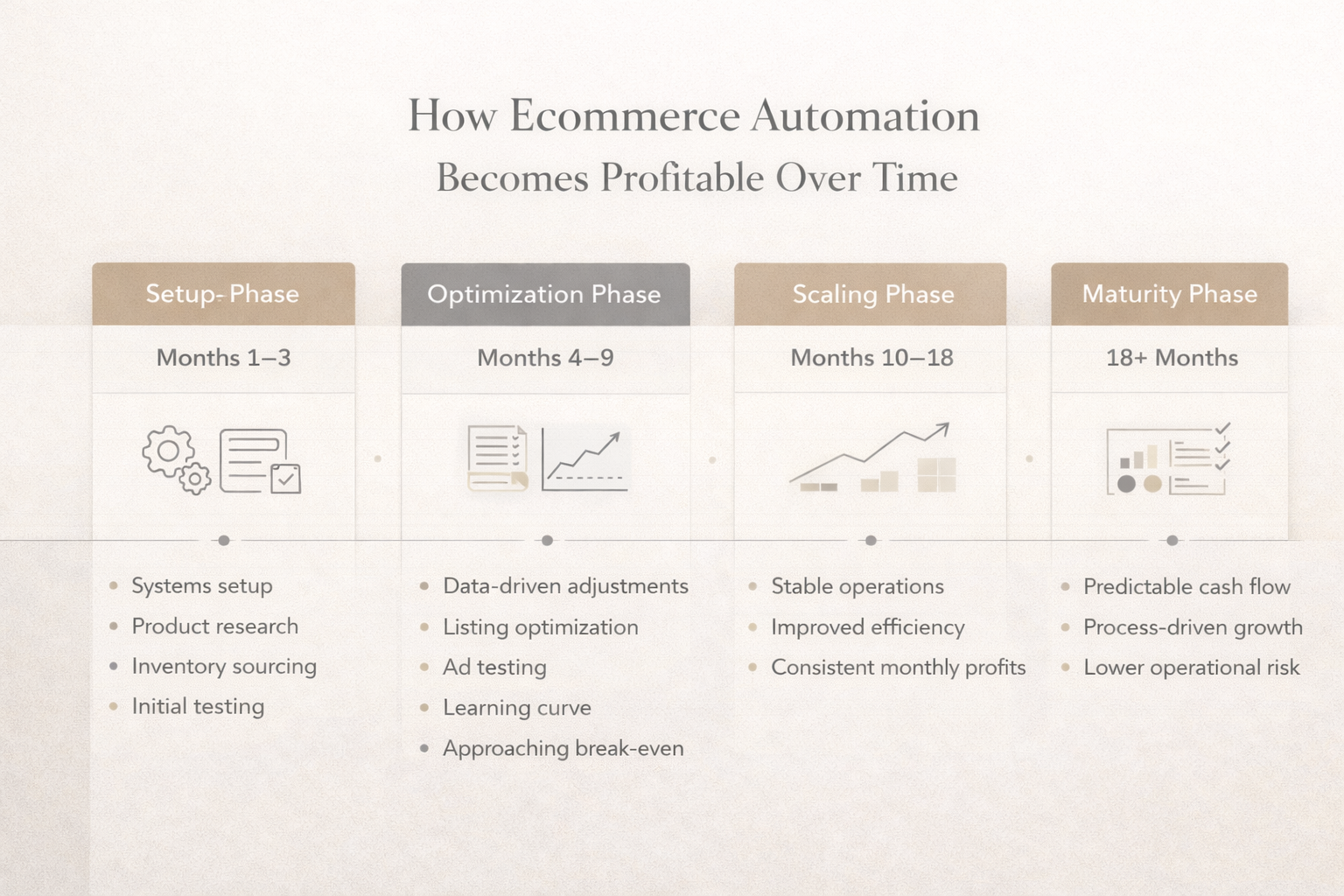
How Long Does It Take to Become Profitable?
Realistic timelines prevent premature quitting.
Setup Phase (Months 1-3)
Focus on platform setup, product research, finding suppliers, and ordering first inventory. Money goes out, nothing comes in.
You’re learning platform requirements, testing automation tools, creating listings, and launching initial ad campaigns.
Money reality: Early stages often involve ongoing expenses with little immediate return, especially while inventory, ads, and systems are being tested. Costs vary widely based on the model, platform, and how aggressively the business scales.
Optimization Phase (Months 4-9)
Revenue starts, but often doesn’t cover expenses yet. You’re refining product selection, improving listings, optimizing ads, and adjusting prices based on actual market response.
Expect volatility, some months approach break-even while others show losses from inventory investments, ad tests, or seasonal swings.
Money reality: Still mostly negative or barely positive cash flow. Additional investment is common during this phase as you figure out what works and what doesn’t.
Scaling Phase (Months 10-18)
Consistent profitability emerges. Revenue exceeds all expenses, including products, fees, ads, and operations. Focus shifts to expanding product lines, increasing inventory depth, and improving efficiency.
Money reality: Positive cash flow with improving margins. Monthly profits vary widely depending on revenue scale and how efficiently things run.
Maturity Phase (18+ Months)
Established operations with proven products, optimized processes, and predictable performance. Opportunities open up for expansion through new products, platforms, or markets.
Money reality: Strong positive cash flow with healthy profit margins possible for well-managed operations.
These timelines assume decent execution and normal market conditions. Mistakes, platform changes, or bad product picks can stretch timelines significantly. Exceptional execution or lucky breaks can compress them somewhat.
Bottom line: E-commerce automation profitability rarely happens fast. Plan for 9-15 months before expecting real, consistent returns.
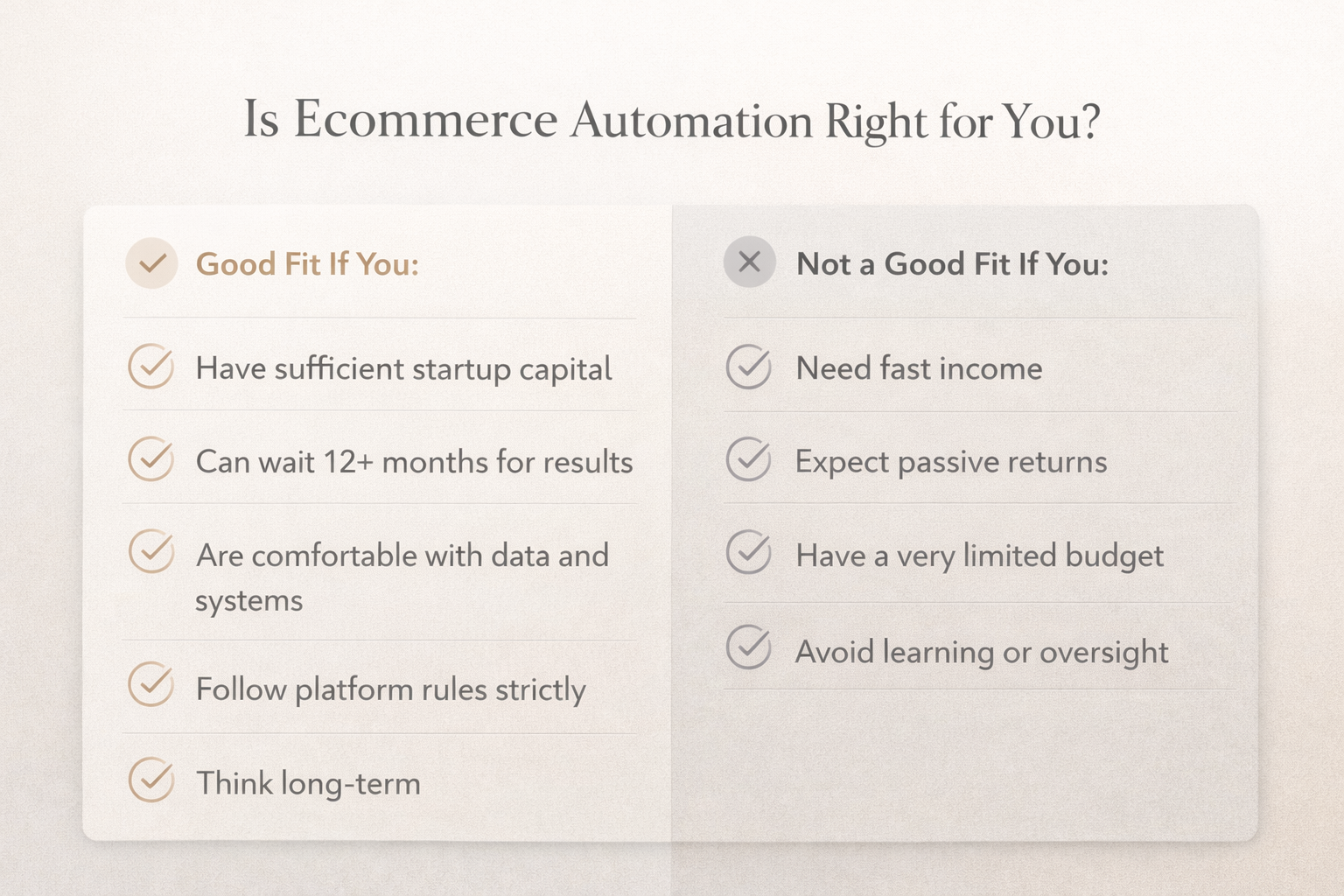
Is E-commerce Automation Worth It in 2026?
Depends entirely on your situation, goals, and resources.
E-commerce Automation Makes Sense For:
People with real capital who can invest $8,000-$25,000 for DIY or $25,000-$75,000+ for managed services, and can let that money work for a year or more without needing it back.
Those willing to keep learning. E-commerce changes constantly. Platform policies shift. Customer preferences evolve. Competition adapts. Success requires ongoing education and adjustment.
Entrepreneurs seeking scalable income. Unlike trading time for money, successful automation businesses can grow without proportionally increasing their time once systems work.
People with patience and long-term vision. Quick-money seekers usually fail. Those viewing this as a 2-3 year business-building project have better odds.
Those comfortable with tech and data. You don’t need technical expertise, but comfort with software, spreadsheets, and basic analytics helps significantly.
E-commerce Automation Probably Isn’t Right For:
Anyone needing income within 3-6 months. The timeline doesn’t support urgent financial needs.
People with limited budgets are expecting high returns. Underfunded operations usually fail before reaching profitability.
Those expecting passive income without work. Truly passive e-commerce income is rare and usually comes only after years of active building.
Anyone unwilling to follow rules. Marketplace violations carry serious consequences. Operating ethically and legally matters.
People seeking guaranteed returns. Like any business, e-commerce automation carries risk. Market conditions, execution quality, and luck all matter.
The question isn’t whether e-commerce automation 2026 offers opportunities; it does. The question is whether those opportunities match your circumstances, resources, and temperament.
For the right person with appropriate expectations, capital, and commitment, e-commerce automation remains viable for building profitable online businesses. For others, the challenges and timeline might not justify the effort and investment.
Those seriously considering this path might benefit from professional guidance and support to navigate modern automation profitably and sustainably.
Frequently Asked Questions
Q. Is e-commerce automation still profitable in 2026?
Yes, but not as easily as before. Automation remains profitable for businesses that approach it strategically with realistic expectations. Healthy profit margins are achievable after a year or more of consistent operation. Success requires adequate capital, patience, and focus on differentiation rather than pure arbitrage. The market has become more competitive and compliance-focused, making professional execution more important than it was in previous years.
Q. What is a realistic e-commerce automation ROI?
Most successful automation businesses see solid annual returns after reaching profitability, which typically takes 12-18 months or longer. Initial investment varies from $10,000-$50,000 depending on the model chosen. Breaking even usually takes 6-12 months, with meaningful profits emerging afterward. Higher returns are possible but usually require exceptional execution, favorable market conditions, or significant brand building over time.
Q. Why do most e-commerce automation businesses fail?
The primary reasons include insufficient startup capital, unrealistic timeline expectations, lack of product differentiation, poor cash flow management, and platform compliance violations. Many entrepreneurs start undercapitalized and quit before reaching profitability. Others fail to build sustainable competitive advantages beyond price competition. Success requires treating automation as a serious business rather than a passive income shortcut or a get-rich-quick scheme.
Q. Should I use automation services or build my own e-commerce business?
DIY automation offers lower costs and full control but requires significant time and learning. Managed services reduce time investment but cost more upfront and offer limited control over decisions. DIY suits people with time to learn and a desire to build a sellable asset. Managed services work better for busy professionals with capital seeking passive involvement. Hybrid approaches, handling core tasks yourself while outsourcing specific functions, often provide the best balance for most people.
Q. How long until an e-commerce automation business becomes profitable?
Most well-executed automation businesses reach break-even within 6-12 months and consistent profitability within 12-18 months or longer. The first few months typically show only expenses as systems are built and inventory sourced. Middle months bring initial revenue but often don’t cover all costs yet. Later months usually see positive cash flow and improving margins. Timeline varies based on available capital, execution quality, and market conditions.
