
Amazon Automation Cost 2026: What You’ll Actually Pay
Amazon automation cost 2026 means investing serious capital into a managed Amazon store. Most people budget $25,000 to $150,000 just to start. Monthly operating costs often add another $3,000 to $8,000 on top of that. Amazon remains the largest ecommerce marketplace globally, accounting for a significant share of online retail sales according to Statista’s ecommerce market data. That scale creates opportunity, but also intense competition.
The real question isn’t just how much it costs, but whether the returns actually justify the risk.
Many people think it’s just one agency fee. However, Amazon takes a cut from every sale. Ads cost money every single day. Products need to be bought upfront and stored in warehouses. All those costs stack up faster than expected.
This guide breaks down exactly where every dollar goes.
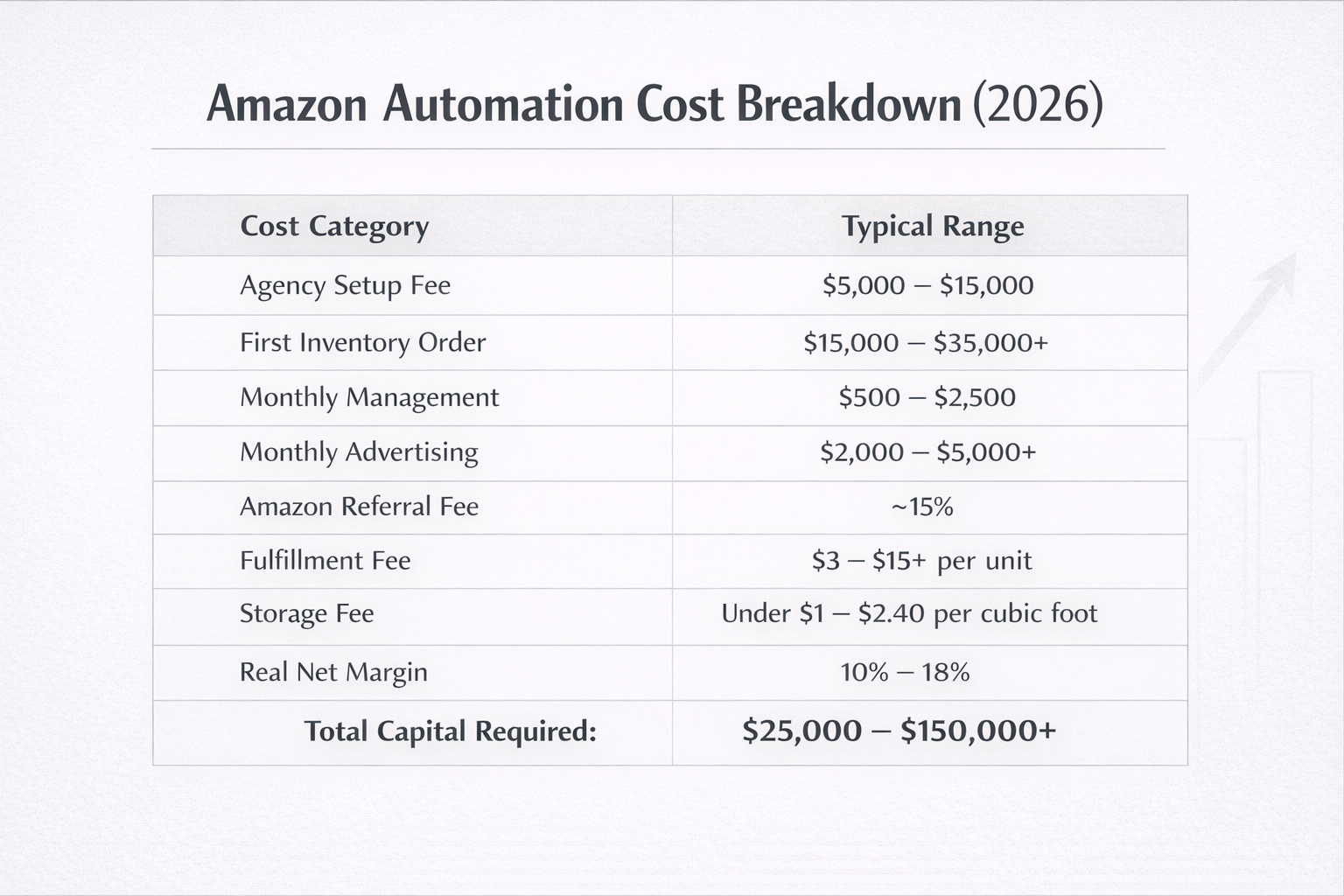
Amazon automation cost 2026 is the total money required to start and operate a managed Amazon store. It includes:
- Agency setup fees – $5,000 to $15,000 (one-time)
- Monthly management fees – $500 to $2,500 per month
- Amazon referral and fulfillment fees – ~15% per sale plus $3-$15+ per unit
- Advertising costs – $2,000 to $5,000+ per month
- Inventory investment – $15,000 to $35,000+ per product
- Storage fees – Under $1 to $2.40 per cubic foot monthly
- Reserve capital – Buffer for cash flow gaps
What Is Amazon Automation Cost 2026?
Amazon automation cost 2026 is the total money needed to start and run a managed Amazon store. When people ask how much does Amazon automation cost, they’re really asking about two things: upfront investment and ongoing monthly expenses.
It includes:
- Agency setup fee – One-time payment to get started ($5,000 to $15,000)
- Monthly management fees – Ongoing cost to keep the store running ($500 to $2,500/month)
- Amazon referral fees – Amazon’s cut from every sale (commonly 15%)
- Fulfillment fees – Amazon packs and ships each order ($3 to $15+ per unit)
- Advertising costs – Paid ads to get products seen ($2,000 to $5,000+ per month)
- Inventory investment – Buying actual products to sell ($15,000 to $35,000+ per product)
- Storage fees – Warehouse rent charged by Amazon (under $1 to $2.40 per cubic foot monthly)
- Reserve capital – Extra money set aside for gaps and surprises
Full Cost Breakdown at a Glance
| Cost Category | Typical Range |
| Agency Setup Fee | $5,000 – $15,000 (one time) |
| First Inventory Order | $15,000 – $35,000+ per product |
| Monthly Management Fee | $500 – $2,500/month |
| Monthly Advertising | $2,000 – $5,000+/month |
| Amazon Referral Fee | ~15% of every sale |
| Fulfillment Fee | $3 – $15+ per unit |
| Storage Fee | Under $1 – $2.40/cubic foot/month |
| Net Profit Margin (realistic) | 10% – 18% after all costs |
How Much Agencies Charge
Understanding Amazon automation pricing comes down to two payments: setup costs and monthly fees.
Agency Setup Costs
First payment goes to the agency. The Amazon automation startup cost commonly ranges from $5,000 to $15,000.
This covers finding products, talking to suppliers, building your listings, and getting your account ready. Some agencies execute this process well. Others do not.
Budget agencies often charge $5,000 to $7,000. Mid-range ones ask $8,000 to $12,000. Premium agencies want $15,000 or more.
Lower prices sound appealing. But cheaper agencies sometimes pick overcrowded products or go quiet after setup. Sometimes spending more upfront saves money down the road.
Monthly Management Fees
Every month, the agency gets paid to keep things running. Figuring out your Amazon automation monthly cost means tracking these recurring charges. Two common structures:
Flat fee: Same payment every month. Usually $500 to $2,500. Sales go up or down, the fee stays the same.
Percentage: Agency takes 10% to 20% of monthly revenue. If they sell $20,000 worth of products, they get $2,000 to $4,000. Sell $50,000, they get $5,000 to $10,000.
Both can work. Flat fees are predictable. Percentages align incentives; the agency earns more only when sales grow.
Monthly fees typically cover:
- Running and optimizing ad campaigns
- Ordering more stock when inventory runs low
- Handling customer service
- Updating product listings
- Monitoring competitors
- Sending monthly performance reports
Good agencies do all of this consistently. Weaker ones collect the fee and give the account minimal attention.
Amazon Automation Fees: What Amazon Takes
These Amazon automation fees come out of every single transaction. No exceptions.
Referral Fees
Amazon takes a percentage of each sale. Most categories charge around 15%.
Sell something for $30? Amazon takes roughly $4.50. Sell for $100? About $15 goes to Amazon right away.
Some categories run lower, around 8% to 10%. But most products land at 15%. Non-negotiable.
Fulfillment Fees
Small light items often cost about $3 to $5 per unit. Medium products run $5 to $8. Large or heavy items can hit $10 to $15 or more, and Amazon keeps adjusting these fulfillment rates along with fuel surcharges, peak season fees, and whatever else they feel like adding.
Storage Fees
Amazon charges rent for keeping products in its warehouses.
Most months, it’s under $1 per cubic foot. October through December jumps to around $2.40 because of holiday inventory volume.
Products sitting for over a year trigger long-term storage penalties, around $7 per cubic foot. One seller ordered too much inventory, products moved slowly, and a $4,000 penalty bill wiped out months of profit.
Amazon FBA Automation Cost: Advertising
Products rarely sell without advertising. Amazon FBA automation cost includes a significant ad budget as an ongoing expense.
Monthly Ad Spending
New products commonly need $2,000 to $5,000 per month in ads just to gain initial traction. That’s for one or two products.
Larger operations with multiple products often spend $10,000 to $30,000 monthly. Bigger brands can go well beyond that.
How Ads Work
It works like an auction. Someone searches “coffee maker” on Amazon. The ad shows up. Each click costs money.
Clicks commonly range from $0.30 to $3.00, depending on how competitive the keyword is. Popular products in crowded categories cost more per click.
Sponsored Products appear inside search results. Sponsored Brands appear at the top of the page with a logo and multiple products displayed together.
Understanding ACoS
ACoS stands for Advertising Cost of Sales. It measures whether ads are generating returns.
Spend $25 on ads, make $100 in sales from those ads, ACoS is 25%.
New products commonly run 30% to 40% ACoS just to build visibility. Established products often get down to 15% to 25%.
That difference matters a lot. At 40% ACoS, there’s very little room for profit. At 20% ACoS, the margins look much healthier.
Product and Inventory Costs
This is the money that goes directly to manufacturers and suppliers.
First Inventory Order
The first order typically costs $15,000 to $35,000 for a single product. This covers:
- Manufacturing overseas
- Ocean freight shipping (often 30 to 60 days)
- Customs and import fees
- Delivery to Amazon warehouses
Factories usually have minimum order requirements. Commonly 500 to 1,500 units. At $12 to $25 per unit, that’s $6,000 to $37,500 just for the products themselves.
Cost of Goods Sold (COGS)
COGS is what each unit costs to make and ship to Amazon.
Ideally, product costs are 15% to 30% of the selling price. Lower is better; it leaves room for Amazon fees, advertising, and actual profit.
Selling a product for $30? Want it to cost around $5 to $9 to make and deliver. Products where COGS is 40% to 50% of the selling price are very hard to profit from.
Restocking Costs
Products that sell need reordering every 60 to 90 days.
Capital stays tied up in inventory continuously. Not a one-time $20,000 investment, more like keeping $20,000 to $40,000 allocated to products as long as the business operates.
What Different Budget Levels Actually Look Like
The Amazon automation business cost looks completely different depending on how much you’re putting in.
Starting Level: $25,000 to $35,000
Bare minimum entry point. Rough breakdown:
- Agency setup: $7,000 to $10,000
- First product inventory: $15,000 to $20,000
- First month management and ads: $2,000 to $3,000
- Reserve capital: $3,000 to $5,000
Working with one product, maybe two. After a few months, monthly sales might reach $8,000 to $12,000.
After Amazon fees, ad spend, and agency cost, actual monthly profit often lands around $600 to $1,800.
Break-even commonly takes 15 to 24 months.
Medium Level: $60,000 to $85,000
This level starts making more financial sense.
- Setup: around $10,000
- Inventory for 2 to 3 products: $40,000 to $50,000
- Management and ads for first 3 months: $10,000 to $15,000
Monthly sales often reach $25,000 to $40,000 by month 6 or 7. Actual monthly profit commonly lands around $3,000 to $8,000.
The break-even timeline is often 12 to 18 months.
Growth Level: $120,000 to $150,000
For businesses targeting faster scaling.
- Setup: around $15,000
- Inventory across 3 to 5 products: $75,000 to $85,000
- Management and advertising budget: $25,000 to $30,000
Monthly sales could reach $60,000 to $100,000 within 6 to 10 months. Net profit may land around $9,000 to $25,000 monthly.
Break-even commonly happens in 8 to 12 months when performance stays strong.
Hidden Costs of Amazon Automation Nobody Mentions
Returns Reduce Profit
Amazon makes returns easy for customers. Sellers absorb the cost.
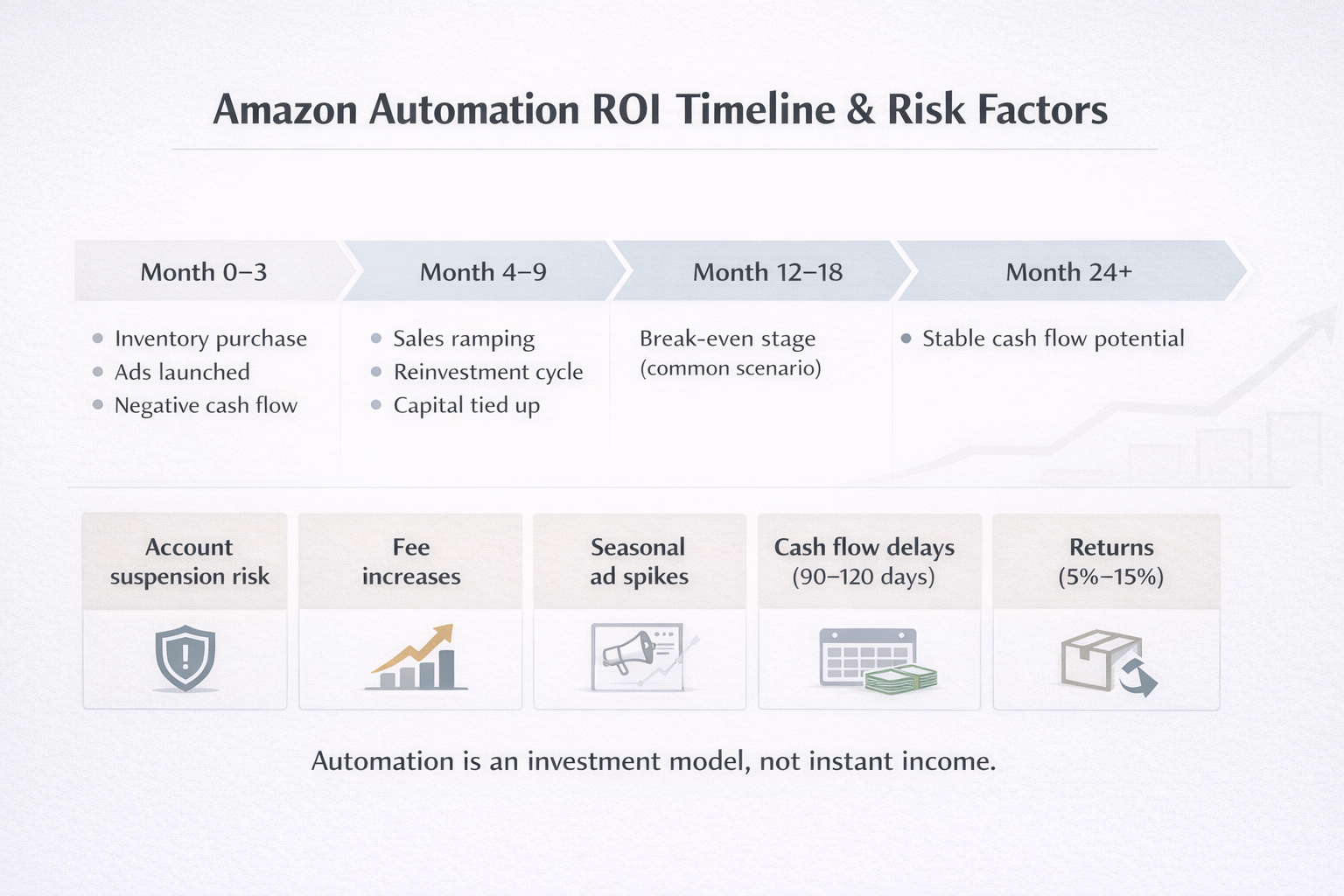
Returns are often around 5% to 15% of orders. Some categories run higher.
Return shipping costs money. Products often come back damaged and can’t be resold. That’s a straight loss every time.
One seller in apparel saw returns hit 20%. Made profitability nearly impossible. Had to switch categories entirely.
Money Gets Frozen for Months
Here’s the actual cash flow timeline:
Pay the supplier $20,000. The product takes 30 to 60 days to manufacture and ship. Sits in an Amazon warehouse. Starts selling. Amazon holds the payout for 2 weeks after each sale.
From paying the supplier to receiving money from Amazon, it commonly takes 90 to 120 days.
Capital is locked during that entire stretch. If the product sells well and needs reordering, cash might not be available yet from the first batch. Paying for batch two before getting paid for batch one.
Advertising Costs Spike Seasonally
That stable $3,000 monthly ad budget can shift significantly.
October through December ad costs commonly rise. A click costing $0.80 can jump to $2. Everyone competes for holiday shoppers at once.
Ad costs can increase 50% to 150% during peak season. Either pay substantially more or risk losing visibility to competitors with bigger budgets.
Account Suspensions Stop Everything
Amazon can suspend accounts for various reasons, such as product complaints, performance metrics dropping, suspected policy violations, or competitor reports.
Section 3 violations are particularly serious and can result in permanent account closure. Once suspended, all sales stop immediately. Inventory sits accumulating storage fees. Agency fees still come due. Zero revenue coming in.
Appeals commonly take one week to a month or longer. Some accounts don’t get reinstated at all.
Amazon Updates Fees Regularly
Fee adjustments happen pretty much every year. Fuel surcharges, peak-period fees, and other additions get introduced periodically.
A business operating at 32% total fees might suddenly face 35% after an update. On $50,000 in monthly sales, that 3% is $1,500 less profit every single month.
Sellers need to plan for fee changes as part of normal operations.
Real Profit After Everything
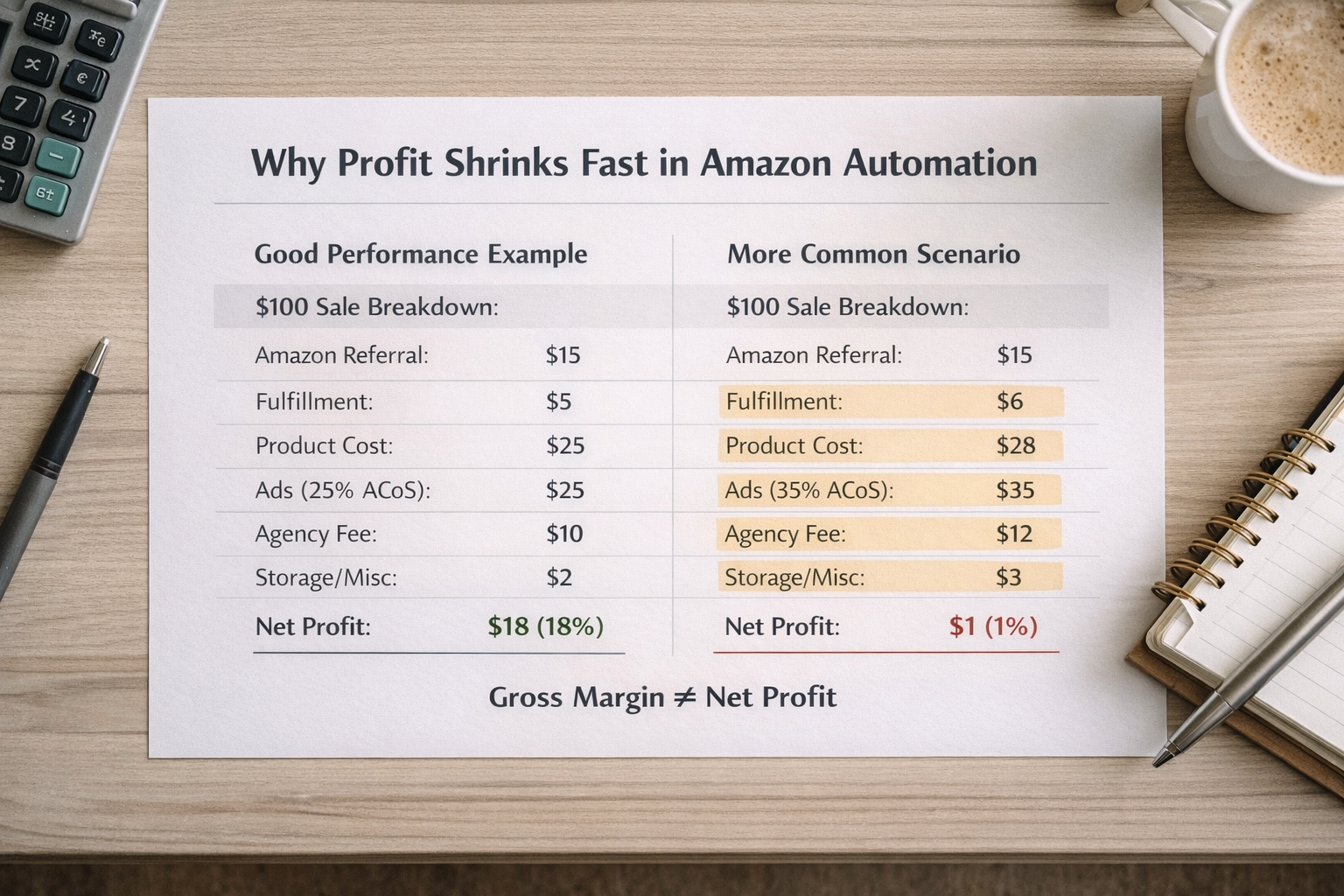
Most marketing materials show gross margins of 25% to 35%. That’s before advertising, before management fees, before many real costs.
Actual Amazon automation profit margin after every expense typically ranges from 10% to 18%.
Strong products in good categories might reach 20% to 25%. Many products operate at 8% to 12%. Some barely break even for extended periods.
Good Performance Example
Sell something for $100.
- Amazon referral fee: $15
- Fulfillment cost: $5
- Product cost (COGS): $25
- Advertising (25% ACoS): $25
- Agency fee (10%): $10
- Storage and misc: $2
Net profit: $18, 18% margin
More Common Performance Example
Same $100 sale.
- Amazon referral fee: $15
- Fulfillment: $6
- Product cost: $28
- Advertising (35% ACoS): $35
- Agency fee (12%): $12
- Storage and misc: $3
Net profit: $1, 1% margin
One dollar profit on a hundred-dollar sale. This happens more often than most expect.
How Long Until Real Profitability
Most people starting with $50,000 to $75,000 commonly wait 12 to 18 months to break even.
Smaller investments often take 18 to 24 months. Larger investments may break even in 10 to 14 months.
That assumes reasonable performance. No major suspensions. No product failures. No sudden competitive pressure.
The Amazon automation ROI timeline is longer than most expect. The first year typically doesn’t generate significant profit after covering costs and reinvesting in inventory. The second year is when businesses commonly turn cash-flow positive. The third year is when returns might start outperforming alternative investments, which matches what most ecommerce profitability studies show about automated stores reaching sustainable returns.
Is Amazon Automation Worth It?
When It Makes Sense
Works best for people with capital they can genuinely invest long-term. Money not needed for 18 to 24 months. Not emergency savings or borrowed funds.
Works for those wanting business ownership without daily operations, but comfortable reviewing reports and making decisions a few hours monthly.
Works when expectations are grounded. You’re targeting 10% to 18% annual returns with moderate risk. Not expecting income replacement in six months or capital to double quickly. The Amazon automation investment works when viewed realistically.
When It Probably Doesn’t
Doesn’t suit situations where capital is tight and starting under $25,000. Undercapitalized businesses struggle with product selection and advertising budgets from day one.
Doesn’t work when capital needs to come back quickly. The path to profitability is a long one.
Doesn’t work when the expectation is fully passive income with zero involvement.
The Risks to Understand
There are real Amazon automation risks worth knowing upfront.
Agency Quality Varies a Lot
Some agencies have real experience and deliver consistent results. Others provide minimal service while collecting fees.
Weaker agencies sometimes pick products in saturated categories. Set up ads once and rarely check them. Become unresponsive when performance drops.
The gap between good and poor agencies isn’t just about results; it’s about whether capital grows or disappears. This is where questions about Amazon automation legitimacy come from. The model works, but whether you’re dealing with Amazon automation scam operators or legitimate professionals makes all the difference.
Markets Shift Fast
A profitable product today might struggle six months from now. New competitors enter. Amazon launches competing products. Overseas sellers undercut pricing significantly.
Whether you’re running private label products, wholesale operations, or dropshipping models, what works this quarter might not work next quarter.
Platform Dependency Is a Real Risk
Marketplace dependency is something every Amazon seller lives with. Harvard Business Review has discussed how platform-dependent businesses face structural risks when algorithms, fee structures, or policies change, in HBR’s platform strategy analysis. Amazon can adjust fees, modify search rankings, restrict products, or suspend accounts.
Unlike owning a Shopify store, where customer data belongs to the business, Amazon sellers don’t own customer relationships. No email lists. No direct customer access. According to Shopify’s ecommerce guide, owning customer relationships provides significantly more long-term business stability.
It’s Not Passive Income
This often gets marketed as passive income. The reality is different.
Not packing boxes or answering emails directly, sure. But owners still review reports, approve decisions, monitor cash flow, and handle restocking timing. Questions come up regularly.
Treating this as fully hands-off usually leads to missed warning signs and disappointment.
Comparing Automation Options
Walmart Automation
A similar model is running on Walmart’s marketplace. Usually, it costs 20% to 30% less to start. Revenue potential is generally lower, often around 40% to 60% of what Amazon produces.
Less competition but a smaller customer base. Walmart’s recent quarterly earnings show steady ecommerce growth, though still significantly smaller than Amazon’s marketplace.
Shopify Automation
Building an independent store instead of selling on Amazon. Typically requires $40,000 to $70,000 to start. Takes 18 to 30 months to reach profitability.
Owning the customer relationship is the main advantage. No marketplace referral fees. But advertising costs are substantially higher, spending serious money just to drive traffic to a standalone site.
Learn more about how ecommerce automation trends are evolving.
Final Thought
Amazon automation cost 2026 is a real commitment. Serious capital. Real risk. Real timelines.
The math works when the agency knows what it’s doing, capital is adequate, and expectations match reality. The math falls apart when any of those three things are missing.
Understanding what gets paid for, and what that money actually buys, is what separates people who succeed at this from people who lose capital chasing promises.
Want to explore Amazon automation services or ask specific questions? Get in touch here. Also worth reading: how AI is changing ecommerce customer service.
Frequently Asked Questions
Q. What’s the minimum investment to start?
Around $25,000 to $30,000 total. Roughly $7,000 to $10,000 for agency setup, $15,000 to $20,000 for products, and remaining funds for ads, management, and reserves. Lower budgets typically don’t provide enough runway to succeed.
Q. How much is needed every month?
Plan for $3,000 to $8,000 monthly. Management fees run from $500 to $2,500. Advertising commonly adds $2,000 to $5,000. Amazon takes fees from every sale. Plus, capital is needed for inventory restocking every 60 to 90 days.
Q. What profit margin is realistic?
After all costs, profit margins typically range from 10% to 18%. Strong products in good categories might reach 20% to 25%. Many products sit at 8% to 12%. Marketing showing 30%+ margins is usually displaying gross figures before advertising and agency fees.
Q. How long to break even?
Most people need 12 to 18 months at medium investment levels. Smaller amounts often need 18 to 24 months. Larger investments may break even in 10 to 14 months. Assumes solid performance without major disruptions.
Q. What hidden costs should be planned for?
Returns often run 5% to 10% of sales. Cash flow gaps create 90 to 120-day capital cycles. Advertising spikes during peak seasons. Storage fees build on slow inventory. Amazon adjusts fees annually. Planning for 15% to 20% more than initial projections is wise.
Q. Is this business model legitimate?
The model is legitimate when executed by experienced agencies. Amazon automation genuinely works for the right operators. However, service quality varies considerably. Some agencies overpromise or lack real expertise. Success depends heavily on selecting an agency with a proven track record and transparent reporting.
