
Walmart’s 2025 Marketplace Policy Updates Increase the Need for Full Automation Services
Walmart’s 2025 marketplace policy updates increase the need for full automation services for online sellers who want to stay competitive. According to Statista reports, Walmart Marketplace achieved over 30 percent quarterly sales growth throughout 2024, making it one of the fastest-growing e-commerce platforms in North America.
This rapid growth brings more competition. Additionally, the new policy changes for 2025 add stricter compliance requirements, faster shipping expectations, and more complex inventory management rules. For sellers, this means more work, higher pressure, and a greater risk of account suspension.
However, the good news is that Walmart marketplace automation tools can handle these challenges while you focus on scaling your business.
These updates represent a major shift in how Walmart expects sellers to operate. The platform now requires near-perfect metrics, real-time inventory syncing, and consistent customer communication.
Missing even a few orders or failing to meet shipping deadlines can harm your seller rating. For detailed guidance, you can refer to the Walmart Seller Help Center.
Because of this, many successful sellers now rely on full automation services and e-commerce automation solutions to stay compliant and competitive. In this guide, we will break down the key policy changes and explain why automation is no longer optional for serious Walmart sellers.
What Changed in Walmart’s 2025 Marketplace Policy Updates
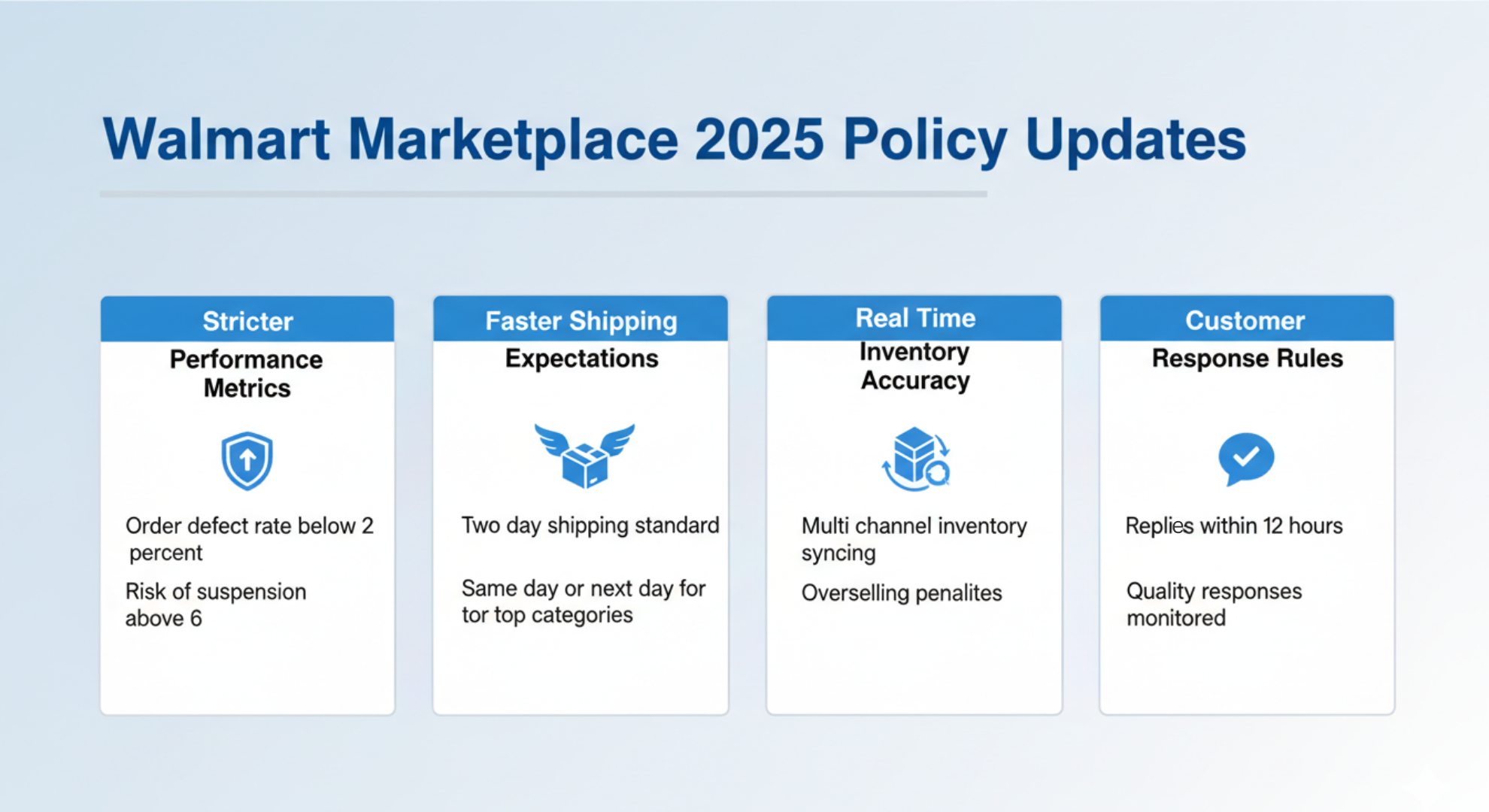
Walmart introduced specific performance thresholds that sellers must meet consistently for account health. For instance, the order defect rate must stay below 2 percent at all times. This metric includes canceled orders, late shipments, and customer complaints.
Even minor issues can push you over this threshold quickly. As a result, sellers need systems that catch problems before they affect performance scores. According to Walmart’s official performance standards, defect rates above 6 percent can lead to immediate account suspension.
Shipping windows have become much tighter under the new rules for seller performance. Previously, sellers had flexibility with delivery timelines. Now, Walmart requires two-day shipping on most items for a better customer experience.
For popular categories like electronics and home goods, same-day or next-day fulfillment is becoming the expectation. Missing these deadlines impacts your visibility in search results. Consequently, slower sellers lose traffic to competitors who meet the faster standards.
Inventory accuracy requirements have also increased significantly with automated tracking systems. Walmart now expects inventory levels to sync in real time across all platforms and sales channels.
Overselling triggers automatic penalties, while frequent stock-outs lower your product ranking. The platform checks inventory data multiple times per hour. Therefore, manual updates are no longer practical for active sellers.
Customer response time rules are stricter than before. Sellers must reply to messages within 12 hours, including weekends and holidays.
Late responses count against your seller rating immediately. Moreover, Walmart tracks response quality, not just speed. Generic or incomplete answers can hurt your metrics just as much as delayed replies.
For guidance on efficient automation, see Shopify’s Walmart integration guide.
Why Walmart’s 2025 Policy Updates Increase the Need for Full Automation Services
Cost Reduction and Scalability
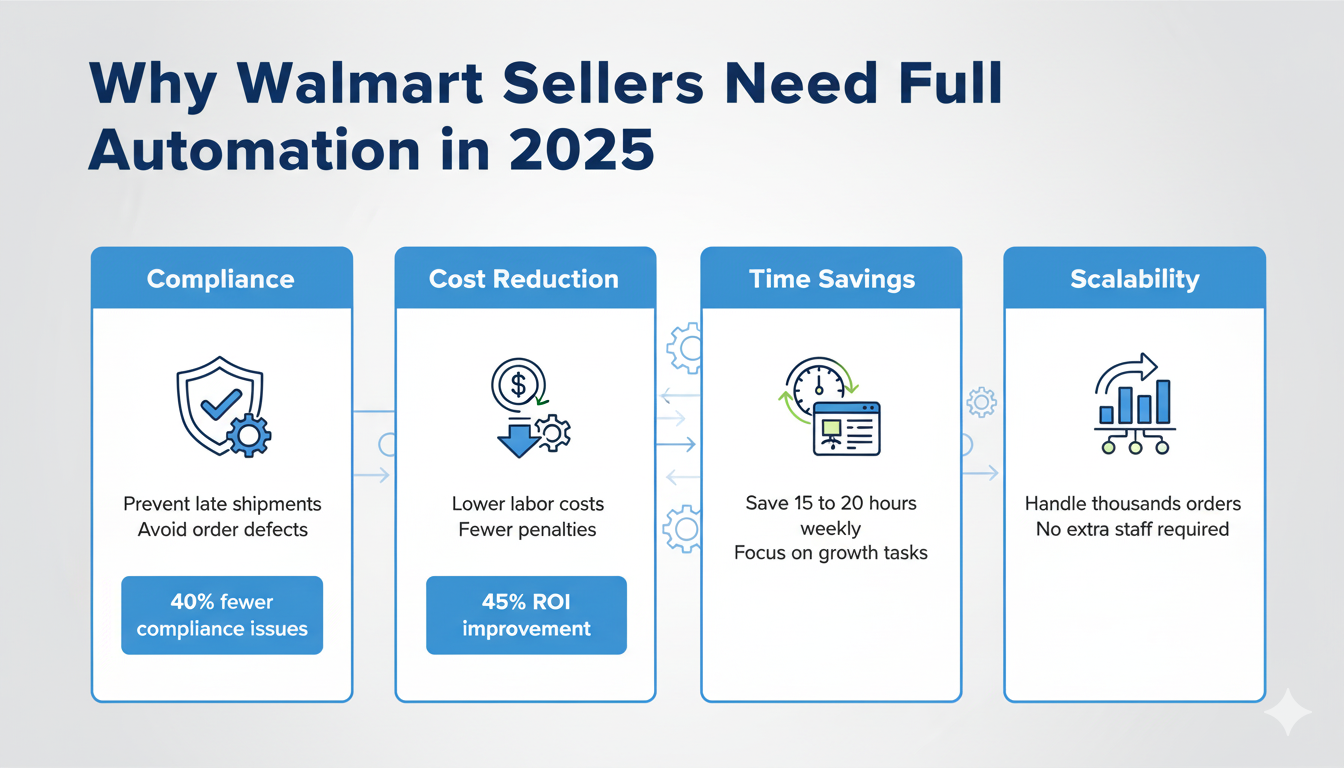
Full automation services deliver measurable business outcomes and operational efficiency that manual operations cannot match. Automation significantly reduces labor costs while increasing output capacity for online retailers.
A single automated system processes thousands of orders daily without additional staff or overhead costs. This scalability allows small businesses to compete with larger brands effectively. In addition, automation eliminates overtime expenses during peak seasons and holiday sales periods, keeping operational costs predictable year-round.
Improved ROI and Compliance
Return on investment becomes visible within the first few months of implementation. Sellers report 40 percent fewer compliance penalties after implementing automation tools and workflow management systems. According to recent e-commerce automation research, businesses adopting automation report a 45 percent improvement in ROI and an 80 percent increase in lead generation.
These savings add up quickly when you consider the cost of account warnings or temporary suspensions. Furthermore, automation prevents revenue loss from overselling and canceled orders, protecting both your income and your seller reputation.
Time Savings for Strategic Growth
Time savings represent another critical advantage for business owners. Automation handles repetitive tasks like order confirmation, tracking updates, and inventory adjustments automatically, freeing up 15 to 20 hours per week.
You can invest this recovered time in product research, supplier negotiations, or marketing strategies. As a result, sellers grow their catalogs faster and identify profitable niches more efficiently, driving long-term business growth.
Enhanced Customer Experience and Retention
Customer lifetime value increases when automation improves service quality. Orders ship faster, tracking information arrives promptly, and support responses come within hours instead of days.
These improvements lead to higher review scores and better seller ratings. Consequently, satisfied customers return for repeat purchases and recommend your store to others, creating a sustainable cycle of growth and positive feedback.
Competitive Advantage Through Performance
Competitive positioning strengthens when automation keeps your metrics consistently high. Walmart’s algorithm favors sellers with strong performance records by ranking their products higher in search results.
For guidance on effective automation tools, check Amzart Solutions, which specializes in Walmart marketplace automation.
How Full Automation Services Help Sellers Stay Compliant
Staying compliant with Walmart’s 2025 policies demands constant attention to detail. Automation services simplify this by managing critical tasks automatically.
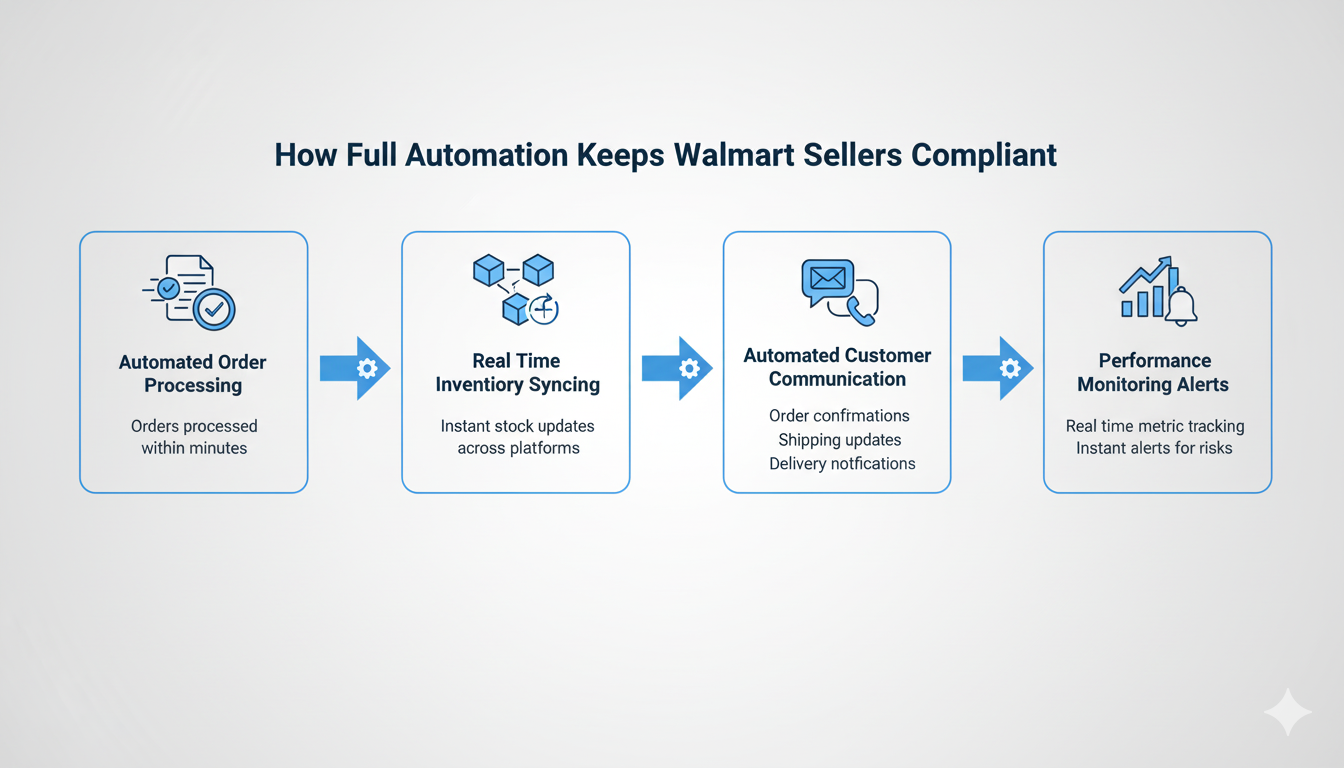
For instance, order management software can process purchases within minutes of receiving them. This ensures orders are never delayed, and shipping deadlines are always met, reducing the risk of negative seller metrics.
Inventory management is another area where automation proves essential. Tools that provide automated inventory syncing prevent overselling by updating stock levels across all sales channels in real time. According to inventory management research, businesses using automated inventory systems reduce stockouts by 30 percent and increase operational efficiency by up to 50 percent.
This means if the last unit of a product sells on Amazon, your Walmart listing updates instantly. Such automation prevents canceled orders, protects your metrics, and keeps customers satisfied.
Customer communication automation is equally important for maintaining seller standards. Automated email sequences can send order confirmations, shipping updates, and delivery notifications without any manual effort. According to customer service research, automation can save up to 40 percent on service costs while improving customer satisfaction scores by 10 to 20 percent.
These messages keep customers informed while reducing support requests. Additionally, automation tools can monitor response times and alert you if messages have been waiting too long.
Performance monitoring is another key benefit. Automation platforms track order defect rates, late shipment percentages, and customer feedback in real time.
If any metric begins trending downward, the system alerts you immediately. This proactive approach helps sellers address issues before they escalate.
According to Forbes, sellers using automation report 40 percent fewer compliance problems compared to manual management.
For Walmart-specific automation features, Amzart Solutions offers tools that handle everything from inventory updates to customer communication seamlessly. Additionally, Shopify’s multi-channel selling guide provides valuable insights for managing multiple platforms efficiently.
Common Challenges Walmart Sellers Face Without Automation
Sellers who rely on manual processes face significant challenges under Walmart’s 2025 policies. One of the biggest hurdles is keeping up with high order volumes.
During peak seasons like Black Friday or the holiday shopping period, orders can come in faster than you can process them. Without automation, this often results in late shipments, canceled orders, and dissatisfied customers.
Inventory management is another major pain point. Manually tracking stock across multiple platforms is tedious and prone to mistakes.
Overselling is common, which leads to canceled orders and negative feedback. On the other hand, understocking causes missed sales opportunities. Both situations can hurt your profitability and damage key seller metrics.
Customer communication also becomes overwhelming without automation. Responding to every message within 12 hours is challenging when you are managing orders, inventory, and supplier relationships simultaneously.
Missing messages can lead to poor reviews, lower seller ratings, and even trigger Walmart’s automated warnings or account suspension.
Performance monitoring is nearly impossible when done manually. Tracking order defect rates, late shipment percentages, and customer satisfaction scores requires constant attention.
Without real-time data, problems may go unnoticed until it is too late. By the time Walmart flags your account, the damage is often irreversible.
These challenges are more than just inconveniences; they directly threaten your ability to succeed on Walmart Marketplace. Fortunately, automation solves these problems efficiently.
If you want guidance on managing Walmart operations effectively, check the Walmart Seller Help Center for tips and resources designed specifically for marketplace sellers.
For additional market insights and trends, check Statista’s e-commerce data to help optimize your Walmart strategy and make data-driven decisions.
Conclusion: Walmart 2025 Policy Updates Make Automation Essential
Walmart’s 2025 marketplace policy updates have raised the bar for sellers. Stricter performance standards, faster shipping requirements, and tighter inventory and communication rules mean manual management is no longer practical.
Automation services have become essential for staying compliant, reducing errors, and scaling efficiently.
By automating order processing, inventory management, and customer communication, sellers can save time, maintain high metrics, and improve customer satisfaction. Automation also helps small and medium-sized businesses compete with larger brands without increasing staff.
Real-world examples show that sellers using full automation achieve higher revenue, fewer compliance issues, and smoother daily operations.
For any Walmart seller aiming to grow in 2025 and beyond, investing in automation is no longer optional; it is critical. Leveraging automation tools ensures consistent performance, protects seller accounts, and allows you to focus on expanding your product catalog and improving customer experience.
Maximize your Walmart store’s potential and stay ahead of policy changes by exploring trusted automation solutions today.
Frequently Asked Questions
Q. What is Walmart Marketplace automation in e-commerce?
Walmart marketplace automation uses software tools to handle repetitive tasks such as order processing, inventory updates, and customer communication automatically. This technology integrates with your existing systems to monitor performance metrics continuously.
Unlike manual management, automation responds to issues within seconds rather than hours. For guidance on automation tools, see Shopify’s Walmart integration guide.
Q. How much does it cost to start Walmart automation in 2025?
Costs vary depending on the platform and your store’s needs. Basic automation tools start at around $30 per month for small businesses.
More comprehensive solutions range from $100 to $300 monthly. Despite the cost, the return on investment is significant when automation helps you avoid penalties, reduce errors, and scale your business efficiently.
Q. Is Walmart Marketplace automation profitable for beginners?
Yes, even new sellers can benefit from automation services immediately. Automated systems prevent common mistakes that often lead to account warnings during the critical first 90 days.
Many platforms offer simplified interfaces designed specifically for sellers with limited technical experience. Starting with automation helps beginners build strong performance records from day one.
Q. What tools automate Walmart marketplace operations?
Popular options include Shopify with Walmart integration, WooCommerce plugins, and dedicated Walmart automation platforms. For specialized solutions tailored to Walmart sellers, Amzart Solutions offers automation services designed to streamline orders, inventory, and customer communication.
Choose a platform that fits your budget and integrates with your existing systems for the best results. If you need personalized guidance, you can contact Amzart Solutions for expert consultation.
Q. How does Walmart automation help small business owners?
Automation maximizes revenue without increasing workload significantly. Small sellers cannot compete with larger brands on staffing alone, but automation levels the playing field effectively.
The technology handles orders, tracks inventory, and communicates with customers automatically. This allows small business owners to focus on sourcing products and growing their stores profitably while maintaining competitive service levels.
