
More than 65% of Amazon sellers now use automation to run their businesses. In fact, sellers using automated systems make up to 40% more money. Meanwhile, your competitors spend hours daily changing prices manually. They search for profitable items by hand. Additionally, they try to avoid stockouts the hard way.
However, your Amazon FBA wholesale automation system does all this work for you. Furthermore, it works 24/7 without stopping.
Amazon FBA wholesale automation is a crucial tool for success. Moreover, this powerful method uses smart technology and proven wholesale strategies. As a result, you can build a self-optimizing business machine. Therefore, you’ll focus on what truly matters: growing your empire.
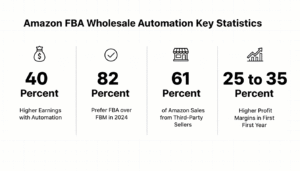
The change is real. Besides, the numbers are mind-boggling. As of 2024, 82% of Amazon sellers preferred FBA over FBM. Moreover, U.S. Amazon sellers sell 7,800 products every minute.
This will open your eyes. In Q1 2024, 61% of Amazon’s sales came from third-party sellers. Furthermore, automation tools helped sellers cut costs by 30% on average. In 2025, 69% of sellers plan to grow by finding new products.
But here’s the most telling fact. Sellers using automation save 40–60% of their time. Additionally, they see a 25–35% profit margin increase in year one. The message is clear: Amazon FBA wholesale automation isn’t just helpful. Instead, it’s necessary for survival.
Ready to join successful automated sellers? AMZ Art Solutions has helped over 500+ sellers implement profitable systems. Therefore, get your free consultation today. Discover how we can boost your profits by 30% or more in just 90 days!
What is Amazon FBA Wholesale Automation?
Amazon FBA wholesale automation involves utilizing technology effectively. Specifically, it helps make your wholesale business run more smoothly on Amazon’s platform. Consider it as a digital assistant. Moreover, it continuously improves your business while you focus on growth.
This method combines bulk buying benefits with Amazon’s fulfillment network. Furthermore, clever automation handles everything from product research to customer service.
Unlike conventional wholesale selling, automation transforms your business. You won’t manually manage spreadsheets and inventory anymore. Instead, your business becomes a smoothly functioning machine. In fact, AI-driven innovations will improve inventory management by 2025. Additionally, they’ll enhance customer service and fulfillment. According to Amazon Seller Central, leveraging FBA services boosts operational efficiency. Therefore, now is the best time to adopt these technologies.
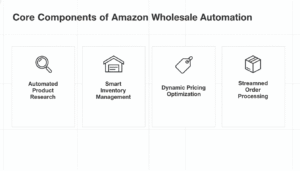
Core Components of Wholesale Automation
Automated Product Research
Automated product research removes the guesswork from finding profitable products. In addition, advanced algorithms evaluate market trends continuously. They check how well competitors are doing. Moreover, they analyze profit margins to find outstanding opportunities. Manual research often misses these chances.
Smart Inventory Management
Smart inventory management keeps you stocked perfectly. You’ll never run out of popular items. Furthermore, you won’t tie up money in slow-moving products. These systems forecast demand accurately. Additionally, they monitor sales velocity and place new orders automatically when needed.
Dynamic Pricing Optimization
Dynamic pricing keeps you competitive while protecting margins. Additionally, these tools constantly monitor competitor prices. They track market conditions too. As a result, they adjust your prices in real time. Therefore, you maximize profits automatically.
Streamlined Order Processing
Streamlined order processing automates your entire fulfillment workflow. This includes receiving orders and sending shipping notifications. As a result, you create a seamless customer experience. Moreover, this builds loyalty and generates positive reviews.
Why Amazon FBA Wholesale Automation is the Future
The traditional wholesale model is like running a marathon with a heavy backpack. You can do it. However, why would you want to? Amazon wholesale automation removes that burden. Therefore, you can run faster and further than ever before.
The Scalability Factor
Manual operations reach their limit quickly. For example, you can personally manage maybe 50–100 products well. But what happens when you want 500 or 1,000 products?
In contrast, automated operations handle this growth seamlessly. They manage thousands of products efficiently. Moreover, they maintain the same quality as with dozens.
Time Freedom and Strategic Focus
Instead of spending hours on routine tasks, automation frees your time. For instance, you won’t manually check inventory anymore. Additionally, you won’t update prices by hand. Therefore, you can focus on finding new suppliers. You’ll expand into new markets. Furthermore, you’ll develop long-term strategies.
Consequently, automating repetitive tasks frees valuable time and resources. You can focus on strategic initiatives instead.
Enhanced Decision Making with Real-Time Intelligence
FBA automation tools provide real-time data and insights. Human analysis simply can’t match this. Modern systems process over 50,000 data points per hour. Additionally, they analyze competitor pricing continuously. They track market trends. Moreover, they study customer behavior patterns.
As a result, you’ll know exactly which products are trending. You’ll see which suppliers perform best. Furthermore, you’ll spot your next opportunities immediately. All of this is backed by data, not guesswork.
Unbeatable Competitive Advantage
Your competitors still manually manage their operations. Meanwhile, you’re leveraging technology to stay ahead. Consider this fact: manual sellers analyze maybe 10-20 products daily. However, automated systems evaluate thousands in the same time.
This isn’t just about efficiency. Instead, it’s about survival in an increasingly competitive marketplace. In fact, speed and accuracy determine success today.
The Powerful Benefits of Amazon FBA Wholesale Automation
1. Dramatic Cost Reduction and Profit Maximization
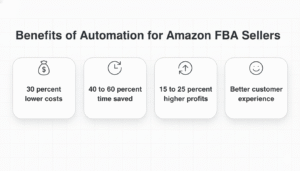
Wholesale automation affects your bottom line in many ways. In fact, automation tools cut sellers’ costs by 30% on average. That’s just the start.
Moreover, better pricing strategies add more savings. Fewer human errors help too. Additionally, better inventory management increases profits significantly.
The Time Factor
Right now, you might spend 20 hours weekly on manual tasks. Amazon FBA wholesale automation could give you back 15 of those hours. As a result, you can use those 780 hours yearly for growth activities.
That’s $39,000 in opportunity cost savings at just $50 per hour. But the real magic happens differently. You’ll use that time to find new products. Additionally, you’ll get better supplier terms. Furthermore, you’ll enter new markets.
Real Results from Sellers
Leading sellers report even better results. They spend 45% less time on routine tasks. Furthermore, their inventory accuracy goes up by 67%. Finally, their overall profitability increases by 28% in the first 12 months. This happens after they install complete automation systems.
2. Intelligent Inventory Management
No more stockouts that hurt your rankings. Additionally, you’ll avoid excess inventory that hurts cash flow. Automated inventory systems use predictive analytics. They forecast demand accurately. Moreover, they consider past sales, market trends, and seasonal factors.
What These Systems Do
These systems can:
- Predict demand changes with 85% or more accuracy
- Change reorder points automatically based on lead times
- Find slow-moving inventory items before they become problems
- Save money on storage by keeping optimal inventory levels
3. Dynamic Pricing That Maximizes Revenue
Automated pricing strategies work like having a pricing expert 24/7. In fact, these systems monitor your competitors’ prices constantly. They track market demand too. Additionally, they change your prices in real time. Therefore, you get the most sales and best profit margins.
What’s the result? Many sellers see overall profits go up by 15% to 25%.
4. Superior Customer Experience
Automated customer service tools handle common questions quickly. They process returns fast. Additionally, they keep communication standards high. As a result, you get higher customer satisfaction scores. You’ll receive better reviews. Moreover, you’ll have better seller metrics. All of these are important for long-term Amazon success.
Essential Tools for Amazon FBA Wholesale Automation Success
Product Research and Market Analysis Tools
Successful Amazon FBA wholesale automation starts with finding the right products. Top-tier research tools have revolutionized product discovery. For example, Helium 10, Jungle Scout, and Viral Launch lead the market.
What These Platforms Offer
These platforms offer:
- Real-time competitor analysis with pricing history
- Profit margin calculators with FBA fee integration
- Demand forecasting algorithms with 85%+ accuracy
- Supplier verification systems with rating databases
- Market trend identification using machine learning
- Keyword research with search volume data
In fact, these tools analyze thousands of products in minutes. They identify opportunities that would take weeks to find manually. Furthermore, advanced users find 3-5x more profitable products. This happens when using automated research compared to manual methods.
Inventory Management Platforms
Automated inventory systems are the backbone of efficient operations. Leading platforms integrate seamlessly with your Amazon seller account. For instance, RestockPro, Inventory Lab, and ScanUnlimited work great. Additionally, they provide:
- Multi-channel inventory tracking across all marketplaces
- Automated reorder triggers based on velocity and lead times
- Demand forecasting with seasonal adjustments (95% accuracy)
- Supplier integration for streamlined ordering via API
- Real-time stock level monitoring with mobile alerts
- Automatic purchase order generation and management
Top sellers using these systems report great results. They see a 40% reduction in stockouts. Moreover, they achieve a 25% improvement in inventory turnover rates.
Pricing and Repricing Solutions
Dynamic pricing automation helps you stay competitive. Additionally, it keeps your profits safe. RepricerExpress, Informed.co, and BQool are advanced repricing tools. They offer:
- Monitoring of prices from 1,000+ competitors
- Rule-based pricing strategies that protect profits
- Algorithms that protect margins and stop price wars
- AI predictions to analyze market conditions
- Custom pricing rules for different product categories
- Improved win rates to get into the Buy Box
In fact, sellers using professional repricing tools see big improvements. Their Buy Box win rates go up by 18–35%. Additionally, their overall profit margins increase by 12–22%.
Customer Service Automation
Automated customer service tools handle routine questions efficiently. They track returns carefully. Moreover, they keep seller metrics high without constant supervision.
Important Features
Important features include:
- Automated response systems
- Automated return processing
- Monitoring and responding to feedback
- Performance metrics tracking
- Escalation procedures when problems arise
Step-by-Step Implementation Guide
Phase 1: Assessment and Planning
Before you start automating, take a close look at current operations. First, find the bottlenecks that slow things down. Next, identify time-consuming tasks. Finally, determine which areas can be automated for the biggest impact.
Key Assessment Areas
Key assessment areas include:
- Current product research methods and effectiveness
- Inventory management problems and accuracy issues
- How well does your pricing strategy work
- Customer service speed and quality
- Operating costs and profit margins
Phase 2: Tool Selection and Integration
Next, pick wholesale automation tools that fit your business. Consider your size, budget, and specific needs. Think about these factors:
- Ability to work with other systems
- Future growth capacity
- User interface and learning curve
- Support quality and availability
- Cost-effectiveness and potential ROI
Phase 3: Implementation and Testing
Then, begin implementing your FBA automation system in one or two key areas. After that, gradually add more areas as you proceed.
Implementation Method
You can use this method:
- Check system performance and reliability
- Train your team on new systems
- Find and fix integration problems
- Review initial results and optimize settings
Phase 4: Optimization and Scaling
Finally, once your automation system works well, keep improving it. Regular reviews and adjustments ensure the best performance. Moreover, they maximize your ROI.
Success Stories: Real Results from Amazon FBA Wholesale Automation
Case Study 1: Electronics Wholesale Transformation
In January 2024, Sarah sold home goods on Amazon. She set up Amazon FBA wholesale automation. Her business changed completely in just six months:
- Revenue Increase: from $8,000 to $27,800 monthly (247% rise)
- Time Savings: Daily management time went from 8 hours to 2 hours
- Profit Margins: Dynamic pricing raised them from 12% to 28%
- Product Catalog: Increased from 50 to 400 items without hiring more people
Case Study 2: Kitchen Appliance Success Story
Mike’s kitchen appliance business struggled with manual inventory tracking. However, after starting wholesale automation tools, everything changed:
- Stockout Reduction: 89% fewer out-of-stock situations
- Inventory Turnover: Went up from 4 times yearly to 8 times
- Operational Cost: Process automation cut costs by 42%
- Customer Satisfaction: 96% positive reviews, up from 78%
Contact us today to get your personalized success roadmap! At AMZ Art Solutions, we help businesses automate operations. Additionally, we help you achieve faster growth. Reach out now and discover how our automation strategies transform your business—no matter your industry!
Advanced Strategies for Maximum Success
Leveraging AI and Machine Learning
Artificial intelligence (AI) will play a big part in improvements by 2025. Specifically, it will enhance inventory management, customer service, and order fulfillment. In fact, advanced Amazon wholesale automation strategies use AI for:
- Forecasting demand ahead of time
- Automated competitor analysis
- Dynamic product recommendations
- Risk evaluation and reduction
- Personalized customer interactions
Multi-Channel Automation
Expand your FBA wholesale automation beyond just Amazon. Add more marketplaces to your strategy. This plan:
- Adds new revenue streams
- Lowers platform dependence
- Expands market reach
- Improves economies of scale
- Provides helpful market insights
Automated Compliance Management
Automated compliance tools help you stay aligned with Amazon’s complex rules. These rules change constantly. According to Amazon’s official documentation, staying compliant with seller policies is critical. Long-term success depends on it. These tools help by:
- Monitoring policy changes continuously
- Ensuring listing compliance
- Tracking performance metrics
- Handling brand registry requirements
- Managing intellectual property issues
Common Challenges and Expert Solutions
Challenge 1: Initial Setup Complexity
Many sellers think that setting up Amazon FBA wholesale automation is overwhelming. What’s the answer? Start small and build up over time.
First, begin with simple automation features. For example, use alerts for low inventory. Additionally, try simple price adjustments. Then, move on to more complex systems gradually.
Challenge 2: Tool Integration Issues
Automation tools don’t always work well together. Therefore, select tools from providers emphasizing integration. Alternatively, hire automation experts. They’ll make sure everything works together smoothly.
Challenge 3: Over-Automation Concerns
Automation has many great benefits. However, keeping people in charge of strategic decisions is important. The key is finding the right balance. Mix automation with human intelligence effectively.
Challenge 4: Keeping Up with Amazon Changes
Amazon’s rules and algorithms change frequently. Therefore, pick automation tools that get regular updates. Make sure they stay aligned with Amazon’s evolving requirements.
ROI and Performance Metrics That Matter
Key Performance Indicators
To measure your Amazon FBA wholesale automation success, monitor specific metrics. Keep an eye on:
- Operational cost savings percentage
- Time savings amount
- Profit margin improvements
- Inventory turnover rates
- Customer satisfaction scores
- Order fulfillment efficiency
- Error reduction rates
Expected Returns and Timeline
Most businesses see big profits within 6 to 12 months. Some common improvements include:
- Operating costs decrease by 20% to 40%
- Productivity increases by 30–50%
- Profit margins improve by 15–25%
- Manual tasks are reduced by 40% to 60%
- Response times become 50% to 70% faster
Long-term Benefits
Besides immediate cost savings, wholesale automation provides strategic advantages. These include:
- Better scalability potential
- Improved competitive positioning
- Superior data-driven decision making
- Higher business valuation
- More flexible work procedures
Best Practices for Sustained Success
1. Start with Clear Objectives
Set clear goals for your automation deployment. Your goal might be to cut costs. Alternatively, it could be boosting sales or improving efficiency. Clear goals guide your approach. Furthermore, they help you measure success effectively.
2. Invest in Quality Tools
Choose well-known automation companies. Look for those with proven track records. In fact, the initial investment in high-quality tools pays off. They work better. Additionally, they cause fewer maintenance problems.
3. Maintain Human Oversight
Automation can handle routine tasks efficiently. However, people need to make strategic decisions. Additionally, humans should handle exceptions. The best sellers find the right balance between both.
4. Continuous Learning and Adaptation
The Amazon marketplace changes constantly. Therefore, stay up-to-date on changes regularly. Learn about new features. Moreover, understand best practices. Additionally, regular training ensures continued success. System updates are important too.
5. Monitor and Optimize Regularly
Use analytics to monitor performance constantly. Find ways to improve continuously. Moreover, regular tuning ensures your automation system delivers maximum value. It should do this consistently.
The Future of Amazon FBA Wholesale Automation
Emerging Technologies
As new technologies become more available, the landscape keeps changing. Watch for:
- Advanced AI and machine learning capabilities
- Voice-command automation systems
- Predictive analytics for market trends
- Blockchain for supply chain transparency
- IoT for real-time monitoring
Market Trends
A surprising 69% of Amazon sellers plan to grow in 2025. Specifically, they’ll look for more products to sell. This shows high demand for automation solutions. These solutions must handle more complexity and size.
Opportunities Ahead
Companies adopting advanced automation technology first will win. They’ll have a big competitive edge. The most important thing? Stay aware of new trends. Additionally, be ready to act quickly.
Conclusion: Your Path to Amazon FBA Success
Amazon FBA wholesale automation isn’t merely a trend. Instead, it’s the best way to sell on Amazon in the future. Since 82% of Amazon sellers prefer FBA, the choice is clear. Moreover, automation solutions cut costs by 30%. You should automate or risk going out of business.
There are many opportunities available. In fact, now is a good time to use automation tools. They help you grow effectively. This is because 61% of Amazon’s sales come from third-party sellers. Additionally, 69% of those sellers plan to grow in 2025.
To succeed with Amazon FBA wholesale automation, use the right mix. Combine tools, strategies, and constant improvement. Therefore, following the instructions in this guide will help you. You’ll start a successful automated wholesale business. Moreover, it will make money consistently. Furthermore, it gives you time to plan for growth.
The question isn’t whether automation is necessary. Instead, ask whether you can do without it. In fact, your competitors already use these strategies. The moment for action is now.
Ready to take the next step? Visit AMZ Art Solutions to learn how we help. We’ll implement a winning automation strategy for you today.
Frequently Asked Questions
1. What exactly is Amazon FBA wholesale automation, and how does it differ from traditional wholesale?
Amazon FBA wholesale automation uses technology to improve your Amazon wholesale business. It fine-tunes every part of operations. Unlike traditional wholesale, it doesn’t require manual work. You won’t do product research by hand. Additionally, you won’t manage inventory manually. You won’t change prices by hand either. Instead, automation does all these things automatically.
The main difference is in efficiency and scalability. Conventional approaches manage only 50 to 100 products correctly. However, automation manages thousands with the same accuracy. Conventional wholesale needs constant manual supervision. In contrast, automated systems work continuously. They help businesses succeed all the time.
2. How much should I expect to invest in Amazon FBA wholesale automation tools?
The money you spend on wholesale automation tools varies. It depends on your business size and specific needs.
Understanding the Investment
Basic automation solutions usually cost $200 to $500 monthly to start. In contrast, large enterprise-level systems can cost $2,000 to $10,000 monthly.
However, automation solutions cut operating expenses by about 30%. This means most businesses recover their investment in 6 to 12 months. Therefore, choose technologies that fit your current size. Make sure they can grow with you too. This gets the most out of your investment from the start.
3. Can new Amazon sellers benefit from wholesale automation, or is it only for established businesses?
For new sellers, Amazon FBA wholesale automation might be more useful. It helps beginners more than experienced sellers. In fact, new sellers often struggle with managing manual tasks well. This makes them more likely to make costly mistakes.
Moreover, automation technologies provide integrated best practices. They offer help and ways to avoid mistakes. These let beginners compete with experienced vendors immediately. Additionally, many automation platforms have easy-to-use interfaces. They also provide lots of training materials. These are perfect for new sellers.
4. How long does it typically take to see results from implementing FBA wholesale automation?
Most sellers start seeing early results from FBA automation quickly. This happens between 30 and 60 days after setup. In the first few weeks, you’ll usually see time savings. Additionally, you’ll notice efficiency improvements.
However, big profit increases usually happen between 2 and 4 months. Full optimization and best ROI usually happen between 6 and 12 months. This is after systems learn about your business and the market.
The timeline depends on several factors. Implementation difficulty matters. Additionally, product catalog size is important. Finally, how quickly people learn the new technologies affects results.
5. What are the biggest risks of implementing Amazon FBA wholesale automation?
The main risks include relying too much on automation. This happens without human oversight. Additionally, picking tools that don’t work together creates problems. Finally, having compliance problems occurs if you don’t watch automated systems carefully.
However, you can easily fix these weaknesses. Keep a big picture view. Additionally, choose reliable technologies that work well together. Moreover, check the system regularly.
The biggest risk is NOT using automation. In fact, in 2025, 69% of Amazon sellers plan to grow. But those who don’t use automation will struggle. They’ll have a hard time competing with automated competitors. These competitors can grow faster and make more money.
Visit us at amzartsolutions.com to learn more about our services. Schedule your free consultation today!
