
Top 10 Shopify Dropshipping Products for 2025: Data-Driven Winners
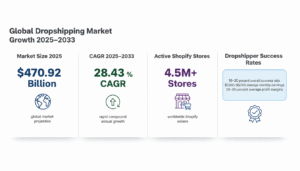
The dropshipping industry is growing fast. In fact, market projections show the sector will reach $470.92 billion in 2025. Moreover, it will continue expanding at a remarkable 28.43% CAGR through 2033. For Shopify entrepreneurs, this represents a massive opportunity. However, success depends on choosing the right Shopify dropshipping products 2025.
Currently, there are more than 4.5 million active Shopify stores worldwide. All of them are competing for customers’ attention. To be successful, you need to choose products carefully. Specifically, pick items that fit with changing buyer habits and new market needs.
According to current research, dropshipping businesses have a 10–20% success rate. Additionally, successful dropshippers make between $1,000 and $5,000 monthly. The best ones earn 20–30% profit on each sale. However, only 10% of dropshippers succeed in their first year. Therefore, strategic product selection is essential.
This guide reveals the top ten product prospects for 2025. Furthermore, we’ll share actionable insights into automation strategies. As a result, you can turn your Shopify store into a hands-free revenue generator.
Why Choosing the Right Products Is Crucial in 2025
The dropshipping world has changed significantly. Nowadays, you can’t just offer any popular item and expect sales. Instead, you need to understand consumer psychology deeply. Additionally, you must know how viral marketing works and how to run your business efficiently.
The New Dropshipping Reality
When traditional niches become saturated, generic products race to the bottom on price. Consequently, this hurts merchants’ profit margins significantly. In contrast, winners in 2025 will develop goods that solve genuine problems. Moreover, they’ll capitalize on emotional triggers and ride social media virality early.
Consumer behavior has shifted toward impulse purchases. This is thanks to social proof, influencer suggestions, and visual platforms like TikTok and Instagram. Therefore, items that look good in photos and have strong value propositions perform better. In particular, products that fit lifestyle goals tend to outperform generic items every time.
Performance Metrics That Matter
Data shows an important fact. Stores with page load times under two seconds have conversion rates 2.4 times higher. Furthermore, to get reasonable dropshipping conversion rates, you need to perform at least 3% better.
Automation has leveled the playing field. As a result, it enables smart business owners to manage larger product catalogs. Additionally, they can adjust prices in real time and grow without increasing workload. Companies that adopt automation early get competitive benefits that build over time.
In 2025, Buy Now, Pay Later (BNPL) usage reached $560 billion. Notably, stores offering services like Klarna and Afterpay have much higher checkout conversion rates. Learn more about setting up payment options on your Shopify dropshipping store.
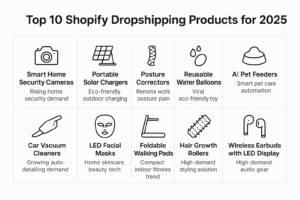
Top 10 Shopify Dropshipping Products for 2025
1. Smart Home Security Cameras
Market Opportunity: Smart security cameras have exploded in popularity. This is because remote work normalizes, and home security concerns intensify. In fact, the global smart security camera market will reach $18.6 billion by 2025.
Sourcing Details:
- Primary Suppliers: Alibaba (1,200+ verified suppliers), AliExpress (500+ options)
- MOQ: Typically 10-50 units for most suppliers
- Sourcing Cost: $25-35 per unit
- Retail Price: $89-149
- Profit Margin: 60-75%
- Shipping Time: 7-15 days from China suppliers
Target Demographics: Homeowners aged 25-45, tech-savvy parents, remote workers, small business owners
Best Launch Timing: Year-round with peaks during back-to-school (August) and winter months (November-February)
Marketing Angle: Focus on peace of mind and smart home integration. Rather than highlighting complex technical features, emphasize easy setup.
Case Study: One successful dropshipper reported $47,000 in monthly revenue. Specifically, they sold WiFi security cameras and achieved a 4.2% conversion rate. They did this through targeted Facebook ads focusing on home safety for families.
2. Portable Solar Chargers
Market Opportunity: Environmental consciousness meets practical utility here. Specifically, portable solar charging solutions are growing fast. The market is expanding at a 15.2% CAGR. This growth comes from outdoor recreation trends and emergency preparedness awareness.
Sourcing Details:
- Primary Suppliers: Alibaba (800+ suppliers), DHgate (300+ options)
- MOQ: 20-100 units typical
- Sourcing Cost: $15-25 per unit
- Retail Price: $49-89
- Profit Margin: 55-70%
- Shipping Time: 10-18 days
- Certifications Required: FCC, CE marking for electronics
Target Demographics: Outdoor enthusiasts, eco-conscious consumers 18-40, campers, festival-goers, emergency preppers
Best Launch Timing: Peak season runs March-August (camping season). Additionally, there’s a secondary peak in November-December (gift season).
Marketing Angle: Position around adventure lifestyle and emergency preparedness. Furthermore, emphasize environmental sustainability.
Compliance Notes: Ensure products meet local electrical safety standards. Additionally, battery capacity restrictions apply for air shipping (generally under 100Wh).
3. Posture Correctors
Market Opportunity: The remote work revolution has created widespread posture problems. In fact, 86% of office workers experience back pain. As a result, the global posture corrector market will reach $3.2 billion by 2025.
Sourcing Details:
- Primary Suppliers: Alibaba (2,000+ suppliers), AliExpress (1,500+ options)
- MOQ: 50-200 units
- Sourcing Cost: $8-12 per unit
- Retail Price: $39-59
- Profit Margin: 75-80%
- Shipping Time: 7-14 days
- Material Specifications: Breathable neoprene or mesh fabric preferred
Target Demographics: Office workers 25-50, remote workers, students, healthcare professionals
Best Launch Timing: Year-round with peaks during the New Year resolution period (January-February). Also, back-to-school season (August-September) works well.
Marketing Strategy: Use before/after testimonials and medical professional endorsements. Additionally, emphasize comfort and discretion.
Case Study: A dropshipper achieved $23,000 monthly revenue with posture correctors. Specifically, they targeted remote workers through LinkedIn ads. As a result, they maintained a 3.8% conversion rate and 78% profit margins.
4. Reusable Water Balloons
Market Opportunity: This innovative product has gone viral across social media. Notably, TikTok videos have generated over 50M views. Furthermore, the eco-friendly toy market is growing 12% annually.
Sourcing Details:
- Primary Suppliers: Alibaba (400+ suppliers), AliExpress (250+ options)
- MOQ: 100-500 units
- Sourcing Cost: $6-8 per set
- Retail Price: $24-39
- Profit Margin: 70-80%
- Shipping Time: 8-15 days
- Material Safety: Ensure BPA-free silicone, CPSIA compliance for children’s products
Target Demographics: Parents with children 3-12, eco-conscious families, summer activity planners
Best Launch Timing: Peak season runs April-August. Additionally, there’s a secondary peak during spring break planning (February-March).
Marketing Strategy: Create viral social media content and parent testimonials. Moreover, emphasize cleanup ease and environmental benefits.
5. AI Pet Feeders
Market Opportunity: Pet technology represents one of the fastest-growing segments. In fact, the smart pet feeder market will reach $1.8 billion by 2025. Additionally, pet owners spend an average of $1,480 annually on their pets.
Sourcing Details:
- Primary Suppliers: Alibaba (600+ suppliers), specialized pet tech manufacturers
- MOQ: 10-50 units (higher price point allows lower MOQ)
- Sourcing Cost: $35-50 per unit
- Retail Price: $89-149
- Profit Margin: 60-70%
- Shipping Time: 12-20 days (complex electronics)
- Certifications: FCC ID required, pet-safe materials certification
Target Demographics: Tech-savvy pet owners 25-45, busy professionals, multiple pet households
Best Launch Timing: Year-round with peaks during pet adoption seasons (spring/summer). Also, holidays work well.
Marketing Strategy: Partner with pet influencers and emphasize convenience. Furthermore, highlight pet health benefits and app functionality.
6. Car Vacuum Cleaners
Market Opportunity: The portable car vacuum market is growing at 8.5% CAGR. This is because car ownership is increasing. Additionally, detailing service costs average $75-150 per session.
Sourcing Details:
- Primary Suppliers: Alibaba (1,500+ suppliers), specialized automotive suppliers
- MOQ: 50-200 units
- Sourcing Cost: $12-18 per unit
- Retail Price: $39-69
- Profit Margin: 60-75%
- Shipping Time: 10-16 days
- Power Specifications: 12V DC compatibility, 100W+ suction power preferred
Target Demographics: Car owners 25-55, rideshare drivers, automotive enthusiasts, busy professionals
Best Launch Timing: Peak spring cleaning season (March-May). Also, pre-winter preparation (October-November) works well.
Marketing Strategy: Show before/after car interior videos. Additionally, emphasize time-saving and compare to professional detailing costs.
Ready to launch but need guidance? Contact our Shopify specialists. We’ll walk you through everything from supplier selection to conversion optimization.
7. LED Facial Masks
Market Opportunity: Beauty technology continues expanding. This is because consumers seek professional-grade treatments at home. In fact, the LED therapy market will grow 6.1% annually. Moreover, home beauty device sales are reaching $12.6 billion globally.
Sourcing Details:
- Primary Suppliers: Alibaba (300+ verified beauty suppliers), specialized beauty tech manufacturers
- MOQ: 20-100 units
- Sourcing Cost: $20-35 per unit
- Retail Price: $79-149
- Profit Margin: 65-75%
- Shipping Time: 12-18 days
- Certifications: FDA registration for light therapy devices, CE marking for EU markets
Target Demographics: Women 25-45, skincare enthusiasts, beauty influencer followers, anti-aging focused consumers
Best Launch Timing: Peak before major events like Valentine’s Day and summer. However, demand remains consistent year-round.
Marketing Strategy: Show before/after skin transformation photos. Additionally, use dermatologist endorsements and spa-at-home positioning.
Compliance: FDA considers LED devices as low-risk medical devices. Therefore, ensure proper labeling and safety instructions.
8. Foldable Walking Pads
Market Opportunity: Home fitness equipment demand remains high after the pandemic. Specifically, space-efficient solutions are leading the growth. The treadmill market will reach $4.7 billion by 2025. Furthermore, compact models show 23% year-over-year growth.
Sourcing Details:
- Primary Suppliers: Alibaba (200+ fitness equipment suppliers), direct manufacturer partnerships recommended
- MOQ: 5-20 units (higher price point)
- Sourcing Cost: $120-180 per unit
- Retail Price: $299-499
- Profit Margin: 55-65%
- Shipping Time: 15-25 days (heavy freight)
- Certifications: UL listing for electrical safety, weight capacity testing certifications
Target Demographics: Urban apartment dwellers 25-50, home fitness enthusiasts, remote workers seeking activity
Best Launch Timing: New Year fitness resolution period (January-March). Also, pre-summer fitness prep (April-May) performs well.
Marketing Strategy: Show space-saving demonstrations and apartment-friendly messaging. Additionally, share fitness transformation stories.
Logistics Note: Requires freight shipping due to weight (30-50 lbs). Therefore, factor in additional $30-50 shipping costs.
9. Hair Growth Rollers
Market Opportunity: Beauty and self-care continue driving e-commerce growth. In particular, hair care represents a lucrative subcategory. The hair care tools market is growing at 7.8% CAGR. Overall, it’s reaching $8.1 billion globally.
Sourcing Details:
- Primary Suppliers: Alibaba (800+ beauty suppliers), AliExpress (400+ options)
- MOQ: 100-500 units
- Sourcing Cost: $8-15 per set
- Retail Price: $29-59
- Profit Margin: 70-80%
- Shipping Time: 8-14 days
- Material Safety: Heat-resistant materials, BPA-free components
Target Demographics: Women 18-45, hair styling enthusiasts, salon-alternative seekers
Best Launch Timing: Year-round with peaks before major events. Specifically, weddings, holidays, and prom season work best.
Marketing Strategy: Create hair transformation videos and partner with influencers. Furthermore, emphasize salon-quality results.
10. Wireless Earbuds with LED Display
Market Opportunity: Audio accessories remain evergreen sellers. However, products with unique design elements command premium pricing. The wireless earbuds market will reach $40.5 billion by 2025.
Sourcing Details:
- Primary Suppliers: Alibaba (2,000+ audio suppliers), specialized electronics manufacturers
- MOQ: 50-200 units
- Sourcing Cost: $12-20 per unit
- Retail Price: $39-79
- Profit Margin: 65-75%
- Shipping Time: 10-16 days
- Certifications: FCC ID required, Bluetooth SIG certification, CE marking
Target Demographics: Tech enthusiasts 16-35, fitness users, students, professionals
Best Launch Timing: Back-to-school season (August-September). Also, the holiday gifting period (November-December) works perfectly.
Marketing Strategy: Highlight the LED display’s uniqueness and battery life. Additionally, demonstrate sound quality.
Technical Specs: Bluetooth 5.0+, 20+ hour battery life, IPX4+ water resistance for market competitiveness.
Want professionals to handle your entire store? Explore our comprehensive Shopify Automation Services. From product research to order fulfillment, we’ll build and run your profitable business.
Seasonal Launch Calendar for Maximum Profitability
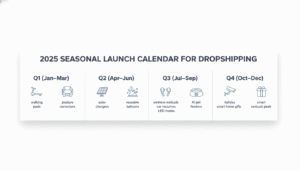
Understanding seasonal trends makes a big difference. In fact, it separates modest success from significant growth. Here’s the best time to launch each product type.
Q1 (January-March): Fitness and Productivity Focus
People buy more walking pads after making New Year’s fitness goals. Similarly, posture correctors are in high demand as people return to desk work. Additionally, smart home security cameras gain interest in winter when break-ins increase.
Q2 (April-June): Outdoor and Beauty Season
As people spend more time outside, demand for portable solar chargers rises. Similarly, reusable water balloons become popular. During spring cleaning season, car vacuum cleaners prove effective. Meanwhile, LED facial masks gain popularity before summer gatherings.
Q3 (July-September): Back-to-School Rush
Sales of wireless earbuds increase during back-to-school season. At the same time, demand for pet feeders stays consistent as families settle into routines. Meanwhile, hair growth rollers maintain steady performance.
Q4 (October-December): Holiday Gift-Giving Peak
Almost all products do well during holiday gift-giving season. However, electronics like headphones and security cameras perform best. In particular, smart home devices make excellent gifts.
Pro Tip: Launch products 6-8 weeks before peak season. This way, you allow time for advertising optimization and inventory scaling.
Legal Compliance and Import Regulations Guide
Following compliance requirements is crucial for long-term success. Moreover, it helps you avoid costly legal issues. According to the U.S. Consumer Product Safety Commission, proper product certification prevents thousands in fines.
Electronics Products (Security Cameras, Earbuds, Pet Feeders)
First, wireless devices must have FCC registration. This costs between $500 and $1,500. Additionally, CE marking is required for European markets. Furthermore, UL listing is recommended for safety. Finally, import duty typically ranges between 2% and 6%.
Health and Beauty Products (LED Masks, Posture Correctors)
FDA registration is needed for medical device claims. This costs more than $5,000 for Class II products. Additionally, CPSC compliance ensures consumer safety. Furthermore, different states have varying rules around health claims. Finally, liability insurance of at least $1 million is recommended.
Children’s Products (Water Balloons)
CPSIA rules require testing for lead and age labeling. Additionally, third-party testing is needed, costing $300 to $800 per product. Furthermore, warning labels must be age-appropriate. Finally, get certification from recognized labs for imports.
Documentation Requirements
You’ll need several important documents. First, get certifications for product safety. Second, obtain certificates of compliance for materials. Third, collect documents for verifying suppliers. Fourth, secure certificates of insurance. Finally, obtain import/export licenses if needed.
Common Compliance Costs
Here’s what to expect financially. First, initial testing and certification cost $1,500 to $5,000 per product. Second, annual maintenance runs $500 to $1,500. Third, legal advice costs $200 to $400 per hour. Finally, insurance premiums range from $1,000 to $3,000 yearly.
How to Find Winning Dropshipping Products in 2025
Effective product research needs systematic procedures. In fact, it goes beyond gut feeling. The most successful dropshippers use many data sources. As a result, they uncover opportunities before markets become oversaturated.
Social Media Intelligence Tools
TikTok Creative Center provides real-time insights into viral trends. Specifically, it highlights popular products among younger audiences. To spot genuine interest, watch hashtag health and engagement rates. Also, check comment sentiment. When a product has over 500,000 views and more than 85% positive comments, it shows strong commercial potential.
Competitor Analysis Platforms
Minea provides comprehensive advertising intelligence. Specifically, it shows which products competitors push heavily. Additionally, it reveals their creative strategies. This research helps identify market gaps. Moreover, it suggests improvement opportunities. Look for brands with over 30 active sponsors that still have room for growth.
Dropship.io provides store analysis and sales data. As a result, you understand how competitors select products and set prices. This knowledge lowers research risks. For accurate data, focus on stores making over $10,000 monthly.
Advanced Research Techniques
First, use Google Trends Analysis. Products showing 6-month upward trends indicate sustainable demand. Look for search volumes above 10K.
Second, try Amazon Best Seller Monitoring. Track BSR changes in relevant categories. This way, you identify emerging winners.
Third, analyze the Facebook Ad Library. Study competitor ad spend and creative approaches. This validates market potential.
Finally, monitor Reddit/Forum Sentiment. Watch product discussions for genuine user feedback and pain points.
Red Flags to Avoid
Watch out for these warning signs. First, avoid products with 100+ competitors advertising simultaneously. Second, skip seasonal items outside their peak demand window. Third, avoid items requiring complex customer support or assembly. Fourth, watch for products with negative Reddit sentiment. Finally, stay away from oversaturated niches with commoditized pricing.
Validation Checklist Before Launch
Before launching, check these items. First, ensure a minimum 60% profit margin potential. Second, verify at least a 6-month trend sustainability. Third, confirm a clear value proposition versus competitors. Fourth, check positive customer review patterns. Fifth, ensure reasonable shipping times under 20 days. Finally, verify supplier reliability with a 4.5+ rating and 1000+ transactions.
How to Automate Your Shopify Store for Scalability
Automation transforms dropshipping from a time-intensive hustle to a scalable business. In fact, the most successful stores automate repetitive tasks. At the same time, they maintain quality customer experiences.
Product Import and Inventory Management Automation
AutoDS handles 500,000+ products automatically. Additionally, it updates inventory every 4 hours. Moreover, it processes orders within 2 minutes of purchase.
Pricing: $7.90-$77.90/month based on volume.
Oberlo integrates seamlessly with 1M+ products. Furthermore, it offers one-click importing and automatic price adjustments. Free plan available, premium starts at $29.90/month.
AliDrop specializes in AliExpress integration. Additionally, it features bulk editing capabilities and profit calculation tools.
Pricing: $9.99-49.99/month.
Order Fulfillment Automation Platforms
CJDropshipping processes 10,000+ orders daily. Moreover, it offers 7-15 day shipping globally and quality control services. No monthly fees; per-order costs vary.
Spocket focuses on US/EU suppliers. As a result, it provides 2-5 day shipping and branded invoicing.
Plans: $24-99/month.
Dropified provides multi-supplier management. Additionally, it handles order splitting and tracking updates.
Pricing: $47-127/month.
Dynamic Pricing Optimization
PricingSuite monitors 50+ competitors simultaneously. Furthermore, it adjusts prices based on demand and competition. It also uses profit protection algorithms. Customize pricing based on store size.
Competitor Monitor offers real-time price tracking. Additionally, it provides automated repricing rules and profit margin protection.
Plans: $29-199/month.
Customer Service Automation
Tidio Chatbot handles 80% of common inquiries. Moreover, it offers 24/7 availability and integrates order status. Free plan available, premium: $18-394/month.
Gorgias is a Shopify-integrated help desk. Additionally, it provides automated responses and order management. Plans: $10-900/month based on tickets.
Email Marketing Automation Sequences
Klaviyo features abandoned cart recovery. In fact, it achieves an average of 10-15% recovery rates. Additionally, it includes post-purchase sequences and customer segmentation. Free up to 250 contacts, then $20-1,700/month.
Mailchimp offers welcome series and product recommendations. Furthermore, it includes customer winback campaigns. Free up to 2,000 contacts, then $10-299/month.
Advanced Marketing Automation
Facebook Ads Manager API Integration automatically pauses low-performing ads. Additionally, it scales winning campaigns and adjusts budgets based on ROAS. Tools like Revealbot ($99-999/month) manage this process.
Google Shopping Feed Automation uses tools like DataFeedWatch ($39-2,000/month). These optimize product feeds and manage inventory sync. As a result, they improve ad performance automatically.
Retargeting Pixel Management automates audience creation and lookalike scaling. Additionally, it optimizes campaigns through platforms like AdEspresso ($49-259/month).
Inventory and Supplier Management
Supplier Scorecard Automation tracks performance metrics automatically. This includes shipping times, quality ratings, and stock levels. Poor-performing suppliers get flagged for replacement.
Stock Level Monitoring provides automatic notifications. Specifically, alerts trigger when inventory drops below thresholds. As a result, this prevents overselling and customer disappointment.
Multi-Supplier Failover routes orders automatically. If the primary supplier runs out, orders go to backup suppliers. Therefore, this maintains fulfillment continuity.
Financial and Analytics Automation
Profit Tracking tools like BeProfit ($25-99/month) calculate real-time profit margins. Additionally, they include all fees, ad costs, and expenses.
Tax Automation through TaxJar ($19-500/month) handles sales tax calculations. Furthermore, it manages filing automatically across multiple jurisdictions.
Chargeback Management provides automated dispute responses. Additionally, services like ChargeBlast (custom pricing) handle documentation.
Performance Metrics After Automation Implementation
After implementing automation, you’ll see major improvements. First, expect a 70% reduction in daily operational time. Second, enjoy 85% faster order processing (2 minutes vs 15 minutes manual). Third, see 40% improvement in customer satisfaction scores. Fourth, gain a 25% increase in profit margins through optimized pricing. Finally, achieve a 90% reduction in inventory sync errors.
ROI Analysis
Here’s the financial breakdown. First, initial automation setup costs $500-2,000. Second, monthly automation tools cost $200-800, depending on scale. Third, time saved equals 20-40 hours weekly (valued at $400-1,200 weekly).
The compound effect of automation creates significant advantages. While competitors manually manage operations, automated stores process more orders with fewer errors. Additionally, they respond faster to market changes. As a result, they scale revenue without proportional increases in workload or stress.
Advanced Competitive Analysis Strategies
Understanding your competition deeply provides crucial advantages. In fact, it helps with product selection and marketing strategy. According to Shopify’s research, businesses conducting regular competitive analysis are 33% more likely to see revenue growth.
Competitor Store Analysis Framework
First, use Traffic Analysis. Tools like SEMrush or Ahrefs analyze competitor traffic sources. Additionally, they reveal top-performing keywords and seasonal patterns.
Second, try Product Performance Tracking. Monitor competitors’ best-selling items through Commerce Inspector ($29-99/month).
Third, implement Pricing Strategy Analysis. Track competitor pricing changes using Price2Spy ($19-199/month).
Finally, conduct Social Media Intelligence. Analyze competitor engagement, content strategies, and influencer partnerships.
Facebook Ads Intelligence
Facebook Ad Library is a free tool. It shows all active ads from competitors. Additionally, it reveals creative formats and messaging strategies.
AdSpy ($149/month) offers advanced filtering. Specifically, it sorts competitor ads by engagement, demographics, and performance metrics.
BigSpy ($9-299/month) provides multi-platform intelligence. It covers Facebook, Google, YouTube, and TikTok.
Market Saturation Assessment
Understanding competition levels is crucial. First, Low Competition means fewer than 20 active advertisers. This represents a good opportunity. Second, Medium Competition means 20-50 advertisers. This requires differentiation. Finally, High Competition means 50+ advertisers. Avoid this unless you have a unique angle.
Competitive Advantage Development
You can develop advantages in several ways. First, try a Bundle Strategy. Combine popular products into value packages. Second, use Premium Positioning. Focus on quality and service over price competition. Third, implement Niche Targeting. Serve specific customer segments that competitors ignore. Finally, try Geographic Focus. Target regions with less competition but strong demand.
Risk Management and Business Protection
Protecting your dropshipping business ensures long-term sustainability. Moreover, it prevents common pitfalls.
Supplier Risk Mitigation
First, use a Multi-Supplier Strategy. Never rely on single suppliers. Instead, maintain 2-3 backup options per product.
Second, implement Supplier Verification. Require business licenses, factory certifications, and quality control documentation.
Third, use Payment Protection. Apply trade assurance programs (Alibaba) or escrow services for large orders.
Finally, always do Sample Testing. Order samples before bulk commitments to verify quality.
Legal Protection Measures
First, consider Business Structure. LLC formation provides personal asset protection. This costs $100-500 for setup.
Second, get Liability Insurance. General liability coverage costs $200-600 annually. It protects against product-related claims.
Third, create Terms of Service. Comprehensive legal documents protect against disputes and chargebacks.
Finally, establish a Privacy Policy. GDPR and CCPA compliance prevent regulatory fines. Legal drafting costs $500-2,000.
Financial Risk Management
First, maintain Separate Business Banking. Keep personal and business finances completely separate.
Second, build an Emergency Fund. Maintain 3-6 months’ operating expenses in reserve. Typically, this means $5,000-15,000.
Third, establish a Credit Line. Get business credit for inventory purchases and cash flow management.
Finally, implement an Accounting System. Professional bookkeeping prevents tax issues. Additionally, it provides financial clarity.
Platform Diversification Strategy
First, take a Multi-Channel Approach. Don’t rely solely on Shopify. Instead, consider Amazon, eBay, and Etsy for additional revenue.
Second, implement Traffic Diversification. Balance paid ads with SEO, social media, and email marketing. This reduces platform dependency.
Third, use Multiple Payment Processors. This prevents single points of failure.
Crisis Management Protocols
First, prepare for Supplier Issues. Document procedures for handling stockouts, quality problems, or supplier failures.
Second, manage Customer Complaints. Use standardized response templates and escalation procedures.
Third, plan for Platform Policy Changes. Have backup plans for advertising account suspensions or policy violations.
Finally, prepare for Economic Downturns. Develop product pivot strategies for recession-resistant categories.
Final Thought: Shopify Dropshipping Products 2025
The dropshipping landscape of 2025 prioritizes preparation and data-driven decisions. Moreover, it values operational excellence over quick-money schemes. Success requires understanding that this is a legitimate business. Therefore, you need professional methods for product selection, customer service, and growth.
There are numerous opportunities ahead. In fact, the global dropshipping industry will grow to $3,479.1 billion by 2033. Additionally, e-commerce continues to expand. However, competition remains equally fierce. Winners stand out because they do superior product research. Furthermore, they use automated processes and focus on customer value.
Most importantly, long-term success requires treating dropshipping like a real business. It needs investment in systems, compliance, and customer relationships. It’s not just a side hustle. Successful entrepreneurs in 2025 combine data-driven product selection with professional methods. Additionally, they use automation to scale efficiently while maintaining quality.
If you want to build a hands-free, scalable Shopify business, focus on what works. Specifically, pick products based on data and set up complete automated systems. Furthermore, follow legal requirements and manage risks carefully. Finally, give customers experiences that make them return and leave positive reviews.
The tools, data, and opportunities exist to build substantial dropshipping businesses in 2025. Your success depends on implementing professional systems. Moreover, it requires treating your store like a real business that needs considerable attention and investment.
Explore more resources and professional guidance at Amzart Solutions. Take your dropshipping journey to the next level.
FAQs: Shopify Dropshipping Products 2025
Q. What makes a product “winning” in 2025?
Winning products solve real-world problems and generate impulse purchases. Additionally, they have high profit margins of 60% or higher. Furthermore, they perform well on social media and ship quickly. They also come from reliable suppliers. Finally, they should show upward trends on Google Trends and have minimal ad platform competition.
Q. Do I need to run ads to succeed with these products?
Organic traffic is good for long-term growth. However, most successful dropshippers use paid marketing. Specifically, they advertise on Facebook, TikTok, and Google Shopping. Paid ads get results faster. Moreover, they let you test quickly and scale winning products rapidly.
Q. Can I sell these products without holding inventory?
Yes, you can. All mentioned products are perfect for dropshipping. Therefore, you don’t need to stock any inventory. Platforms like AutoDS, Spocket, and CJDropshipping automate order fulfillment. Additionally, they update inventory and provide tracking. As a result, managing without storing products becomes easy.
Q. Are these products trending globally or in specific regions?
Most of these products are globally popular. However, performance varies by region. For example, smart home devices like pet feeders are very popular in the U.S. and Europe. In contrast, beauty tech like LED facial masks performs exceptionally well in Asian markets.
Q. How much investment do I need to start dropshipping these products?
You can start with $500 to $2,000. This depends on your goals. The investment covers business setup, product samples, advertising, and automation tools. Higher budgets allow for faster testing and scaling. However, even with limited funding, the right strategy can deliver results.
Ready to Start Dropshipping Smarter in 2025?
Don’t waste time guessing what works. Instead, let our Shopify automation experts handle everything. We’ll manage your product research, supplier setup, marketing, and scaling. As a result, you can focus on growing your business.
Book a Free Strategy Call Now and get started with your winning Shopify store today!
