
The top Walmart dropshipping automation tools in 2025 are changing how sellers manage their online businesses.
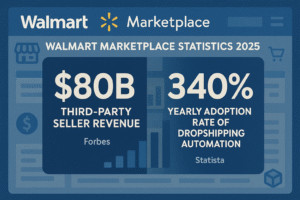
According to Forbes, Walmart’s marketplace has generated over $80 billion in revenue from third-party sellers. Moreover, automation tool adoption is growing by over 340% each year, as reported by Statista.
Therefore, finding the right Walmart dropshipping software in 2025 is crucial. As a result, it helps you stand out and build a successful business.
Why Automation Matters
These e-commerce automation software platforms save sellers a lot of time. Specifically, they sync inventory with suppliers automatically. Additionally, they process orders without manual work.
Consequently, Walmart seller automation tools let you grow your business faster. Furthermore, experienced Walmart sellers have tested these tools. In fact, they show clear gains in efficiency and profit.
Want to explore automation services that help you scale faster? Discover our comprehensive Walmart dropshipping solutions here.
Top 7 Best Walmart Automation Tools for Beginners
1. AutoDS: Complete Walmart Dropshipping Integration Platform
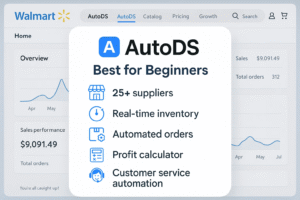
AutoDS is one of the most reliable platforms for Walmart dropshipping automation. Moreover, it offers tools that make daily selling simple.
Since it connects with Walmart’s seller API, you get real-time updates. Consequently, Walmart’s inventory management automation runs smoothly across multiple suppliers.
Key Features:
The platform provides automated product importing from 25+ suppliers, including CJ Dropshipping, AliExpress, and even Walmart itself. Real-time price and stock monitoring delivers instant updates to your listings. Walmart order fulfillment automation comes with integrated tracking numbers. Built-in profit calculators plus margin optimization tools protect your earnings. Customer service automation includes ready-to-use templated responses.
Pricing Details
Plans start at just $7.90 per month for up to 200 products. In contrast, higher tiers cost $77.90 monthly for sellers managing 10,000+ products.
Who Should Use AutoDS
AutoDS works best for new to intermediate sellers. Furthermore, it’s user-friendly and easy to set up. As a result, it’s one of the most beginner-friendly Walmart dropshipping tools in 2025.
2. Inventory Source: Enterprise-Level Walmart eCommerce Automation Solutions
Inventory Source handles high-volume Walmart dropshipping businesses. In addition, it offers features designed for large operations.
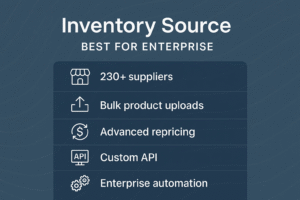
The platform manages complex supplier relationships easily. Additionally, it handles thousands of SKUs at once. Therefore, it’s ideal for Walmart dropshipping automation at scale.
Key Features:
The platform offers direct integration with 230+ verified suppliers. Advanced data feed management enables bulk product uploads. Sophisticated Walmart repricing software includes competitor analysis. Automated quality control and listing optimization come standard. Custom Walmart dropshipping API integration handles unique requirements.
Pricing Details
The Base package costs $99 per month. However, enterprise features have separate pricing.
Who Should Use Inventory Source
High-volume merchants who handle 1,000+ products benefit most. Also, it’s great for multi-channel sellers.
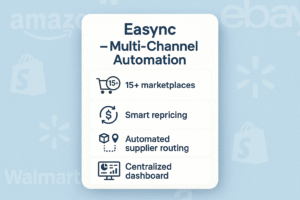
3. Easync: Multi-Channel Walmart Dropshipping Automation
Easync is designed for sellers on multiple marketplaces. In particular, it keeps Walmart inventory synced with Amazon, eBay, and Shopify.
Therefore, each platform runs smoothly with multi-channel Walmart dropshipping automation.
Key Features:
Cross-platform inventory synchronization works across 15+ marketplaces. Intelligent repricing uses marketplace-specific algorithms. Automated order routing directs orders to optimal suppliers. A centralized dashboard manages multi-channel operations. Automated listing creation includes SEO optimization.
Pricing Details
The starter plan costs $24.99 monthly. Meanwhile, professional features cost $99.99 per month.
Who Should Use Easync
Sellers across multiple platforms who need a single control center will find this ideal.
4. Spocket: Curated Supplier Integration for Walmart
Spocket combines a vetted supplier network with automation tools. Specifically, it focuses on product quality and supplier reliability.
Additionally, it ensures smooth fulfillment. As a result, it’s perfect for Walmart dropshipping sellers who value quality and trust.
Key Features:
A pre-vetted supplier network provides quality guarantees. Automated product research identifies trending items. Custom branding options cover packaging and inserts. Automated order processing delivers 2-24-hour fulfillment times. Product sample ordering enables quality verification.
Pricing Details
The premium Walmart plan starts at $39.99 per month.
Who Should Use Spocket
Sellers who prioritize product quality and customer experience will appreciate this tool. In particular, it’s perfect for branded products.
5. DSers: Affordable Walmart Dropshipping Automation Tools
DSers is one of the most affordable Walmart dropshipping automation tools available. Therefore, it’s perfect for sellers on a budget.
While it lacks some advanced features, it covers all the basics. Consequently, new sellers can run operations smoothly without high costs.
Key Features:
Basic inventory synchronization and order processing form the foundation. Simple repricing rules and stock monitoring keep operations running. Order tracking automation includes customer notifications. Supplier management tools help track relationships. Performance analytics and reporting provide insights.
Pricing Details
DSers offers a free plan for beginners. However, premium features start at $19.90 monthly.
Who Should Use DSers
New Walmart sellers testing automation will find this helpful. Also, it’s ideal for budget-conscious sellers.
6. Flxpoint: Operations-Focused Walmart Marketplace Automation
Flxpoint helps businesses grow through better operations. Specifically, it focuses on workflow automation for Walmart sellers.
In addition, the platform emphasizes process optimization over marketing features.
Key Features:
Advanced supplier onboarding and integration tools streamline operations. Sophisticated order splitting and routing automation optimize fulfillment. Inventory forecasting and automated reordering prevent stockouts. Quality control automation monitors supplier performance. Custom workflow creation accommodates unique business requirements.
Pricing Details
The Standard package costs $99 per month. Nevertheless, advanced features cost extra.
Who Should Use Flxpoint
Growing sellers who need flexible workflows will benefit from this platform.
Need personalized help choosing the right automation tools? Contact our e-commerce specialists today.
7. Oberlo (Shopify Integration): Walmart Shopify Integration Bridge
Oberlo offers automation for Shopify users who dropship from Walmart. Specifically, it connects Shopify features with Walmart’s supplier network.
Thus, it creates a smooth Walmart Shopify platform experience.
Key Features:
Seamless Shopify-Walmart inventory synchronization keeps stock levels accurate. Automated product importing includes customizable markup rules. Order processing automation integrates with Shopify workflow systems. Performance tracking connects with Shopify analytics integration. Automated customer communication flows through Shopify’s messaging system.
Pricing Details
It’s included with Shopify plans. However, premium automation features cost extra.
Who Should Use Oberlo
Shopify store owners who want to dropship on Walmart will find this essential.
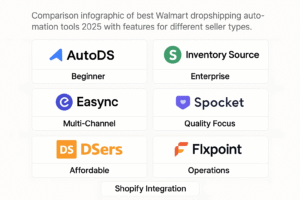
Walmart Automation Tools Comparison 2025: Features and Capabilities Matrix
Core Automation Features
Inventory Management: AutoDS and Inventory Source excel at keeping inventory levels up to date in real-time. Specifically, changes from suppliers are typically reflected within 5 to 15 minutes. Meanwhile, Easync excels at syncing across platforms. In contrast, DSers does a good job of tracking inventories, although it lacks advanced features.
Order Processing: Flxpoint excels at routing and separating complex orders. Therefore, this makes it ideal for sellers who work with multiple suppliers. On average, Spocket processes orders within 2 to 4 hours. Specifically, this includes everything from when the order is received to when it is sent to the supplier.
Pricing Automation: Inventory Source features the most advanced repricing algorithms. In particular, these consider over 20 factors, including competitor analysis, profit margins, and market trends. Meanwhile, AutoDS offers robust, user-friendly repricing tools. On the other hand, Easync specializes in optimizing prices for specific marketplaces.
Integration Capabilities
Marketplace Support: Among all the Walmart dropshipping automation tools, Easync stands out by supporting the most sales channels. Specifically, it offers over 15 integrations. In comparison, AutoDS follows with 8 channels. Meanwhile, Inventory Source covers 6. On the other hand, DSers and Oberlo focus mainly on their core platforms. Therefore, they offer fewer options if you are planning to expand into multiple marketplaces.
Supplier Networks: When it comes to supplier coverage, Inventory Source leads the way with the largest verified supplier network. In fact, it provides sellers with access to over 230 partners. Similarly, Spocket offers a curated network of over 100 high-quality suppliers. Meanwhile, AutoDS connects sellers to around 25 trusted and well-known dropshipping vendors.
Third-Party Integrations: For businesses that require more advanced functionality, Flxpoint offers the most robust third-party integrations. For instance, from accounting software and CRM systems to advanced analytics, it provides flexibility. As a result, this works especially well for vendors running complex operations.
Walmart Automation Tools Comparison Matrix – Detailed Feature Ticks
| Feature / Tool | AutoDS | Inventory Source | Easync | Spocket | DSers | Flxpoint | Oberlo |
|---|---|---|---|---|---|---|---|
| Inventory Management | ✅ Real-time inventory sync, multi-supplier | ✅ Enterprise-grade, large SKU support | ✅ Multi-channel sync across 15+ marketplaces | 🟡 Limited to curated suppliers | ✅ Basic sync, smaller catalog | ✅ Advanced forecasting & automated reorder | 🟡 Shopify-Walmart integration only |
| Order Processing | ✅ Automated order fulfillment, tracking integration | ✅ Enterprise automation, custom workflows | ✅ Automated routing to optimal suppliers | ✅ Fast 2–24 hour fulfillment, automated orders | ✅ Basic order processing & tracking | ✅ Advanced order splitting & routing | ✅ Shopify workflow order automation |
| Pricing Automation | ✅ Robust repricing tools, margin optimization | ✅ Advanced repricing algorithms, competitor analysis | ✅ Marketplace-specific intelligent repricing | — Minimal / not a focus | 🟡 Simple repricing rules | — Pricing is not a core feature | 🟡 Basic markup rules in Shopify |
| Supplier Networks | ✅ 25+ suppliers (AliExpress, CJ, Walmart) | ✅ 230+ verified suppliers | 🟡 Multiple suppliers across channels, smaller network | ✅ 100+ curated, vetted suppliers | 🟡 Limited supplier options | ✅ Supports multiple supplier integrations | 🟡 Limited to the Shopify-Walmart network |
| Marketplace Support | ✅ 8+ channels supported | ✅ 6+ channels supported | ✅ 15+ marketplaces | — Focus on Walmart only | — Focus on Walmart only | 🟡 Multi-channel limited | 🟡 Shopify main platform |
Legend:
- ✅ Full support / advanced feature
- 🟡 Partial/basic support
- — Not supported
Pricing Analysis and ROI Considerations
Cost-Benefit Analysis by Business Size
Startup Operations (0-500 products): For startup operations with 0–500 goods, DSers and AutoDS offer the best value. Notably, DSers starts at $7.90 per month and includes free basic functionality. As a result, these solutions meet the most basic automation needs without making things too complicated for beginning sellers.
Growing Businesses (500-2,000 products): Businesses with 500 to 2,000 products find that Easync and Spocket offer the best features. In particular, they provide advanced automation without the complexity typically associated with enterprise-level solutions. Prices range from $24.99 to $39.99 a month. Moreover, you may expect to see a return on your investment in 6 to 8 weeks.
Enterprise Operations (2,000+ products): Inventory Source and Flxpoint charge more ($99+/month) because they provide additional features. Specifically, these features are necessary when a business grows. Furthermore, these platforms can handle complex processes involving multiple suppliers and channels. Otherwise, such processes would be too cumbersome for simpler solutions.
Hidden Costs and Additional Fees
Most systems automatically impose transaction fees ranging from $0.02 to $0.15 on every order. When determining your potential earnings, be sure to factor in these fees. Particularly, this is important if you conduct a high volume of business. Additionally, some programs can charge more for premium integrations, sophisticated analytics, or faster customer support.
The cost of setting up and learning to use different platforms can vary significantly. For instance, AutoDS and DSers are easy to use and can be up and running in a few hours. In contrast, Inventory Source may take days or weeks to optimize fully.
How to Automate Walmart Dropshipping Business: Tool Selection Guide
For New Walmart Sellers
Select tools that prioritize ease of use and offer comprehensive educational resources. Specifically, AutoDS and DSers offer extensive tutorials, community support, and guided setup processes. Thus, these help new sellers avoid common mistakes. Additionally, these platforms provide built-in product research tools. Consequently, sellers can identify profitable opportunities more easily.
Focus on tools that offer strong customer support and an active user community. Indeed, the learning curve for dropshipping automation can be steep. Therefore, having access to experienced users and responsive support teams significantly improves your chances of success.
According to Walmart’s official Seller Help Center, sellers must comply with specific API usage guidelines to maintain account standing.
For Multi-Channel Sellers
Prioritize platforms with strong marketplace integration features. For example, Easync and Inventory Source are great for keeping track of inventory across multiple sales channels. Meanwhile, they ensure that each platform works best for its own needs. As merchants move outside Walmart, these technologies help keep things simple. Thus, they prevent operations from getting too complicated.
Look for consolidated dashboard features that provide a single view of your entire business. In fact, when managing a large number of channels, manual tasks become unfeasible. Therefore, full automation is necessary for long-term growth.
For High-Volume Operations
Planning for growth ahead of time is one of the smartest moves you can make. Specifically, it saves you stress later and ensures your operations scale smoothly. Examine closely how your chosen Walmart dropshipping automation platform handles bigger order volumes, expanded product catalogs, and multiple marketplace integrations. In reality, some tools are built to grow with you and can adapt seamlessly. However, others may reach their limits and require an upgrade or even a switch to a more advanced platform.
Redundancy is another key factor. In particular, building in backup systems or maintaining simple manual methods for your most critical tasks ensures your business remains operational. As a result, this is true even if your automation platform experiences downtime or technical issues. With this safety net in place, your store remains stable and ready for growth. Indeed, this holds regardless of the challenges that arise. Walmart’s official API documentation provides comprehensive guidelines for advanced integrations.
Implementation Best Practices
Initial Setup Strategy
When you are just getting started, it is best to begin with a simple level of automation. Then, slowly expand as you build confidence in how the platform performs. A smart first step is to automate basic tasks, such as repricing rules and inventory updates. Once you are comfortable, you can move on to automating order processing. Eventually, you can even automate parts of customer service.
Instead of applying new Walmart dropshipping automation tools across your entire product catalog right away, test them on a smaller group of items first. Specifically, this trial run enables you to identify potential issues and fine-tune your settings. As a result, you avoid putting your entire business at risk.
Monitoring and Optimization
For the first month after launching your automation system, set aside time for daily checks. Particularly, confirm that your inventory is syncing correctly. Review order statuses and track price changes to make sure everything is functioning smoothly. Fortunately, most Walmart dropshipping software platforms now include dashboards and real-time alert systems. Consequently, these make this process much easier to manage.
It is also smart to create automated reports that highlight key performance indicators. For instance, these include processing speed, inventory accuracy, and overall revenue. These insights reveal where your automation is most effective. Moreover, they show where adjustments could further enhance results.
Scaling Considerations
Planning for scale before you need it saves you major headaches later. Specifically, explore how your chosen Walmart dropshipping automation platform handles larger order volumes, bigger product catalogs, and additional marketplace integrations. In reality, some tools adapt seamlessly as your business grows. However, others may require upgrading or even switching to a new platform.
Finally, think about redundancy. In particular, adding backup systems or maintaining simple manual methods for essential processes ensures that your business continues to run smoothly. As a result, this is true even if the automation platform experiences downtime or technical issues. Having this safety net in place will keep your store stable as you grow.
Ready to scale your business with advanced automation and specialized services? Explore our comprehensive Walmart automation solutions.
Conclusion: Choose Your Walmart Automation Tool
The top Walmart dropshipping automation tools in 2025 are designed to cater to various business needs. Notably, AutoDS remains the most beginner-friendly option for sellers seeking a comprehensive Walmart dropshipping software solution in 2025. For larger operations, Inventory Source is built to handle enterprise-level workflows. Meanwhile, Easync is ideal for sellers focused on multi-channel growth. If product quality and trusted suppliers are your priority, Spocket is the tool that stands out.
Your choice really depends on your business’s stage. For instance, new sellers should consider starting with AutoDS or DSers. Both offer affordable Walmart dropshipping automation tools that cover all the basics. In contrast, sellers experiencing steady growth may benefit more from Easync or Spocket. On the other hand, high-volume operations usually turn to Inventory Source or Flxpoint for advanced Walmart eCommerce automation solutions.
Most sellers find that these tools quickly pay for themselves. Specifically, by boosting efficiency and enabling you to handle more orders with minimal effort, the right Walmart dropshipping automation tools often return their investment within 60 to 90 days.
FAQ: Walmart Dropshipping Automation Tools
Q. Which Walmart dropshipping tool is best for beginners?
AutoDS is the best Walmart dropshipping tool for beginners.
AutoDS is the ideal automation tool for Walmart beginners. This is thanks to its user-friendly interface, comprehensive tutorials, and affordable pricing starting at $7.90/month. The platform offers guided setup processes and built-in product research tools. Therefore, it helps new sellers avoid common mistakes while learning the fundamentals of automation.
Q. Do these Walmart seller tools violate Walmart’s seller policies?
No, reputable automation tools do not violate Walmart policies.
Reputable automation tools comply with Walmart’s seller policies by utilizing official APIs. They also adhere to marketplace guidelines. However, sellers remain responsible for ensuring that their automation settings don’t create policy violations. These include price manipulation or inventory misrepresentation. Always review Walmart’s current policies and configure automation accordingly.
Q. Can I use multiple Walmart automation tools simultaneously?
Yes, you can combine tools for different functions.
Many successful sellers use complementary automation tools for different functions. For example, you might use AutoDS for basic automation while adding Inventory Source for advanced analytics. However, avoid overlapping tasks that could create conflicts. Also, avoid duplicate actions that might trigger marketplace flags.
Q. What ROI should I expect from these automation tools?
Sellers typically see 300-500% ROI within 90 days.
Most sellers see 300-500% ROI within 90 days of implementing quality automation tools. Time savings typically range from 10 to 20 hours per week. Meanwhile, improved operational efficiency often increases order capacity by 200-400%. Calculate ROI based on both time savings and increased revenue potential from improved scaling capabilities.
Q. How do I migrate from manual operations to Walmart automation?
Start with inventory sync, then add repricing and order automation.
Start by implementing inventory synchronization first. Next, add basic repricing automation. Add order processing automation once you’re comfortable with inventory management. Then, gradually introduce advanced features like customer service automation and advanced analytics. This phased approach minimizes disruption while building confidence in automated systems.
Ready to take your Walmart dropshipping business to the next level? Get expert guidance on our specialized Walmart dropshipping automation services.
