
Choosing between Etsy and Shopify has become more challenging as both platforms continue to grow and adapt. For instance, Etsy now has over 5.4 million active sellers, while Shopify powers more than 1.75 million businesses as of 2024. With numbers like these, the decision you make today could shape whether your online business flourishes or struggles to stand out in such a competitive marketplace.
This in-depth comparison of Etsy vs. Shopify is designed to guide you through the key factors that truly matter. Specifically, we will examine startup costs, monthly fees, marketing tools, and the long-term growth opportunities that each platform offers. By the end, you will have a clear understanding of how these two e-commerce leaders stack up in 2025’s fast-changing landscape.
The reality is that the stakes are high. Indeed, your choice of platform directly impacts your profit margins, visibility, and how easily customers can discover your products. Therefore, let’s explore what makes Etsy and Shopify unique, so you can make an informed decision that aligns with your business goals.
Ready to explore the possibilities? Discover comprehensive e-commerce solutions that can complement whichever platform you choose.
Understanding the Core Differences
What Is Etsy?
Etsy operates as a global marketplace built around handmade items, vintage finds, and craft supplies. In fact, you can picture it as an endless online craft fair, where millions of shoppers come specifically looking for creative and one-of-a-kind products. Moreover, the best part is that Etsy takes care of the technical side, so you can spend more of your energy creating and listing your products, rather than worrying about website setup.
Because Etsy follows a marketplace model, your shop is essentially renting space inside a much larger store. That means you are part of Etsy’s ecosystem, working within their rules and design structure. For many sellers, especially artisans, crafters, and vintage collectors, this setup is ideal. Additionally, it provides immediate access to buyers who are already motivated to purchase, without the extra burden of building and maintaining your own website from scratch.
What Is Shopify?
Shopify is a comprehensive e-commerce website builder that provides everything you need to create and manage your own independent online store. With Shopify, you get your own domain name, complete control over design and functionality, and the flexibility to sell just about any legal product or service you want.
The main difference from Etsy is that Shopify is not a shared marketplace. Instead of competing side by side with millions of other sellers, you are building your own digital storefront where customers can shop your products directly. Consequently, this setup makes Shopify especially powerful for anyone focused on long-term brand growth and building a loyal customer base tied to their store rather than the marketplace.
Cost Comparison: Startup and Ongoing Expenses
Etsy Selling Costs
Getting started on Etsy is appealing for new sellers because the upfront investment is very low. This makes it an easy entry point for anyone who wants to test the waters before committing more resources. Here is how the costs break down:
- Listing fees: $0.20 per item, lasting for four months or until the item sells
- Transaction fees: 6.5% of the item price, plus shipping and gift wrap charges
- Payment processing: 3% + $0.25 per transaction
- Advertising costs: Optional, usually between 2% and 4% of sales if you want stronger visibility
While the costs may seem small at first, they can add up faster than many new sellers expect. For example, if you sell an item for $50, you would pay about $6.50 in transaction fees, $1.75 in payment processing, and the original listing fee. Altogether, that is close to 16.5% of your sales going directly to Etsy, before factoring in materials, packaging, shipping, or the time it takes to create and fulfill the order.
Shopify Pricing Structure
Shopify operates on a monthly subscription model, offering various plans and transaction fees that vary depending on the chosen plan. Here is the breakdown of Shopify pricing:
- Basic Shopify: $39 per month with 2.9% + 30¢ per transaction
- Shopify: $105 per month with 2.6% + 30¢ per transaction
- Advanced Shopify: $399 per month with 2.4% + 30¢ per transaction
On top of the subscription fee, most sellers also spend on extras such as:
- Premium themes, which usually range from $100 to $300 as a one-time purchase
- Apps and plugins, which can run anywhere from $10 to $100+ monthly, depending on the features you need
- Custom development varies widely depending on whether you hire developers for unique functionality or not
- Marketing and advertising, which depend on your budget and goals
If you sell a $50 product on the Basic Shopify plan, you would pay about $1.75 in transaction fees. You also need to factor in your monthly subscription, divided across however many sales you make that month. For higher-volume sellers, this structure often proves to be more cost-effective than Etsy’s percentage model, as the fixed subscription fee becomes easier to absorb with increasing sales.
Cost Comparison Table
| Cost Type | Etsy | Shopify |
|---|---|---|
| Setup Cost | $0 (Free to create an account) | $0 (Free trial available) |
| Monthly Subscription | $0 | Basic: $39/month
Standard: $105/month Advanced: $399/month |
| Listing Fees | $0.20 per item (4 months or until sold) | Unlimited listings included |
| Transaction Fees | 6.5% of the sale price + shipping | Basic: 2.9% + $0.30
Standard: 2.6% + $0.30 Advanced: 2.4% + $0.30 |
| Payment Processing | 3% + $0.25 per transaction | Included in transaction fees |
| Advertising (Optional) | 2-4% of sales (Etsy Ads) | Variable (self-managed budget) |
| Offsite Ads | 15% fee on resulting sales | Not applicable |
| Design/Themes | Limited customization (free) | Free themes or $100-$300 premium |
| Apps/Plugins | Limited third-party options | $10-$100+/month per app |
| Example: $50 Sale Total Cost | ~$8.45 (16.9% of sale) | $1.75 + monthly fee divided by sales |
Note: Etsy costs are percentage-based and scale with sales volume, while Shopify uses fixed monthly fees plus lower transaction costs, making it more economical at higher sales volumes.
Traffic and Customer Acquisition
Etsy’s Built-in Marketplace Advantage
Etsy’s biggest strength is the size and loyalty of its built-in customer base. In fact, the platform attracts more than 90 million active buyers, and these shoppers already know they are coming to Etsy to find handmade, vintage, or craft products. For new sellers, this means instant visibility and the opportunity to reach motivated buyers without needing to master complicated marketing strategies immediately.
Etsy SEO also plays a crucial role in helping you get discovered. Unlike traditional search engine optimization, Etsy’s search works within its own platform. Your products appear in search results based on factors such as keyword relevance, listing quality, customer reviews, and overall shop performance. Therefore, learning how to work with Etsy’s algorithm is often more important than trying to compete on Google search results.
Of course, there is a flip side to this. Indeed, the same marketplace that gives you visibility also puts you up against millions of other sellers. Highly searched keywords can return thousands of competing listings, which makes it harder to stand out unless your products are truly unique or you have strong marketing skills.
Building Your Own Traffic with Shopify
Shopify marketing requires a bit more effort initially, but it ultimately provides you with far more control. Since Shopify does not come with a built-in audience like Etsy, you will need to create your own traffic streams. That usually means focusing on strategies such as:
- Search engine optimization (SEO)
- Social media marketing
- Email campaigns
- Paid advertising (Google Ads, Facebook, etc.)
- Content marketing and blogging
- Influencer partnerships
For new entrepreneurs, this responsibility can feel overwhelming at first. However, the trade-off is powerful. In essence, you are building a customer base that belongs entirely to you, not to a third-party platform. Every visitor who lands on your site, every email subscriber, and every repeat customer becomes part of your own independent business ecosystem.
Many successful Shopify store setup strategies revolve around targeting niche markets. By focusing on a specific product category or customer segment, your marketing becomes sharper and more effective. Instead of trying to compete with millions of sellers all at once, you can claim ownership over specific keywords, attract a highly relevant audience, and steadily grow a loyal customer base.
Need help developing a comprehensive marketing strategy? Contact our team for personalized guidance on driving traffic to your online store.
Design and Customization Options
Etsy Shop Customization
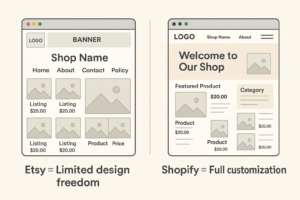
Etsy provides sellers with a handful of basic customization tools that enable them to maintain some level of brand consistency, even within its framework. For instance, you can upload a shop banner, design a simple logo, write strong product descriptions, and organize your listings into neat categories. Furthermore, Etsy has expanded its customization options over the past few years; however, you are still working within Etsy’s design structure.
That means your shop will always carry the familiar Etsy look and feel. This has its pros and cons. On the positive side, buyers instantly recognize how to browse and purchase, which creates trust and makes shopping easy. On the other hand, the downside is that you have less freedom to build a unique brand experience. Because of this, product photography becomes one of the most powerful tools you have on Etsy. In fact, high-quality images often make the difference in whether a shopper clicks into your listing or scrolls past it in search results.
Shopify Design Flexibility
Shopify themes range from free options to premium designs costing several hundred dollars. More importantly, Shopify themes can be customized in detail or even completely rebuilt so they align perfectly with your brand vision. You have control over every part of the customer experience, from the layout of the homepage to the steps in the checkout process.
This flexibility also applies to functionality. Shopify offers thousands of apps that enable you to add features such as product reviews, advanced analytics, subscription services, or complex product configurations. In most cases, there is likely an app that meets your needs, and if not, you always have the option to work with developers to create a custom solution.
The learning curve can be challenging, especially for those without a strong technical background. Still, Shopify’s theme becomes easier to use over time, and many successful store owners begin by making simple adjustments before progressing to more advanced customizations as their business expands.
Feature Comparison Table
| Feature Category | Etsy | Shopify |
|---|---|---|
| Design Flexibility | • Basic customization
• Shop banner and logo • Fixed Etsy template • Limited branding control |
• Full design control
• Customizable themes • Custom code access • Complete brand freedom |
| SEO & Visibility | • Etsy internal search only
• Built-in marketplace traffic • Limited Google visibility • Platform-dependent SEO |
• Full Google SEO control
• Custom meta tags • Independent domain • Blog & content marketing |
| Customer Base | • 90+ million active buyers
• Immediate marketplace access • High competition • Platform owns customers |
• Build your own audience
• Own customer relationships • Email list ownership • Independent traffic required |
| Marketing Tools | • Etsy Ads (PPC)
• Offsite Ads (15% fee) • Basic coupon tools • Social media sharing |
• Email marketing integration
• Abandoned cart recovery • Social commerce (FB, IG, TikTok) • Advanced analytics |
| Product Restrictions | • Handmade items only
• Vintage (20+ years old) • Craft supplies • No mass-produced items |
• Any legal product
• Physical & digital goods • Services & subscriptions • No category limits |
| Customer Support | • Community forums
• Email support • Seller handbook • Response times vary |
• 24/7 phone support
• Live chat • Email support • Shopify Academy |
| Payment Options | • Etsy Payments (required)
• Credit/debit cards • PayPal • Limited alternatives |
• Shopify Payments
• 100+ payment gateways • PayPal, Stripe, etc. • Cryptocurrency options |
| Scalability | • Good for small to medium
• Fees increase with sales • Platform dependency • Limited growth options |
• Unlimited scalability
• Enterprise solutions • Advanced features • Multi-location inventory |
| Analytics & Reporting | • Basic shop stats
• Traffic sources • Search analytics • Limited customization |
• Advanced analytics
• Custom reports • Customer behavior tracking • Integration with Google Analytics |
| Best For | Creative entrepreneurs, artisans, and crafters seeking quick marketplace access | Serious businesses are focused on brand building and long-term growth |
Product Categories and Restrictions
What Sells Best on Etsy?
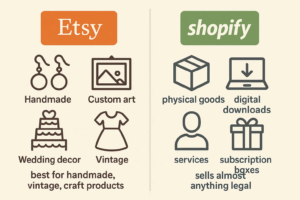
Etsy’s market revolves around creativity and uniqueness, which is why specific categories consistently outperform others. Some of the top-selling categories on Etsy include handmade jewelry and accessories, custom artwork and prints, wedding and party supplies, home decor and furniture, vintage clothing and collectibles, digital downloads and templates, as well as craft supplies and materials.
The platform is clear about its rules and explicitly prohibits mass-manufactured products, although enforcement can sometimes feel inconsistent. For most sellers, success on Etsy stems from offering personalization, custom work, or designs that truly stand out as unique and cannot be easily found elsewhere.
In addition, Etsy is especially well-suited for small businesses, particularly artists, makers, and crafters who want to turn their creative skills into income without having to set up or manage a complicated business infrastructure.
Shopify’s Product Flexibility
Shopify places virtually no restrictions on legal products or services. You can sell:
- Physical products of any type
- Digital downloads and courses
- Services and consultations
- Subscription boxes
- Print-on-demand items
- Wholesale to other businesses
This flexibility allows for business model experimentation and growth into new product categories without platform constraints. Many entrepreneurs begin with one product type and expand into complementary areas as they gain a deeper understanding of their market.
Marketing and SEO Capabilities
Etsy Marketing Tools
Etsy provides several built-in marketing features explicitly designed for its marketplace:
- Etsy Ads: Pay-per-click advertising within Etsy search results and category pages
- Offsite Ads: Etsy promotes your products on Google, Facebook, and other platforms (with a 15% fee on resulting sales)
- Sales and coupon tools: Create discounts to attract buyers
- Social media integration: Share listings directly to Instagram and Facebook
The platform’s marketing tools are most effective when used in conjunction with robust Etsy SEO practices. Indeed, understanding how Etsy’s search algorithm works becomes crucial for organic visibility. However, external marketing remains possible but challenging since you’re directing traffic to Etsy’s domain rather than building your own brand recognition.
Shopify Marketing Advantages
Shopify marketing encompasses the full spectrum of digital marketing strategies:
- Built-in SEO tools: Customize meta titles, descriptions, and URLs for better Google rankings
- Email marketing integration: Connect with services like Klaviyo or Mailchimp
- Social commerce: Sell directly through Instagram, Facebook, and TikTok
- Content marketing: Add blogs and landing pages to your site
- Abandoned cart recovery: Automatically email customers who leave without purchasing
- Advanced analytics: Track customer behavior and marketing performance
The key advantage lies in building your own brand recognition and customer relationships. In other words, every marketing effort strengthens your independent business rather than primarily benefiting a third-party platform.
Long-term Business Growth Potential
Scaling on Etsy
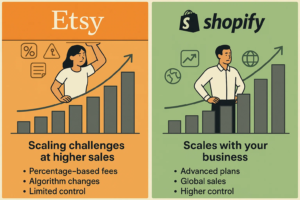
Etsy’s marketplace model creates natural growth limitations. As your business expands, the percentage-based fees become increasingly expensive. For example, a seller doing $100,000 annually might pay $16,000-20,000 in various Etsy fees.
Etsy vs Shopify for growth becomes particularly relevant as businesses mature. In fact, Etsy’s algorithm changes, policy updates, and fee increases directly impact your business without your input or control.
However, some sellers successfully scale by:
- Expanding into wholesale through Etsy’s wholesale portal
- Using Etsy as one channel among several
- Building email lists to maintain customer relationships
- Creating systems for efficient production and fulfillment
Shopify’s Scalability
Shopify grows with your business through increasingly sophisticated features and integrations. Advanced plans include:
- Multi-location inventory management
- Advanced report building
- Third-party calculated shipping rates
- Enhanced security features
- Priority customer support
The platform supports businesses at all levels, from startups to enterprises. Indeed, many successful brands process millions in annual revenue through Shopify, with the platform handling the technical demands of high-volume sales.
Setting up a Shopify store for growth often involves gradually adding functionality as the business expands, spreading costs over time while building increasingly sophisticated operations.
Customer Support and Resources
Etsy Seller Support
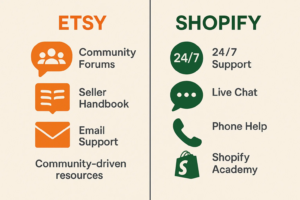
Etsy gives sellers access to community forums, educational articles, and email support. One of its most valuable resources is the Seller Handbook, which covers topics like product photography, Etsy SEO, customer service, and overall business management. These tools can be helpful for new sellers, although direct support may sometimes feel slow when addressing individual issues, and policy enforcement is not always consistent.
The community aspect of Etsy adds another layer of value. In fact, many sellers share their experiences, tips, and advice, which creates a sense of peer-to-peer support. At the same time, you are ultimately reliant on Etsy’s priorities and resources for platform updates and improvements, which means you have less control compared to running your own independent store.
Shopify Support Infrastructure
Shopify provides 24/7 customer support across several channels, including phone, email, and live chat. For sellers looking to learn more about running an online business, Shopify Academy offers in-depth educational resources. Additionally, the platform connects you with certified experts who can provide specialized assistance when needed.
Another strength is Shopify’s vast app space. In essence, there are solutions for almost every business challenge you might face, from marketing automation to inventory management. However, the only drawback is that the sheer number of choices can feel overwhelming for beginners, especially when you are still figuring out which tools are truly essential.
Looking for expert guidance on setting up your online store? Our team specializes in both Etsy automation services and Shopify dropshipping solutions to help maximize your success. Learn more about our Shopify dropshipping options or explore our full range of e-commerce services.
Making Your Decision: Key Factors to Consider
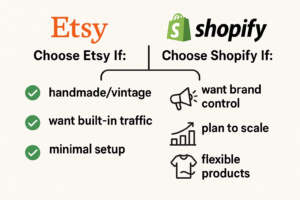
Choose Etsy If You:
- Create handmade, vintage, or craft items that align with Etsy’s marketplace focus
- Want immediate access to motivated buyers without building traffic from scratch
- Prefer minimal technical complexity and are comfortable with platform limitations
- Have limited startup capital and want to test market demand
- Enjoy the community aspect of being part of a creative marketplace
- Don’t mind paying higher fees in exchange for built-in traffic and infrastructure
Choose Shopify If You:
- Want complete control over your brand and customer experience
- Plan to scale beyond hobby-level sales into a substantial business
- Can invest time in learning marketing and basic website management
- Prefer paying fixed monthly costs rather than percentage-based fees
- Want to sell any legal product or service without category restrictions
- Value building your own customer base, independent of third-party platforms
The Hybrid Approach
Many successful sellers choose not to limit themselves to just one platform. A typical path is to start on Etsy, where it is easier to validate products and build those first sales, then expand to Shopify once the business is ready for greater control and lower fees. This approach enables sellers to leverage Etsy’s built-in audience in the early stages, while later utilizing Shopify’s flexibility to scale their brand independently.
This approach allows you to:
- Test products with minimal investment
- Learn e-commerce fundamentals in a supportive environment
- Build capital for a more substantial Shopify investment
- Diversify sales channels for reduced risk
- Gradually transition customers to your independent store
How Much Does It Cost to Start Selling?
Starting an Etsy shop can cost as little as $20 for your initial listings, making it accessible to almost anyone who wants to test their products in an online marketplace. The main expenses are listing fees and transaction costs, which increase as your sales rise.
Shopify startup costs are typically higher, often ranging from $200 to $1,000 in the first month. This normally includes the subscription fee, a basic theme, and a few essential apps. While the upfront investment is larger, it provides the structure and flexibility to run a scalable and fully independent business.
When comparing the two, it is helpful to consider your available capital, personal risk tolerance, and long-term growth goals. Neither platform is automatically better than the other. Etsy and Shopify serve different types of business models, and the best choice comes down to what aligns most closely with your entrepreneurial vision.
Final Recommendations
Deciding between Etsy and Shopify ultimately comes down to what you want out of your business, your comfort level with technology, and where you envision yourself growing. Etsy is an excellent fit for creative entrepreneurs who wish to have quick access to a ready-made marketplace without encountering numerous technical hurdles. On the other hand, Shopify is better suited for ambitious business owners who are ready to invest in long-term brand building and want complete control over their online store.
Start on the platform that feels right for you now, then branch out as your confidence and sales grow. Indeed, many of the most successful online sellers do not lock themselves into just one option. Instead, they use Etsy and Shopify strategically to reach more customers and scale at their own pace.
It is also important to remember that choosing a platform is never set in stone. In fact, many businesses start with Etsy, then transition to Shopify once they are ready to expand into a more advanced setup. What matters most is simply getting started and staying flexible as you learn the ropes.
At the end of the day, your success in online selling will depend less on whether you choose Etsy or Shopify and more on the strength of your products, the quality of your customer service, and your consistency in showing up. Select the platform that best suits your current needs, while always keeping your future growth goals in mind.
Frequently Asked Questions
Q. Can I use both Etsy and Shopify at the same time?
Yes, many sellers successfully operate on both platforms. Etsy can provide initial sales and market validation while you build your Shopify store. However, ensure you can manage inventory and customer service across multiple channels effectively.
Q. Which platform is better for beginners?
Etsy offers a gentler learning curve with built-in traffic and simplified setup processes. In contrast, Shopify requires more initial learning but provides greater long-term growth potential. Your choice depends on whether you prioritize immediate simplicity or long-term control.
Q. How do I migrate from Etsy to Shopify?
Migration involves exporting your customer list (where permitted by law), recreating product listings, and gradually redirecting traffic to your new store. Many sellers maintain their Etsy presence while building their Shopify store to ensure continued sales during the transition.
Q. What are the main disadvantages of each platform?
Etsy’s main limitations include high fees at scale, limited customization, and dependence on platform policy changes. Meanwhile, Shopify’s challenges involve higher technical complexity, the need to build your own traffic, and higher upfront costs.
Q. Which platform has better SEO capabilities?
Shopify offers superior long-term SEO potential since you’re building authority for your own domain. In comparison, Etsy offers immediate visibility within its marketplace, but it provides limited opportunities for Google ranking. Your SEO strategy should align with the strengths of your chosen platform.
Ready to scale your e-commerce business in 2025? Explore our Shopify dropshipping, Etsy automation, and multi-platform management services to maximize growth and profits. Work With Us →
