
Building a profitable 6-figure Etsy shop that generates six-figure revenue is achievable for Etsy sellers who combine creativity with smart Etsy automation tools. With over 95.5 million active buyers on Etsy and successful Etsy shops generating $10,000 or more monthly, the opportunity exists for systematic Etsy business automation.
The data is clear: while the average Etsy seller earns $2,900 per year, successful Etsy sellers and top performers earn $65,000 per month. The difference? They utilize Etsy automation tools to handle repetitive tasks, continuously optimize their Etsy listings, and scale their profitable Etsy shop operations without burning out. This complete guide shows you exactly how to build your six-figure Etsy shop using proven automation strategies for Etsy success.
Understanding the Etsy Marketplace for Automated Success
The Etsy marketplace ecosystem has 8.13 million active Etsy sellers competing for 95.5 million buyers. Building a successful Etsy business requires strategic Etsy shop automation, not just great products. 70% of Etsy sellers now treat their Etsy shops as legitimate businesses, with 89% operating as sole proprietorships.
Six-figure Etsy sellers understand that manual processes don’t scale profitable Etsy shops. They implement automated Etsy systems to handle routine tasks, allowing focus on product development, Etsy SEO strategy, and customer relationships that drive Etsy shop success.
Essential Etsy Automation Tools for Six-Figure Success
Etsy SEO and Listing Optimization Tools
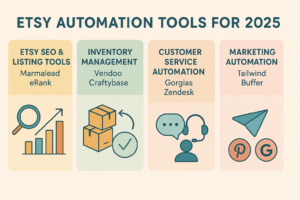
Marmalead ($19/month) automates Etsy keyword research and tracks Etsy search rankings for your Etsy listings. This powerful Etsy SEO tool monitors competitors, identifies trending Etsy keywords, and suggests Etsy listing improvements automatically to boost your Etsy shop’s visibility.
eRank ($5.99/month) provides automated Etsy listing performance tracking, Etsy keyword analysis, and comprehensive Etsy shop analytics. Both Etsy automation tools eliminate manual SEO work while improving search visibility for profitable Etsy shops.
Automated Inventory Management for Etsy Shops
Vendoo ($29/month) syncs Etsy inventory across multiple platforms, prevents overselling situations, and sends automated reorder alerts. This inventory automation tool is essential for Etsy sellers managing high order volumes in their six-figure Etsy business.
Craftybase ($19/month) tracks material costs, calculates true product costs, and manages production workflows for Etsy makers. This Etsy business tool integrates with accounting systems for seamless financial tracking of your profitable Etsy shop.
Automated Customer Service for Etsy Success
Gorgias ($60/month) handles routine Etsy customer inquiries, routes complex issues to humans, and maintains professional response templates. This customer service automation integrates with your Etsy shop to provide a complete customer history and enhance Etsy seller efficiency.
Zendesk ($19/month per agent) provides professional ticketing systems, automated escalation workflows, and performance analytics. This platform scales Etsy customer service without adding staff, crucial for six-figure Etsy shop operations.
Etsy Marketing Automation Tools
Tailwind ($12.99/month) automates Pinterest posting schedules, optimizes pin timing, and tracks marketing performance. This marketing automation tool is crucial for Etsy sellers, as Pinterest generates substantial traffic to profitable Etsy shops.
Buffer ($6/month per channel) schedules social media posts across platforms, analyzes marketing performance, and maintains a consistent brand presence for your Etsy automation strategy.
Advanced Etsy Automation Strategies for Six-Figure Growth
Multi-Channel Integration for an Automated Etsy Business
Successful six-figure Etsy sellers use automation tools to manage operational complexity while expanding beyond the Etsy marketplace.
- Amazon Handmade integration for broader market reach and automated inventory sync
- Facebook/Instagram Shopping automation for social commerce expansion
- Automated Etsy website integration for higher profit margins and customer control
Advanced Etsy automation tools, such as Vendoo, sync inventory across platforms, while automated pricing algorithms adjust for varied audiences, maximizing the revenue of your successful Etsy shop.
Production and Fulfillment Automation for Etsy Shops
Printful and other print-on-demand automation services handle the creation and shipping of your Etsy orders for you. Third-party logistics (3PL) companies handle warehousing and fulfillment automation for physical items on Etsy.
Automated production planning systems generate schedules based on Etsy orders, track completion status, and trigger shipping notifications without manual intervention, which is essential for scaling your six-figure Etsy shop operations.
Financial Management Automation for Profitable Etsy Shops
QuickBooks integration brings in sales data from Etsy, sorts transactions into categories, and makes financial reports for your Etsy business. BeProfit and other profit analytics automation tools figure out how much money you really make, taking into account all of your Etsy fees and costs.
Automated financial dashboards display Etsy’s sales, profit margins, and cash flow in real-time. These are important numbers for running a successful six-figure Etsy business.
Real Six-Figure Etsy Success Stories Using Automation
Sarah’s Automated Personalized Gift Etsy Shop: $150K Annual Revenue
Challenge: Manual design processes limited her Etsy shop’s capacity to 10 custom orders per week, preventing her from achieving a six-figure success on Etsy.
Etsy Automation Solution:
- Created customizable templates with automated personalization tools for faster Etsy order processing
- Implemented automated Etsy order intake and proof generation systems
- Added customer service chatbots for routine Etsy inquiries
Results: Sarah’s automated Etsy shop now processes 200+ orders monthly with the same time investment. Her profitable Etsy business revenue grew from $ 45,000 to $ 150,000 annually, with 45% profit margins achieved through strategic Etsy automation.
Mike’s Vintage Jewelry: $200K Annual Revenue
Challenge: Manual inventory tracking and individual item listing are limited in scale.
Solution:
- Automated sourcing alerts from estate sales
- Batch photography with standardized editing
- Multi-platform inventory sync
- Dynamic pricing based on market conditions
Results: 10x inventory processing capacity. Multi-platform expansion tripled the addressable market. Revenue increased from $ 25,000 to $ 200,000 in two years.
Lisa’s Digital Planners: $300K Annual Revenue
Challenge: Manual file delivery and customer service limited growth.
Solution:
- Automated digital delivery upon purchase
- Email sequences for onboarding and upselling
- Template-based design system for rapid product creation
- Automated social media and email marketing
Results: Complete fulfillment automation. The product catalog has been expanded from 12 to over 200 items, with 85% profit margins and $ 300,000 annual revenue.
Implementation Roadmap
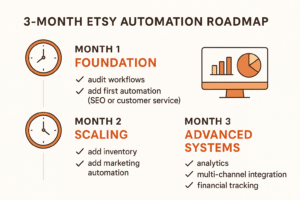
Month 1: Foundation
- Week 1: Audit the current processes and identify the biggest time drains.
- Week 2: Implement the first automation tool (typically SEO or customer service).
- Week 3: Optimize workflows, document processes.
- Week 4: Add a second automation system, measure time savings.
Month 2: Scaling
- Weeks 5-6: Add inventory management and marketing automation
- Week 7-8: Implement multi-channel integration if applicable
Month 3: Advanced Systems
- Week 9-10: Advanced marketing automation and analytics
- Week 11-12: Financial tracking and seasonal optimization
- Week 13: Review results, plan next phase
Common Pitfalls
Over-Automation Without Strategy
Do not implement tools without first understanding your processes. Start with one automation, prove it works, then expand systematically.
Losing Personal Touch
Automate operational tasks, not relationship building. This saved time for meaningful customer interactions and creative work.
Poor Quality Control
Build monitoring into automated processes. Set up alerts for quality issues and conduct regular manual reviews to maintain quality control.
Technology Dependence
Maintain backup plans and establish manual alternatives for critical processes to ensure continuity. Document all processes and diversify your tool stack.
Key Performance Indicators
Track these metrics to measure automation success:
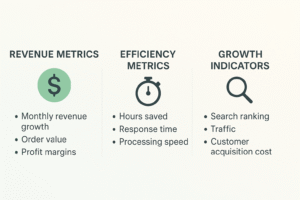
Revenue Metrics:
- Monthly recurring revenue growth
- Average order value increases
- Customer lifetime value
- Profit margin improvements
Efficiency Metrics:
- Hours saved per week
- Error rate reductions
- Customer response times
- Order processing speed
Growth Indicators:
- Search ranking improvements
- Organic traffic growth
- Customer acquisition cost
- Market expansion success
Tool Investment Guide
Starter Level ($50-100/month):
- Basic SEO tool (eRank)
- Simple inventory alerts
- Email templates
- Social media scheduler
Growth Level ($200-400/month):
- Advanced SEO (Marmalead)
- Professional inventory management (Vendoo)
- Marketing automation (Mailchimp)
- Customer service platform (Freshdesk)
Scale Level ($500-1000/month):
- Enterprise inventory (TradeGecko)
- Advanced customer service (Gorgias)
- Comprehensive analytics
- Multi-channel integration
ROI typically exceeds 300% within 6 months for properly implemented systems.
Advanced Growth Strategies
International Expansion
Use automated translation services, currency conversion, and international shipping tools to access global markets. Many six-figure sellers generate 30-50% of their revenue internationally.
Seasonal Optimization
Automated demand forecasting predicts inventory needs. Scheduled marketing campaigns launch seasonal promotions without manual management.
Partnership Automation
Automated influencer outreach, affiliate management, and cross-promotion networks efficiently expand reach.
Future Trends
AI Integration: Predictive analytics, automated content creation, and dynamic optimization will provide competitive advantages.
Voice Commerce: Optimize for voice search as smart speakers enable voice shopping.
Sustainability Automation: Track and communicate environmental impact as consumers prioritize responsible businesses.
Conclusion: Your Path to Six-Figure Etsy Success Through Automation
Building a six-figure Etsy shop with automation tools is more than a possibility; it’s a tried-and-true method that hundreds of successful Etsy sellers have already mastered. This comprehensive guide provides you with all the techniques, tools, and procedures necessary to transform your creative passion into a thriving, six-figure Etsy business.
There is considerable evidence that Etsy sellers who utilize strategic automation outperform those who complete tasks manually. The case studies demonstrate that setting up Etsy automation correctly can significantly increase revenue while reducing the time required for manual tasks. For example, Sarah’s personalized gift shop made $150,000, and Lisa’s digital planner business made $300,000.
Key Takeaways for Your Automated Etsy Business Success:
Start strategically: Don’t try to automate everything at once; it will be overwhelming. Begin with your most time-consuming task, such as Etsy SEO optimization, customer support, or inventory management, and work your way up to automating these tasks.
Invest wisely: Within 90 days, your Etsy automation tools should pay for themselves by saving you time and improving your work. The $200 to $400 a month spent on professional automation solutions is less than 1% of a six-figure income, but it gives you a lot of operational leverage.
Maintain quality: Before scaling up, ensure your foundation is strong, as automation enhances your current processes. Successful six-figure Etsy sellers utilize automation to manage everyday tasks while maintaining the human touch that distinguishes their brand.
Think long-term: Building a six-figure Etsy business through automation takes time. Sellers who want to be successful for a long period focus on creating systems that improve over time, rather than seeking short-term fixes.
Frequently Asked Questions
Q 1: How much can you realistically make with an automated Etsy shop?
A: Sellers who use professional automation usually make between $5,000 and $15,000 a month in their first year. The best shops generate $20,000 to $50,000 per month, and some even earn more than $100,000 per month. The results depend on the niche, the quality of the product, and the effectiveness of the automation strategy.
Q 2: What’s the total investment for automation tools?
A: For basic automation, you need to pay $50 to $100 a month for the most important tools. Intermediate configurations cost $200 to $400 per month and enable most vendors to grow their businesses to $100,000 per year. Advanced systems for sellers who earn six figures a year typically cost between $500 and $1,000 per month, but they account for only 1–2% of gross income and provide significant operational leverage.
Q 3: How long to see results from automation?
A: You can see time savings in the first week. Optimized listings typically begin to generate more revenue within 30 to 60 days. Many businesses undergo significant changes in the first 6 to 12 months after full adoption, when many sellers double or triple their sales while spending less time on them.
Q 4: Can automation handle Etsy’s creative and personal aspects?
A: Automation takes care of things like keeping track of inventory, processing orders, and answering routine questions, but people still make creative decisions and build relationships with customers. Successful sellers utilize automation to free up more time for creative work and foster meaningful relationships with customers.
Q 5: What if automation tools fail?
A: Professional sellers have backup plans that include using a variety of tools, keeping manual procedures for important tasks, backing up data routinely, and writing down all of their operations. The idea is to manage the risks associated with technology while reaping significant growth benefits.
