
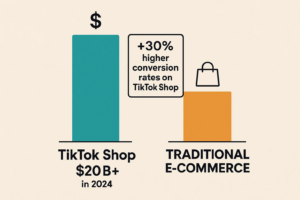
Learning how to scale TikTok Shop sales with paid ads has become the golden ticket for e-commerce businesses looking to capitalise on the platform’s explosive growth. TikTok Shop generated more than $33.2 billion in gross merchandise value globally in 2024, which shows just how massive this social commerce opportunity really is. Brands that know how to run TikTok Shop paid advertising campaigns the right way are already seeing conversion rates that outperform traditional e-commerce channels by 30% or even higher.
The reason TikTok Shop stands out is because of its seamless mix of entertainment and shopping. Unlike other e-commerce platforms where buyers have to leave the app to finish a purchase, TikTok keeps the entire process in one place. That simple difference is what makes it so powerful. It allows businesses to capitalize on impulse buying behavior in the exact moment when users are already entertained, engaged, and primed to shop.
But here is the reality. Just pouring money into TikTok ads for e-commerce will not guarantee success. The algorithm does not reward lazy campaigns. What actually works is a TikTok Shop ads strategy that combines creative storytelling with a smart, data-driven approach. Businesses that align their content with trending formats and track their metrics closely are the ones that scale faster.
Whether you are new to TikTok Shop or already building momentum, mastering TikTok Shop marketing strategies for 2025 is key to achieving modest results or unlocking explosive growth. Sellers who adapt quickly and consistently update their testing, content creation, and optimization strategies are the ones who win long-term.
6 Proven Methods to Scale TikTok Shop Sales with Paid Ads
Method 1: The Product Seeding Strategy
Start by identifying your 3 to 5 bestsellers and build separate campaigns for each one. This kind of TikTok Shop campaign optimization allows you to test the waters before scaling. A simple testing budget of $20 to $50 per day spread across different consumer categories is enough to figure out which product and audience combinations perform best.
When setting up your first tests, begin with a broad interest that relates directly to your product group. For example, if you are selling fitness equipment, you could target audiences interested in “fitness,” “home workouts,” and “health and wellness.” Run these experiments for 5 to 7 days to gather enough data, and then narrow down which products and audiences deliver the lowest cost per acquisition.
Once you know what is working, the next step is to scale carefully. Increase your daily budgets by around 20 to 25% every 2 to 3 days. This controlled TikTok ad scaling strategy gives the algorithm time to adjust without disrupting performance, which helps bring in steady, profitable traffic. It is the same approach that many top TikTok Shop sellers use to move from spending just $100 a day on ads to comfortably managing more than $1,000 a day while keeping returns strong.
Method 2: The UGC Amplification Method
One of the most effective ways to scale TikTok Shop conversions is by leaning into user-generated content. UGC has the kind of authenticity that buyers connect with, because seeing real people enjoying a product feels more genuine than a polished brand ad. A simple yet powerful strategy is to encourage your existing customers to create short TikTok videos showcasing your products. To keep them motivated, consider offering small rewards like discounts, gift cards, or running contests where winners receive something special.
Aim to gather 10 to 15 solid pieces of user-generated content, then take the next step by running TikTok’s Spark Ads. The Spark Ads format is especially effective because it boosts posts that already have traction, meaning they come with built-in engagement. On top of that, Spark Ads are usually 30 to 50 percent cheaper than traditional campaigns since they rely on social proof.
From there, create 3 to 5 UGC ads for TikTok videos for each campaign and target the same audience. Track which video gets the most clicks and promote it as your main creative. Keep the other ones in your back pocket as backups if results dip. The key here is freshness, so swap out your creatives every week to keep your audience entertained and prevent ad fatigue.
Method 3: The Funnel-Based Scaling Approach
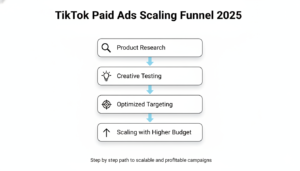
The funnel-based TikTok Shop targeting strategy for 2025 is all about guiding cold audiences through multiple stages until they are ready to buy. Think of it as a structured journey: awareness, consideration, and conversion.
Start with awareness campaigns. These focus on broad targeting and engaging content that gets people to notice your business. Dedicate about 40% of your ad budget here. At this stage, it is less about making instant sales and more about capturing people’s attention with engaging, scroll-stopping videos.
Next are consideration campaigns. Here, you shift gears and show product demos, testimonials, or highlight clear benefits. These ads target people who have already interacted with your awareness content, and you should put about 35% of your budget here. The primary goal is to drive traffic to your TikTok Shop and boost email list sign-ups.
Finally, conversion campaigns are where you close the deal. These focus on direct offers, limited-time discounts, or urgency-driven messages targeting warm audiences. That includes people who have already visited your website, signed up for your email, or even made a purchase. Set aside 25% of your budget for these groups, because they often convert 3 to 5 times better than cold traffic.
Method 4: The Creative Testing Matrix
To keep TikTok Shop sales growth steady, you need a constant flow of fresh content. That is where the TikTok Shop creative testing strategy comes into play. It is a systematic way to experiment with ad variables while controlling performance.
Create a comprehensive testing matrix that includes five key elements: the hook (the product’s critical first three seconds), product demonstration, background music, on-screen text overlay, and the call to action. Keep everything else consistent, and test one variable at a time.
Run three or four ad variations simultaneously with daily budgets of $30 to $50. After 48 to 72 hours, cut the ads that are underperforming and double down on the versions that resonate. This cycle keeps your ad strategy fresh as you scale, ensuring you don’t waste budget.
To make the process even easier, track winning creative patterns in a spreadsheet. Note down what type of hooks work, which music styles fit, and which calls to action lead to conversions. Later, when you need to pump out new content quickly, you will already have a bank of proven creative directions to pull from.
Method 5: The Lookalike Expansion Strategy
When you are ready to expand your TikTok Shop reach, similar audiences are a goldmine. This strategy leverages data from your top customers to identify new prospects with similar habits and interests.
Start by uploading your top 20% of customers based on order value to create a strong seed audience for TikTok lookalike modeling. From there, generate 1%, 2%, and 5% lookalike audiences. The 1% audience will be the most similar but smaller, while the 5% audience gives you a wider net. Use the same creatives and budgets across each test to pinpoint which percentage drives the highest ROI.
Once you identify your sweet spot, take it further by creating additional lookalike audiences based on customer groups like high lifetime value buyers, recent purchasers, or even those who bought a specific type of product. Done right, this method can expand your target audience by 5 to 10 times while still maintaining strong conversion quality.
Method 6: The Seasonal Scaling Method
TikTok thrives on trends, so it only makes sense to scale your TikTok Shop campaigns around seasonal spikes. With this TikTok Shop seasonal ad strategy, you can ride viral moments and key buying seasons to maximize results.
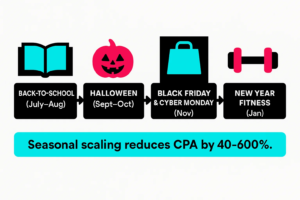
Use TikTok Business Creative Hub to find trending hashtags, seasonal challenges, and viral content ideas that fit your niche. Then, build campaigns around high-intent shopping periods. Some of the most profitable times include back-to-school in July and August, Halloween in September and October, and of course, big sales events like Black Friday and Cyber Monday. Do not forget the New Year fitness boom either, as TikTok always lights up with health-related trends after the holidays.
During these peak times, increase your ad budget by 30 to 50 percent. Because users are already primed to buy, these seasonal campaigns often lower your acquisition costs by 40 to 60 percent compared to regular campaigns. To maximize impact, blend your product promotions with trending effects, popular sounds, or relevant challenges so your ads feel native to the platform.
Essential Tools and Platforms for TikTok Shop Advertising
TikTok Ads Manager Setup and Navigation
TikTok Ads Manager serves as your primary command center for all TikTok Shop paid advertising initiatives. You can visit ads.tiktok.com and link it directly to your TikTok Shop account for seamless integration of your product inventory. The UI has everything you need to make a campaign, learn about your audience, get creative, and analyze your performance all in one place.
As soon as you make an account, set up TikTok Pixel tracking. You put this tracking code on your website and TikTok Shop pages to track metrics like page views, add-to-carts, and transactions. You can’t track conversions or make retargeting audiences if your pixels aren’t set up correctly.
TikTok Business Creative Hub is a place for advertisers to find trendy sounds, hashtags, and creative ideas. Use this tool once a week to discover viral content opportunities and stay ahead of platform trends that can significantly reduce your advertising costs.
Campaign Structure and Ad Set Organization
Use TikTok’s three-tier structure to plan your campaigns: Campaign (goal), Ad Group (budget and targeting), and Ad (creative content). This hierarchy lets you control spending and improve performance with great accuracy.
Your main goal (Traffic, Conversions, App Installs), your overall budget, and the dates of your campaign are all part of the campaign-level parameters. For TikTok Shop sales, choose “Conversions” to ensure ads are delivered to the people most likely to make a purchase.
Ad Group level controls include targeting parameters, TikTok Shop bidding strategies, budget allocation, and ad placement. Create separate ad groups for different types of people, products, or locations. This detailed method makes it easier to analyze and improve performance.
Your creative material, headlines, and call-to-action buttons are all in individual ads. To find the best advertising and keep your creativity fresh, test 3–5 commercials in each ad group.
Advanced Targeting Strategies and Tools
TikTok lets you target people based on their age, gender, geography, interests, behavior, and custom or lookalike audiences. The platform’s machine learning works best when it starts with a broader objective and then gets more specific based on the job it performs.
You can retarget people based on their visits to your website, use of your app, customer lists, or TikTok involvement with specialized audiences. You can make “Customer File” audiences by uploading email lists or phone numbers of your customers. This lets you target current customers with new items or upsells.
Lookalike audiences locate people who are like your best customers. Make seed audiences from your top 20% of clients who are worth the most, and then test 1%, 2%, and 5% similarity levels to discover the right balance between quantity and quality.
Behavioral targeting examines how people interact with TikTok to identify those most likely to make a purchase. Target individuals who have made purchases on the app, engaged with shopping content, or followed e-commerce profiles.
On TikTok, interest targeting works differently than it does on other sites. TikTok doesn’t ask users about their hobbies; instead, it figures them out based on their behavior, engagement with content, and the number of accounts they follow. Begin with broad interest groups and then narrow them down based on their performance.
TikTok Shop Bidding Strategies and Budget Optimization Tools
There are four basic ways to bid on TikTok: Cost Cap, Bid Cap, Lowest Cost, and Lowest Cost with Bid Cap. For TikTok Shop campaigns, start with “Lowest Cost” so that the algorithm has the most freedom to locate conversions that make money.
Once you know how much you want to spend to attract a new customer, cost cap bidding works nicely. Set your cap at 80% of your break-even point so that you can still make money while the algorithm has room to improve.
Campaign budget optimization (CBO) and ad group budget control are two examples of budget allocation technologies. CBO automatically divides the budget among ad groups based on their performance, while customized budgets allow you to manage your exact spending.
Automatic bidding usually works better than manual bidding for new advertisers since TikTok’s algorithm knows more about how users behave and how likely they are to convert than any one marketer does.
Specific Ad Set Strategies for Maximum Performance
Audience Segmentation and Testing Framework
Create different ad sets for cold audiences (those who have never engaged with your business), warm audiences (people who have visited your website or watched your videos), and hot audiences (people who have left their carts or bought anything from you before). Different innovative messages and bidding methods are needed for each group.
Ad settings for a cold audience should focus on identifying pain points and introducing the product. Use broader targeting with content that is interesting and informative, but doesn’t try to sell right away. About 50 to 60% of the overall budget should be allocated to this.
Ad sets for warm audiences can be more straightforward about the benefits of a product and contain reviews or testimonials from customers. Since these visitors have already shown interest, messages that focus on conversion work better. Budgeting: 25–35% of overall spending.
Ad settings for hot audiences should emphasize urgency, exceptional deals, and address common reasons why people hesitate to buy. These highly qualified leads often turn into customers at rates 3 to 5 times higher than cold traffic. You should allocate 10 to 15% of your total budget to them.
Geographic and Demographic Targeting Tactics
Start with tier-1 markets (big cities) where TikTok Shop is most popular and shipping is most reliable. Only move into tier-2 and tier-3 markets when you have shown that you can make money in your main markets.
Age targeting should match the demographics of your product, but keep in mind that TikTok has a lot of younger users. Even if your product typically targets older adults, consider the 18–34 age group, as TikTok users often purchase gifts for others.
Targeting by gender can have a significant effect on expenses and conversion rates. Try out both broad targeting and gender-specific ad packages. TikTok’s algorithm can identify audiences that are more profitable than you thought.
Time-based targeting lets you choose when your ads show up. Review your TikTok Shop sales statistics to identify peak buying times, and then target your ads during these periods.
Creative Rotation and Testing Strategies
Use methodical creative testing to keep up your performance as you grow. People who use TikTok view a lot of content every day, so creative fatigue is always a problem that needs to be dealt with before it happens.
A/B testing frameworks should only change one thing at a time by running the same ads with various hooks, background music, or call-to-action buttons. To find out what makes anything work, change only one thing at a time.
Organizing a creative asset collection helps keep things consistent and lets you test things quickly. When creating new versions, store effective hooks, music tracks, visual elements, and messages in structured files for easy access.
During testing phases, performance monitoring needs to be done every day. If your ads stop working after 48 to 72 hours, pause them and create new creative variations to keep your campaign running smoothly.
Have questions about implementing these strategies for your business? Contact our team of experts who specialize in TikTok Shop optimization and can provide personalized guidance.
Campaign Launch and Optimization Workflow
Pre-Launch Checklist and Setup Process
First, we need to optimize the TikTok Shop product inventory. Ensure that all your products feature high-quality vertical videos, engaging descriptions, competitive prices, and clear shipping information. Even the strongest advertising strategies will fail if the product listings are bad.
Using TikTok’s debugging tools to check the installation of pixels makes sure that conversion tracking works from day one. Make a test purchase through your TikTok Shop to make sure that all events fire successfully.
When preparing creative assets, you should have 10 to 15 different videos ready to test. Having multiple creative assets ready prevents campaign delays when the first ads need to be changed due to non-performance or rule violations.
To design your TikTok Shop paid ads budget strategy, you need to figure out your maximum cost per acquisition based on product margins and the value of a customer during their lifetime. This formula finds the number of bids that can be kept and the points at which they can be scaled.
Week 1-2: Learning Phase Management
For new campaigns, TikTok’s learning phase usually lasts between 24 and 48 hours. Avoid making significant changes to targeting, finances, or creative elements at this time, as they reset the learning process and slow down optimization.
Keep an eye on essential numbers, but don’t get too worked up over short-term changes. Instead of focusing on daily performance swings, which are natural during the learning phase of an algorithm, examine patterns over 3 to 5 days.
You should wait at least 5 to 7 days to see how well campaigns are doing before making scaling decisions. Scaling too soon can disrupt optimization and unnecessarily increase costs.
Week 3-4: Performance Optimization and Scaling
Look at the cost per acquisition, return on ad spend, and conversion volume over the last 14 days to find the ad sets that are working well. Top performers may secure larger budgets and attract more viewers to their videos.
For winning campaigns, the scaling strategy calls for budget increases of 20–25% every 2–3 days. Bigger changes typically make performance less stable, meaning you have to restart the optimization process.
As successful advertising starts to exhibit signs of fatigue, like lower click-through rates or higher expenses, it’s essential to schedule creative refreshes. Create a plan for weekly creative updates across all your active campaigns.
Setting Up Your TikTok Shop for Paid Advertising Success
Before diving into TikTok Shop marketing 2025 campaigns, ensure your TikTok Shop foundation is solid. This means having a complete business profile, high-quality product listings, and clear brand messaging that resonates with TikTok’s audience.
Your product catalog should be optimized not just for search, but for TikTok’s unique visual format. Think vertical videos, eye-catching thumbnails, and descriptions that speak the platform’s language. Remember, TikTok users expect authenticity and creativity, not polished corporate messaging.
Setting up proper tracking is essential from day one. TikTok’s Pixel integration allows you to track user actions across your entire sales funnel, from initial ad view to final purchase. This data becomes invaluable for optimizing your campaigns and understanding which creative elements drive the best results.
Whether you’re just starting out or looking to scale, our comprehensive e-commerce solutions can help you build a strong foundation for TikTok Shop success.
Product pricing strategy on TikTok Shop requires careful consideration. The platform’s audience is price-sensitive and frequently compares prices. However, they’re also willing to pay premium prices for products that offer clear value or solve specific problems they relate to.
Creating High-Converting TikTok Shop Ad Campaigns
The most successful TikTok Shop advertising campaigns start with understanding the platform’s unique content culture. Users come to TikTok to be entertained, not sold to, so your ads need to feel like natural content that happens to feature your products.
User-generated content (UGC) style ads consistently outperform polished, studio-produced content on TikTok. These ads feel authentic and trustworthy because they mirror the organic content users already engage with. Consider working with micro-influencers or encouraging existing customers to create content featuring your products.
Video length matters more than you think. While TikTok allows longer videos, ads that get to the point within the first 3 seconds perform better. The platform’s users have short attention spans, and if you don’t hook them immediately, they’ll scroll past.
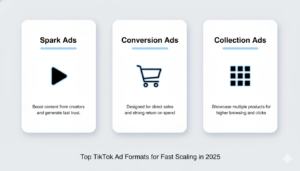
Testing different best TikTok Shop ad formats for sales is crucial for finding what works for your specific products and audience. In-Feed ads work well for demonstrating product benefits, while TopView ads are excellent for brand awareness campaigns. Spark ads, which promote existing organic posts, often deliver the best ROI because they leverage content that’s already proven to resonate with users.
Advanced Targeting Strategies for Maximum ROI
TikTok’s targeting capabilities have become increasingly sophisticated, allowing advertisers to reach users based on interests, behaviors, and even lookalike audiences based on existing customers. The key is finding the sweet spot between broad enough reach and specific enough targeting to drive conversions.
Interest-based targeting on TikTok goes beyond simple demographics. The platform tracks user engagement patterns, including the types of content they interact with, the hashtags they follow, and the sounds they use in their own videos. This behavioral data creates opportunities for highly relevant ad targeting.
Lookalike audiences have proven particularly effective for TikTok Shop campaigns. By uploading your best customer data, TikTok can find users with similar characteristics and behaviors. Start with your highest-value customers for the seed audience, as this typically produces the best results.
Custom audiences allow you to retarget users who have already interacted with your brand, whether through website visits, app engagement, or previous TikTok interactions. These warm audiences often convert at higher rates and require different messaging than cold audiences.
Geographic targeting shouldn’t be overlooked, especially for businesses with physical locations or region-specific products. TikTok’s location-based targeting is quite precise and can help you focus your ad spend on areas where your products are most likely to resonate.
Budget Optimization and Bidding Strategies
Getting your bidding strategy right on TikTok can make or break your campaign’s profitability. The platform offers several bidding options, each suited to different campaign objectives and business goals.
Cost per click (CPC) bidding works well when you’re focused on driving traffic to your TikTok Shop. This approach gives you control over how much you’re willing to pay for each click, making it easier to maintain profitability margins.
Cost per thousand impressions (CPM) bidding is ideal for brand awareness campaigns where your goal is maximum reach rather than immediate conversions. This strategy works particularly well for new brands looking to establish a presence on the platform.
Optimized cost per mille (oCPM) bidding, TikTok’s recommended option for most campaigns, uses machine learning to automatically optimize your bids for the best possible results within your budget constraints. This approach often delivers better results than manual bidding, especially for newer advertisers.
Daily budget allocation should account for TikTok’s learning phase, which typically lasts 24-48 hours for new campaigns. During this period, the algorithm gathers data about your audience and optimizes delivery. Changing budgets or targeting too frequently during this phase can reset the learning process.
Have questions about implementing these strategies for your business? Contact our team of experts who specialize in TikTok Shop optimization and can provide personalized guidance.
Creative Best Practices That Drive Sales
The creative elements of your TikTok ads often determine success more than targeting or bidding strategies. TikTok users expect content that feels native to the platform, which means embracing the raw, authentic aesthetic that dominates organic content.
Hook viewers within the first three seconds with compelling visuals or statements. This might be a surprising product demonstration, a relatable problem statement, or an eye-catching transformation. Remember that users are scrolling quickly, and you need to stop them in their tracks.
Storytelling works exceptionally well on TikTok. Instead of simply showcasing product features, tell a story about how the product fits into someone’s life or solves a specific problem. This narrative approach creates emotional connections that drive purchasing decisions.
Music and sound effects play a crucial role in TikTok content engagement. Use trending sounds when appropriate, but ensure they align with your brand message. Original audio can also work well if it’s catchy and memorable.
Text overlays help communicate key messages even when users are watching with sound off. Keep text concise and use fonts that are easy to read on mobile devices. Avoid cluttering the screen with too much text, as this can make content feel overly promotional.
Measuring Success and Optimizing Performance
Tracking the proper metrics is essential for understanding campaign performance and making data-driven optimization decisions. TikTok’s advertising platform provides comprehensive analytics, but knowing which metrics matter most for your business goals is crucial.
Return on ad spend (ROAS) remains the most important metric for e-commerce campaigns. Calculate this by dividing revenue generated by ad spend. A ROAS of 3:1 or higher is generally considered suitable for most industries, though this varies based on profit margins and business models.
Click-through rates (CTR) indicate how compelling your creative content is to users. Higher CTRs typically correlate with better ad performance and lower costs. If CTR is low, focus on improving your creative elements rather than adjusting targeting or bidding.
Conversion rate optimization tells you how well your TikTok Shop listing and checkout process are working. Low conversion rates despite high click-through rates often indicate issues with product presentation, pricing, or the purchase process itself.
Cost per acquisition (CPA) helps you understand the actual cost of acquiring new customers through TikTok ads. This metric is significant for budgeting and determining the scalability of your campaigns.
Video engagement metrics like average watch time and completion rates provide insights into content quality. Videos with higher engagement rates typically receive better ad delivery and lower costs from TikTok’s algorithm.
Common Mistakes to Avoid
When businesses start using TikTok Shop ads, they often make the same mistakes. Avoiding these frequent mistakes can save you a lot of time and money, helping you reach your goals faster.
Because TikTok is all about being real, content that is too polished frequently doesn’t fare well there. People can easily tell when an ad has been overproduced, and they usually just scroll over it. Use the style of raw, user-generated content that works best on the site.
If you don’t optimize for mobile, you’re making a big mistake because almost all TikTok use happens on mobile devices. Ensure that your TikTok Shop, including listings, purchase process, and linked landing pages, functions flawlessly on smartphones.
If you target too narrowly, your campaign won’t be able to reach as many people, and it may cost more. It makes sense to target specific groups, but TikTok’s algorithm frequently works better with larger groups, especially when you’re first starting.
The system can’t optimize delivery correctly if you change campaigns too often. Before making significant changes to targeting, finances, or creative components, give campaigns at least 48 to 72 hours to collect enough data.
Ignoring sound design means missing an essential part of engagement. TikTok is primarily a platform for audio and video content; therefore, advertisements with poor audio quality often perform poorly. The platform’s algorithm still takes audio interaction into account when deciding how to distribute content, even if viewers watch with the sound off.
Future Trends and Opportunities
TikTok Shop is changing quickly, with new features and chances popping up all the time. If you stay ahead of these trends, your firm will keep growing in 2025 and beyond.
As TikTok expands its live shopping services, integrating live shopping is becoming increasingly important. Brands that excel at live selling often achieve higher sales and foster stronger customer relationships. Consider incorporating live product demos or question-and-answer sessions into your marketing plan.
TikTok’s advertising platform has improved its targeting and bidding capabilities due to advancements in artificial intelligence and machine learning. These new technologies will likely improve campaign effectiveness and reduce the need for manual tuning.
Augmented reality (AR) tools for visualizing products are growing, giving shoppers new options to “try before they buy.” Beauty, fashion, and home décor firms are well positioned to take advantage of these new features.
As TikTok Shop becomes available in more places, there are more chances for cross-border e-commerce. This allows businesses to reach people all around the world without having to deal with complicated logistics or currency issues.
Ready to take your TikTok Shop to the next level with professional management and optimization? Discover our specialized TikTok marketing services designed to maximize your sales and streamline your operations.
Conclusion
Learning how to scale TikTok Shop sales with paid ads in 2025 has become one of the biggest game changers in e-commerce advertising. The sellers who take time to master TikTok Shop marketing strategies are the ones setting themselves up for real growth, because the platform continues to blend entertainment, product discovery, and seamless shopping in a way no other competitor has matched.
The real difference comes from how you approach it. Success is not about guessing or overspending but about testing, optimizing, and scaling with proven methods. Whether you lean into UGC amplification, build out a funnel-based targeting approach, or ride seasonal scaling strategies, TikTok Shop gives you tools that can adapt to almost any business model. With global expansion and AI-powered ad improvements, the window of opportunity for sellers has never looked bigger.
If your goal is to maximize TikTok Shop ROI, avoid the usual mistakes, and get faster results, now is the right time to move. Start with small, manageable campaigns, scale them step by step, and regularly refresh your creative content to keep it relevant and engaging. The businesses that take action today are the ones that will dominate tomorrow.
Frequently Asked Questions
Q. How much does it cost to run TikTok Shop ads for beginners?
TikTok Shop advertising campaigns can start as low as $20 per day, making it accessible to businesses of all sizes. The minimum campaign budget is $50 total, with $20 daily minimums for most ad formats.
Q. What are the best TikTok Shop ad formats for sales?
In-Feed ads typically perform best for direct sales because they appear naturally in users’ feeds and include clear call-to-action buttons. Spark ads that promote existing high-performing organic content often deliver the highest return on investment.
Q. How can you effectively increase TikTok Shop ROI with ads?
Most campaigns show initial results within 24-48 hours, but meaningful optimization data typically requires 5-7 days of consistent spending. Complete campaign optimization usually occurs within 2-3 weeks of consistent operation.
Q. Can small businesses compete with larger brands on TikTok Shop?
Yes, TikTok’s algorithm prioritizes content quality and relevance over brand size or advertising budget. Smaller companies often outperform larger competitors by creating more authentic, relatable content that resonates with specific audience segments.
Q. What products work best with scaling TikTok Shop ads step by step?
Visually appealing products that demonstrate clear benefits, solve specific problems, and perform well. Beauty products, gadgets, fashion items, and problem-solving tools consistently show strong performance, but almost any product can succeed with the right creative approach.
Ready to transform your TikTok Shop performance with expert guidance and proven strategies? Get started with our specialized e-commerce solutions and join the businesses already scaling successfully on the platform.
