
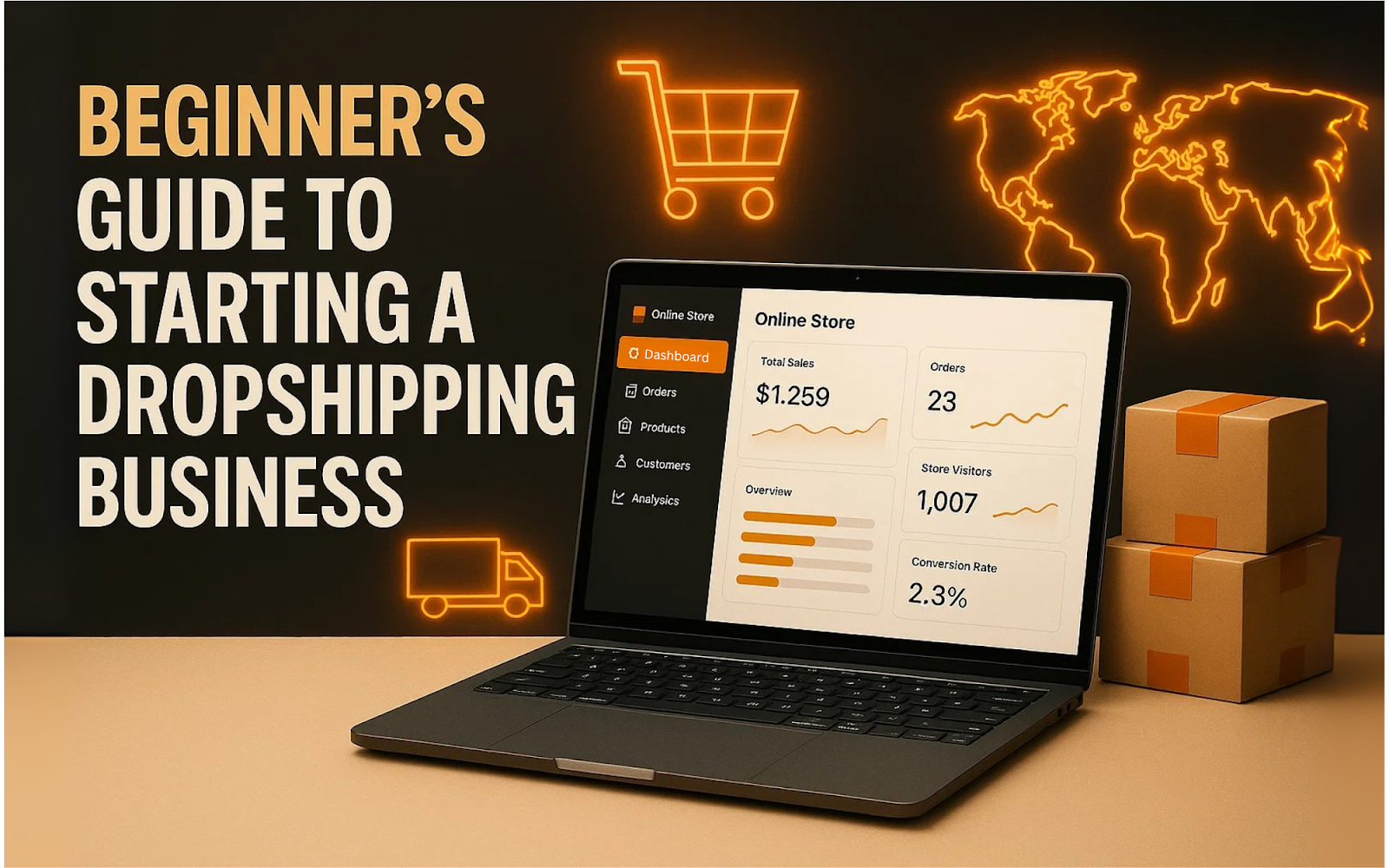
Starting a Dropshipping Business in 2025
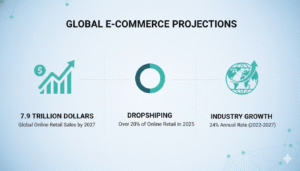
Starting a dropshipping business in 2025 remains one of the fastest-growing opportunities in e-commerce. Industry research shows that global online retail sales are expected to reach $7.9 trillion by 2027, and dropshipping is projected to account for over 20% of those sales in 2025. Over the past five years, the dropshipping industry has grown at an average annual rate of 24%, confirming its long-term potential and profitability for aspiring entrepreneurs.
A major advantage of starting a dropshipping business in 2025 is the low startup cost. You do not need to purchase bulk inventory or rent expensive warehouse space. Instead, you can launch a full dropshipping store on a laptop and manage it from anywhere. This model allows you to test multiple products with minimal financial risk and quickly identify profitable niches.
Dropshipping is also highly flexible. For some individuals, it generates consistent side income. For others, it becomes the base of a long-term, scalable e-commerce brand with global reach. Modern supplier networks, advanced e-commerce platforms, and efficient fulfillment systems enable global sales without complex logistics.
This beginner’s guide to starting a dropshipping business in 2025 will take you through all the essential steps. You will learn how to find profitable dropshipping niches, select reliable dropshipping suppliers, and create a professional Shopify store. You will also explore effective marketing strategies and discover how to manage orders like a professional, giving you the foundation to build a successful dropshipping business in the coming year.
If you need expert help getting started, visit our homepage to explore our services.
For more information on e-commerce trends, check out Shopify’s E-commerce Blog. You can also explore BigCommerce’s Resources for industry insights.
What Is Dropshipping and How Does It Work?
Dropshipping is a retail fulfillment method. In this model, you sell products online without keeping them in stock. Instead of buying inventory in advance, you work with third-party suppliers. These suppliers handle fulfillment on your behalf.
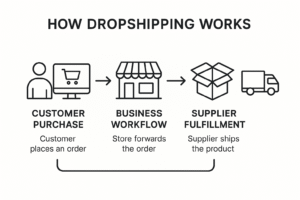
Here’s a quick breakdown of how the dropshipping process works:
First, a customer places an order on your online store and pays you directly. Next, you forward the order to your supplier along with the customer’s shipping details. Finally, the supplier ships the product straight to your customer.
That’s it. You don’t have to buy stock or manage a warehouse. Additionally, you won’t deal with the logistics of shipping. Instead, you focus on marketing your store and providing excellent customer service. Meanwhile, your supplier handles everything behind the scenes.
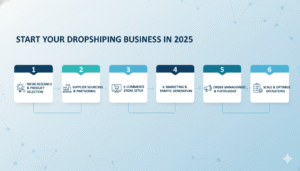
Why Start a Dropshipping Business in 2025?
If you’ve been thinking about launching an online store, 2025 might be the best time to get started. The current market environment offers incredible advantages. Therefore, anyone considering a dropshipping business should take notice.
Low Investment Risk
One of the biggest reasons to start now is the low financial barrier. In fact, you can get started with as little as $100 to $500. There’s no need to buy inventory upfront. Consequently, this significantly reduces your risk. Moreover, it gives you room to test different products before committing to anything long-term. This model makes it much easier for first-time entrepreneurs to step into retail without large capital.
Explosive Online Shopping Growth
E-commerce isn’t simply increasing. Instead, it’s blowing up. People are shopping online more and more. Furthermore, that trend isn’t going to stop anytime soon. By 2025, mobile commerce is expected to account for 10.4% of all retail transactions. This is up from just 6% in 2020. Therefore, this shows that there is a demand for it.
Global Market Access
Modern platforms and global supplier networks make expansion easier. As a result, they facilitate growing your business beyond your existing market. You may sell things to people all across the world right away. Therefore, dropshipping in 2025 lets you tap into global demand. Moreover, you can do this without managing international warehouses or logistics.
Learn more about global e-commerce from the World Trade Organization or Statista’s E-commerce Statistics.
Step 1 – Choose a Profitable Niche
When starting a dropshipping business in 2025, choosing the right niche is crucial. In fact, it’s one of the most important decisions you will make. Conducting thorough market research helps you identify products with consistent or growing demand. As a result, this increases your chances of long-term success.
How to Find Winning Niches
Google Trends Research: Use it to find products whose demand stays steady. Alternatively, look for items with increasing demand over time. However, be cautious with items that only experience short-term spikes during certain seasons. This is important unless you plan to update your store’s offerings throughout the year regularly.
TikTok Trend Analysis: TikTok has become a goldmine for spotting viral products. This is especially true among younger shoppers. Therefore, follow popular influencers and relevant hashtags in your potential niches. As a result, you can discover trending items early and capitalize on them before competition rises.
Amazon Best Sellers: Examining top categories can provide valuable insights. Products that perform well on Amazon often make excellent dropshipping candidates. This is because their popularity indicates proven consumer interest. Therefore, use this data to guide your niche selection and build a winning product lineup.
For niche research tools, visit Google Trends or explore Jungle Scout for Amazon insights.
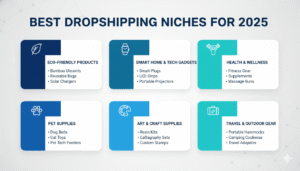
Top 2025 Trending Niches
Sustainable and Eco-Friendly Products: Consumers are more eco-conscious than ever. Consequently, this is driving demand for greener alternatives.
Pet Care and Accessories: As pet ownership grows, spending in this category increases as well.
Home Office and Productivity Tools: With remote work becoming the norm, tools that improve focus and efficiency remain in demand.
Health and Wellness Devices: Products related to personal fitness, mental health, and self-care are continuing to sell well.
Smart Home Accessories: Items that make daily life easier through automation and connectivity continue to gain traction.
Step 2 – Find Reliable Suppliers
Finding the right dropshipping suppliers is crucial. In fact, it’s essential for running a successful online store in 2025. Reliable suppliers help ensure product quality and timely shipping. Moreover, they provide great customer service. These factors are key to building trust with buyers.
Best Supplier Platforms
AliExpress remains a popular choice for beginners. This is due to its massive product selection and low prices. However, keep in mind that longer shipping times from overseas warehouses can sometimes affect customer satisfaction. Therefore, setting clear expectations is important.
CJ Dropshipping is a strong alternative to AliExpress. It offers faster shipping options and better customer support. Additionally, with multiple global warehouses, CJ Dropshipping helps reduce delivery times. As a result, it improves the reliability of order fulfillment.
Spocket is excellent for entrepreneurs targeting the US and EU markets. It connects you with local suppliers. Consequently, this results in faster delivery times and fewer customer service issues. Furthermore, this can boost repeat sales and positive reviews.
Choosing the right supplier based on your target market and product niche can greatly impact your dropshipping business’s growth and reputation.
Explore supplier platforms at AliExpress, CJ Dropshipping, and Spocket.
Supplier Vetting Checklist
Before you commit to a supplier, make sure they check the following boxes:
- At least a 95% positive feedback rating
- Responds to messages within 24 hours
- Offers competitive pricing that still allows for healthy profit margins
- Provides shipping options under 15 days
- Supplies high-quality product photos and clear descriptions
- Open to sending product samples so you can assess quality firsthand
Contact us today to discuss your supplier sourcing strategy. Furthermore, we can help you avoid common pitfalls that cost new dropshippers thousands.
Step 3 – Select the Right E-Commerce Platform
Your choice of e-commerce platform plays a major role. Specifically, it affects how easy it is to start your dropshipping business. Moreover, it determines how well it can scale over time. Here is a comparison of the top options. Therefore, this will help you decide which one best fits your needs.
Shopify vs Competitors
Shopify is one of the most beginner-friendly platforms available. It offers seamless integration with popular dropshipping apps and tools. As a result, this makes product import, order fulfillment, and store management simple. Shopify’s monthly plans range from $29 to $299. However, the extensive features, robust ecosystem, and excellent customer support make it worthwhile. Therefore, it’s a good investment for serious dropshipping entrepreneurs.
WooCommerce is a free WordPress plugin. It gives you full control and customization over your online store. It is ideal for those with some technical knowledge. Alternatively, it suits those who want more flexibility. However, properly setting up and managing WooCommerce takes time. Additionally, you’ll need a basic understanding of web hosting, plugins, and security.
Wix is known for its easy drag-and-drop website builder. Therefore, it’s perfect for simple stores or beginners who want to launch quickly. While Wix works well for small dropshipping operations, it can be limiting for large-scale growth. This is because it offers fewer advanced e-commerce features and integrations.
Choosing the right platform based on your experience level, budget, and business goals is essential. Consequently, this helps in building a successful dropshipping store in 2025.
Compare platforms at Shopify, WooCommerce, and Wix.
Shopify Advantages for Beginners
- One-click dropshipping app installations
- Mobile-responsive themes that look great on any device
- Built-in payment processing for a smoother checkout experience
- 24/7 customer support to assist anytime
- Automatic inventory management to keep things running efficiently
Starting Cost Breakdown:
- Shopify subscription: $29/month
- Domain name: around $15/year
- Premium theme: optional, ranges from $100 to $300
- Apps and tools: $20 to $100/month, depending on your needs
Step 4 – Build and Design Your Store
Building a professional dropshipping business for beginners is important. In fact, it’s about more than just putting products on a page. A clean, trustworthy design builds confidence. Moreover, it boosts sales.
Essential Design Elements
Theme Selection: Choose a clean, fast-loading, mobile-optimized theme. Additionally, avoid cluttered designs that distract from your products.
Product Descriptions That Convert: Focus on benefits, not just features. Furthermore, add details such as size, specs, and real-world use cases.
Trust-Building Pages: Include a professional About Us page and Contact page. Additionally, add clear Shipping and Return Policies. These pages go a long way in building trust with customers.
Store Optimization Tips
- Use high-quality product images. Specifically, show items from different angles.
- Add customer reviews and real testimonials.
- Include trust badges and security seals.
- Offer live chat support. Therefore, you can answer questions in real time.
- Create urgency. For instance, use limited-time offers and countdown timers.
For design inspiration, check out Canva for creating graphics or Unsplash for free high-quality images.
Step 5 – Market Your Dropshipping Store
The best dropshipping tips almost always focus on marketing. In fact, it’s often the single biggest difference between stores that succeed and those that don’t.
Free Marketing Methods
Search Engine Optimization (SEO): Optimize each product page for relevant keywords. Additionally, target long-tail keywords to start. This is because they’re less competitive.
Social Media Marketing: Build a presence on platforms like Instagram, TikTok, and Facebook. Furthermore, share content that adds value instead of just pushing sales.
Content Marketing: Start a blog. Specifically, one that answers common customer questions or tackles pain points within your niche.
Learn about SEO from Moz’s Beginner’s Guide or Ahrefs Blog.
Paid Advertising Strategies
Running targeted paid ads is essential. In fact, they drive traffic and sales to your dropshipping store in 2025. Here are three powerful advertising platforms to consider:
Facebook Ads are excellent for reaching specific demographics. This includes targeting by age, interests, location, and behavior. Additionally, they offer advanced retargeting features. Therefore, you can show ads to users who have already visited your site or engaged with your content. As a result, this increases the chance of conversion.
TikTok Ads have quickly become a go-to platform. Specifically, they’re great for connecting with younger audiences. With short, engaging video formats, TikTok ads can generate viral product interest. Moreover, they build brand awareness fast. Therefore, TikTok is valuable for dropshipping businesses targeting Gen Z and millennials.
Google Ads are ideal for targeting high-intent shoppers. Specifically, these are people actively searching for products like yours. By bidding on relevant keywords, you can show your ads to people ready to buy. Consequently, this often results in higher conversion rates and better return on ad spend.
Explore advertising platforms like Facebook Ads Manager, TikTok for Business, and Google Ads.
Influencer Collaborations
Work with micro-influencers in your niche. Typically, these are those with 1,000 to 100,000 followers. They often generate better engagement. Moreover, they cost much less than bigger influencers.
Step 6 – Manage Orders and Customer Service
Handling orders smoothly is crucial. Additionally, delivering outstanding service is what sets professionals apart from amateurs in dropshipping.
Automation Tools
Automation plays a major role. In fact, it’s essential in running a smooth and profitable dropshipping business in 2025. Tools like Oberlo, DSers, and AutoDS can automatically sync orders with your suppliers. Consequently, this eliminates the need for manual order entry. Moreover, it reduces human error and saves valuable time. Therefore, you can focus on scaling your store.
Customer Service Excellence
Equally important is delivering exceptional customer service. Respond to customer inquiries within 2 to 4 hours. This shows buyers that you value their time and trust. Additionally, be proactive in notifying customers of shipping delays. Furthermore, make your return and exchange process simple and hassle-free. Following up after a purchase to request feedback not only builds customer relationships. Moreover, it provides insights for improving your business.
A combination of automation and outstanding customer service can significantly boost customer satisfaction. As a result, it increases repeat purchases and long-term profitability for your dropshipping store.
If you want to launch faster, our Shopify store setup and marketing services come pre-loaded with professional automation systems. Therefore, they streamline your operations from day one.
Check out automation tools at Oberlo, DSers, and AutoDS.
Common Mistakes to Avoid
Avoiding beginner mistakes helps you move forward faster. Moreover, it helps you waste less money.
Critical Errors New Dropshippers Make
Selling Oversaturated Products: Avoid items that are trending heavily or widely available. These often have razor-thin margins. Additionally, they come with higher ad costs.
Poor Supplier Communication: Always make sure your supplier can handle your expected order volume. This is important before launching big campaigns.
Incorrect Pricing Strategy: Your pricing needs to cover everything. This includes ad spend, payment fees, platform charges, and a buffer for unexpected costs.
Neglecting Customer Research: Understand your ideal customer before launching. Knowing their pain points, desires, and buying behavior gives you a competitive edge.
How Much Can You Earn From Dropshipping?
Achieving dropshipping success in 2025 requires realistic income expectations. Moreover, you need to understand profit margin dynamics.
Profit Margin Breakdown
Most successful dropshipping stores operate with gross profit margins between 15% and 45%. However, your actual net profit will depend on several important factors. These influence your overall costs and pricing strategy.
Product Markup: Many dropshipping businesses price products at two to three times the supplier cost. This helps cover expenses and generate profit.
Advertising Costs: Paid advertising often accounts for 20% to 40% of your total revenue. This is especially true when running Facebook Ads, TikTok Ads, or Google Ads to drive traffic.
Platform and App Fees: Selling platforms like Shopify or WooCommerce usually charge fees. Additionally, dropshipping apps typically take 3% to 8% of your revenue.
Payment Processing Fees: Payment gateways typically charge around 2.9% plus $0.30 per transaction. Therefore, this should be factored into your pricing.
Realistic Earning Timeline
If you’re starting a dropshipping business, here’s what a typical first-year journey looks like:
Months 1 to 3: This is the learning phase. Your focus should be on understanding how dropshipping works. Additionally, you’ll research profitable niches and test multiple products. Revenue during this period is often modest. Typically, it ranges between $0 and $1,000. This is because you build your store and learn from early sales data.
Months 4 to 6: By now, you should have identified products with strong potential. Therefore, the focus shifts to scaling those winning products. This involves marketing, supplier optimization, and better customer service. Many new store owners start seeing monthly revenues between $1,000 and $10,000 during this stage.
Months 7 to 12: This is the growth and optimization phase. You refine your advertising and improve your website for conversions. Additionally, you expand your product range. With the right strategies, hitting $10,000 in revenue or more becomes very achievable. Furthermore, your dropshipping business starts to feel like a well-structured, profitable operation.
Remember, these numbers depend heavily on niche selection, marketing effectiveness, and how much time you invest.
Final Tips for Dropshipping Beginners
Starting a dropshipping business with little money is entirely possible. However, even a tiny quantity of money can help you go faster. Moreover, it allows you to test more thoroughly. If you can buy tools and advertise from the start, your business will grow faster.
Success Acceleration Strategies
Continuous Learning: E-commerce is always evolving. Therefore, stay informed through online courses, podcasts, blogs, and YouTube channels. These focus on platform updates and marketing tips.
Product Testing: Relying on just one product is risky. In fact, the most successful dropshippers are constantly testing new items. Additionally, they’re improving underperformers.
Scaling Through Automation: As your profits grow, reinvest them. Specifically, invest into automation tools, hiring virtual assistants, and expanding your ad strategy.
Budget-Friendly Start Options
- Start with free Shopify themes instead of paid ones.
- Use organic social media marketing. Therefore, you can drive your first sales.
- Reinvest your early profits into growth before paying yourself.
- Create ads and content with free tools like Canva.
For free learning resources, explore YouTube channels on dropshipping, Oberlo’s Blog, or Neil Patel’s Marketing Blog.
Conclusion
Starting a dropshipping business in 2025 offers outstanding opportunities. This is especially true for entrepreneurs who are ready to learn, stay consistent, and adapt to changes. The fundamentals include selecting profitable dropshipping niches and partnering with reliable suppliers. Moreover, they involve building professional stores and applying effective marketing strategies.
Dropshipping does not guarantee overnight success. However, with a clear plan and continuous effort, your chances of success improve significantly. Therefore, focus on putting your customers first. Additionally, build trust with your suppliers. Furthermore, constantly refine your processes.
If you treat your dropshipping store like a real business rather than a quick way to make money, you can build something sustainable. In fact, it can be long-lasting. With smart decisions and hard work, dropshipping can lead to financial freedom. Moreover, it provides the flexibility to work from anywhere in the world.
Have questions about getting started? Alternatively, do you need personalized guidance for your dropshipping business plan? Contact us today. Let’s discuss your specific goals and challenges.
If you’re also interested in Amazon FBA as an alternative or complementary business model, check out our Amazon FBA services to explore more opportunities.
FAQs About Starting a Dropshipping Business
Q: Is dropshipping still profitable in 2025?
Indeed, dropshipping remains highly profitable in 2025. Projections indicate that the global dropshipping market will grow at a 23.6% annual rate. As a result, it will reach $243.42 billion by 2025. Supplier relationships, marketing effectiveness, and niche selection are more critical to success than the business model itself.
Q: How much money do I need to start dropshipping?
Basic setup costs for dropshipping can range from $100 to $500. This includes platform subscription, domain registration, and an initial advertising budget. However, having between $1,000 and $3,000 gives you more freedom. Specifically, it allows you to test products and expand successful campaigns.
Q: Is it possible to start dropshipping with no money?
Free trials, organic marketing strategies, and reinvesting early profits can all help you start with low upfront costs. However, this is difficult. Therefore, prioritize email list development, SEO, and social media marketing before spending money on paid advertising.
Q: Which platform is considered the best for beginners?
Shopify’s user-friendly interface, vast app ecosystem, and outstanding customer service make it the most popular platform. This is especially true for dropshipping beginners. Even though it’s more expensive than other options, it’s worth buying. This is because of its ease of use. Moreover, it can grow with your needs.
Q: How long does it take to start making sales?
Depending on their product choices and marketing strategies, most new dropshipping stores see their first sales within 2 to 8 weeks of launch. However, it usually takes three to six months to achieve consistent profitability. This happens as you optimize your operations, advertising, and product offerings.
This comprehensive guide provides the foundation for starting your dropshipping journey. Success requires dedication, continuous learning, and adapting to market changes. However, the potential rewards make it worthwhile for committed entrepreneurs.
For additional guidance, visit resources like Entrepreneur Magazine, Forbes Small Business, or Shopify’s Learning Center.
