
Walmart vs Amazon Automation Risk Comparison 2026
In 2026, the most talked-about issue among online sellers trying to choose the best platform is Walmart vs Amazon automation. Furthermore, Statista says that U.S. e-commerce sales will reach $1.3 trillion this year. Consequently, picking the wrong marketplace could cost you thousands of dollars and hours of work. The stakes have never been higher, and sellers are finally realizing the hard truth: not all of these platforms are equally risky when comparing Walmart vs Amazon automation strategies.
People think that Amazon and Walmart work the same way. However, they don’t. Moreover, Amazon will cut into your profits, and Walmart might not even look at your application. One platform is full of competition, while the other one doesn’t get enough traffic. Therefore, knowing these differences before you invest could mean the difference between making money that lasts and losing it all.
This comparison cuts through the noise and shows you exactly what each platform will be like in 2026.
Why Sellers Are Rethinking Amazon Automation in 2026
For a long time, Amazon felt like the only real option. If you wanted to sell online, you would list on Amazon. That was just how it worked. Additionally, the traffic was already there, customers trusted the platform, and it seemed easier than building everything from scratch.
However, that version of Amazon does not really exist anymore.
Today, the competition is on another level. Consequently, you are not just competing with a few similar sellers. You are up against millions of listings, many backed by large teams, serious budgets, and long-standing supplier relationships. Furthermore, price wars are constant. They are not something that happens once in a while. They happen every day. Moreover, repricing software reacts in seconds, pushing prices lower and lower. A product that makes sense at $30 can quickly slide down to $22 just to stay visible. At that point, you are working hard for very little return.
The Real Cost of Amazon FBA Automation
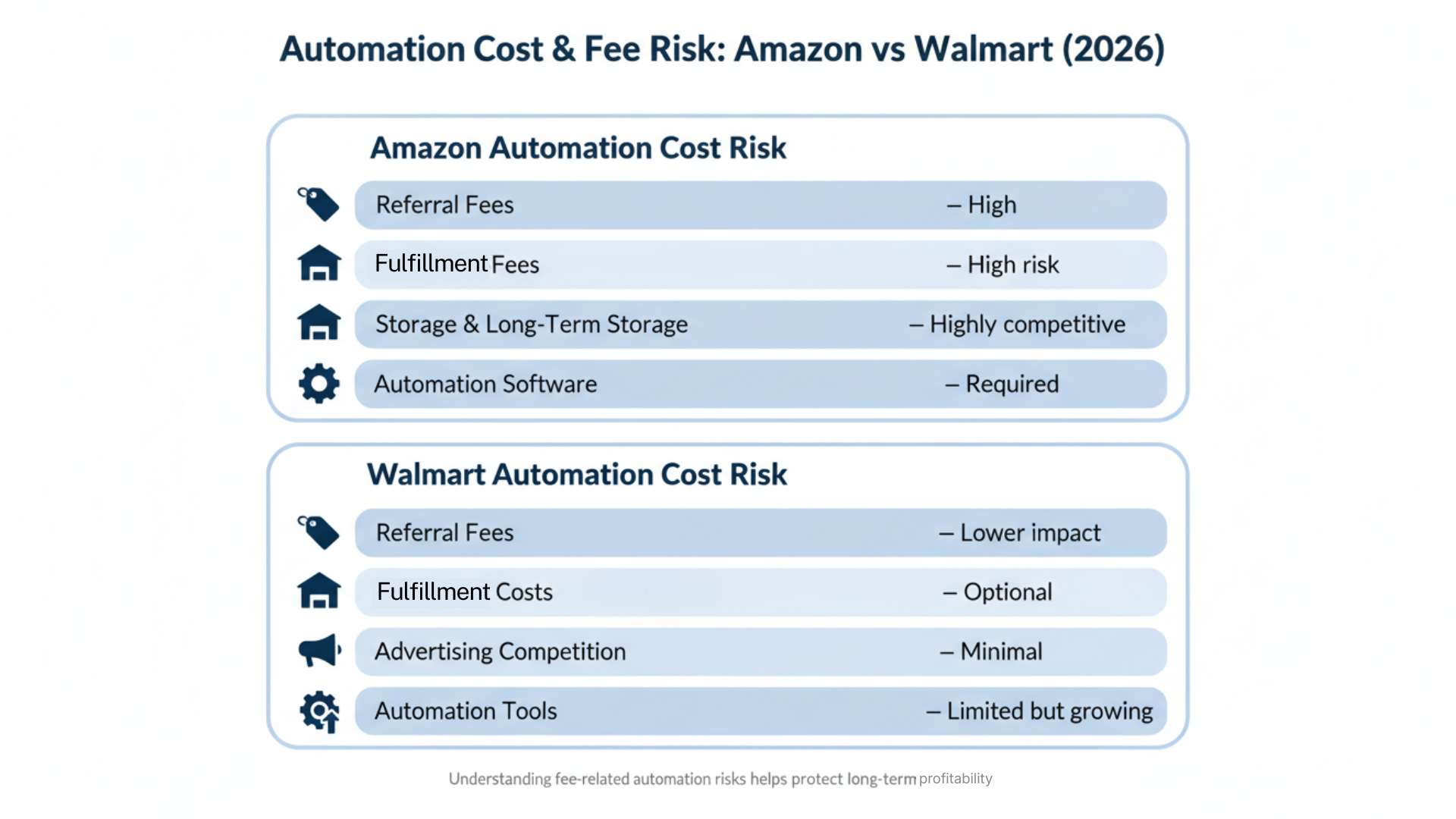
Fees are where a lot of sellers start feeling the pressure. Referral fees, fulfillment fees, storage fees—all of it adds up quietly. On paper, each fee seems manageable. In reality, it is common to hand over 40% or more of your revenue to Amazon by the time the sale is complete. If a product does not move fast enough, long-term storage fees can turn a decent product into a loss.
Then there is the constant risk of suspension. Additionally, Amazon’s rules are strict, and they change often. Sometimes they change without much notice. One unhappy customer, one delayed shipment, or one small mistake can freeze your entire account. Consequently, sales stop immediately. Cash flow stops, too. Amazon FBA automation helps with scale, but if something is set up wrong, it can create problems just as fast as it solves them.
Algorithm Changes That Kill Sales
Amazon tweaks its search algorithm regularly. Moreover, a product ranking on page one can drop to page five after an update. This unpredictability makes long-term planning difficult, especially for sellers relying on organic traffic.
The platform also favors its own products. Furthermore, Amazon Basics competes directly with third-party sellers, often winning the Buy Box despite higher prices. This gives Amazon an unfair advantage that cuts into your sales.
What Makes Walmart Automation Different from Amazon
Walmart’s marketplace operates on completely different principles. Specifically, the platform is still growing, which means less competition but also fewer established systems. Therefore, understanding Walmart vs Amazon automation becomes critical for strategic planning.
Lower Fees, Higher Margins with Walmart Automation
Walmart charges lower referral fees than Amazon on most categories. This difference might seem small, but it adds up quickly. Moreover, a product earning $5 profit on Amazon could generate $7 or $8 on Walmart simply due to fee structures.
Storage costs are also more reasonable. Additionally, Walmart doesn’t penalize long-term storage as aggressively as Amazon, giving you more flexibility with inventory management. In addition, advertising costs are lower because fewer sellers compete for the same keywords.
Stricter Approval Process
Walmart doesn’t let just anyone sell on its platform. Furthermore, the approval process requires meeting specific standards, including performance metrics and business verification. This selectivity reduces competition but also creates a barrier to entry.
Many sellers get rejected initially. Specifically, Walmart wants established businesses with proven track records. Consequently, new sellers often struggle to gain approval, which can delay launch timelines by weeks or months.
Growing But Still Maturing
Walmart’s marketplace lacks some of the sophisticated tools Amazon offers. Fewer automation options exist, and integration with third-party software can be challenging. However, this also means opportunities exist for early adopters who figure out the system before it becomes saturated.
The platform is investing heavily in infrastructure. Moreover, new fulfillment centers and technology upgrades are rolling out throughout 2026, which should improve the seller experience over time. Therefore, Walmart dropshipping services are becoming increasingly viable for sellers seeking lower-risk entry points.
Breaking Down the Risks: Walmart vs Amazon Automation
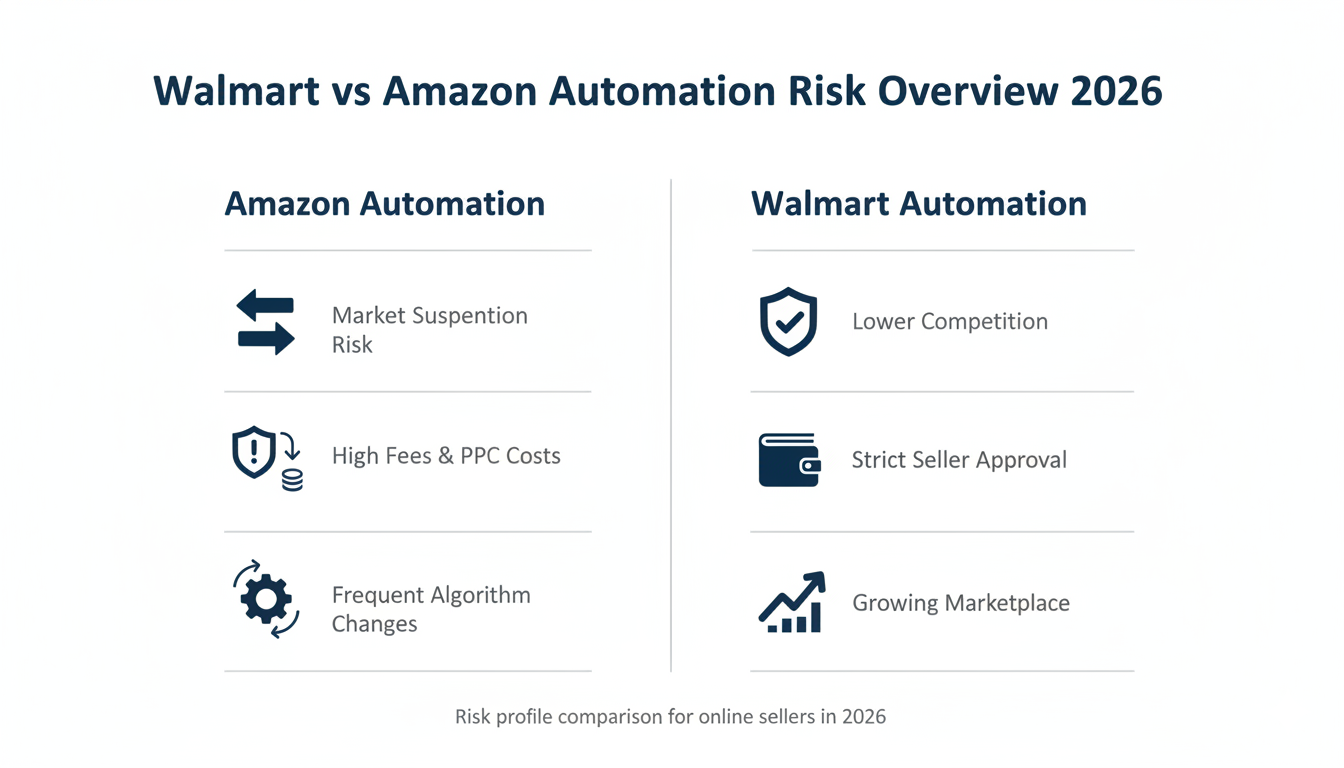
Understanding risk profiles helps you make smarter decisions about where to invest your time and money. Consequently, comparing Walmart vs Amazon automation risks becomes essential.
Walmart vs Amazon Automation: Complete Risk Comparison Table
| Risk Factor | Amazon Automation | Walmart Automation | Winner |
| Competition Level | Extremely High – Millions of sellers | Moderate – Growing but manageable | Walmart |
| Initial Investment | $5,000 – $15,000+ | $1,000 – $3,000 | Walmart |
| Monthly Ad Spend | $1,000+ for visibility | $300 – $500 average | Walmart |
| Referral Fees | 8% – 45% depending on category | 6% – 15% on most categories | Walmart |
| Account Suspension Risk | High – Strict policies change frequently | Moderate – Evolving standards | Walmart |
| Traffic Volume | 2.5+ billion monthly visits | 400+ million monthly visits | Amazon |
| Approval Difficulty | Easy – Most sellers approved quickly | Difficult – Selective vetting process | Amazon |
| Tool Ecosystem | Extensive – 100+ automation tools | Limited – 20+ growing tools | Amazon |
| Profit Margins | Lower – 40%+ fees total | Higher – 20-30% fees total | Walmart |
| Brand Building | Excellent – Strong registry & A+ content | Good – Basic branding options | Amazon |
| Customer Trust | Very High – 89% trust rating | Moderate – 72% trust rating | Amazon |
| Return Rates | 5-10% average across categories | 8-15% in many categories | Amazon |
| Policy Stability | Moderate – Established but evolving | Low – Rapid changes in 2026 | Amazon |
| Long-term Storage Fees | High – Penalties after 6 months | Low – More flexible terms | Walmart |
| Best For | High-volume, fast-moving products | Everyday essentials, stable inventory | Depends |
Amazon Automation High-Competition Risks
Amazon’s biggest risk is market saturation. Nearly every profitable niche has dozens or hundreds of competitors. Therefore, standing out requires significant investment in advertising, photography, and review generation.
Counterfeit products are another major issue. Furthermore, competitors might hijack your listings or sell knockoffs under your brand name. Fighting these violations takes time and often requires legal action. Amazon’s brand registry helps, but it’s not foolproof.
Account Health Is Everything
Your account health determines whether you can sell on Amazon. Specifically, metrics like order defect rate, late shipment rate, and customer service response time must stay within strict limits. Falling below these thresholds triggers warnings, and repeated violations lead to suspension.
Automation can monitor these metrics, but it can’t fix underlying operational issues. Moreover, if your supplier ships late or your product arrives damaged, automation won’t save you. You need solid processes in place before automation becomes useful.
Walmart Automation Policy Evolution Risks
Walmart’s marketplace is changing rapidly. Therefore, policies that work today might not exist tomorrow. This uncertainty makes long-term planning difficult, especially for sellers investing in inventory or automation tools.
Return rates on Walmart tend to run higher than Amazon in some categories. Additionally, the platform’s customer-friendly return policy makes it easy for buyers to return products, which can hurt profitability if you’re selling items with high return rates.
Limited Traffic Compared to Amazon
Walmart gets significantly less traffic than Amazon. While this reduces competition, it also means fewer eyeballs on your products. Consequently, you’ll need to work harder to drive external traffic through ads, social media, or other channels.
Brand recognition also plays a role. Furthermore, consumers trust Amazon more than Walmart for online shopping, especially for non-essential items. Convincing buyers to purchase from Walmart instead of Amazon requires competitive pricing and excellent reviews.
The Automation Tools That Actually Work for Walmart vs Amazon Automation
Choosing the right tools makes or breaks your automation strategy on either platform. Therefore, understanding which tools support Walmart vs Amazon automation is crucial.
Walmart vs Amazon Automation: Essential Tools Comparison
| Tool Category | Amazon Tools | Walmart Tools | Price Range |
| Product Research | Helium 10, Jungle Scout, Viral Launch | Auto DS Market Research, SaleFreaks | $29 – $199/month |
| Repricing Software | RepricerExpress, Seller Snap, Feedvisor | Repricer Express (Walmart), Informed Repricer | $40 – $500/month |
| Inventory Management | Restock Pro, SoStocked, InventoryLab | SkuVault, Linnworks, Sellbrite | $50 – $300/month |
| Order Processing | Amazon Seller Central (native) | AutoDS, DSers, CedCommerce | $19 – $99/month |
| Analytics & Reporting | Sellerboard, HelloProfit, ManageByStats | DataCaciques, eComEngine (expanding) | $15 – $150/month |
| Listing Optimization | Listing Dojo, SellerApp, ZonGuru | List Perfectly, Listing Mirror | $29 – $199/month |
| Review Management | Feedback Whiz, Feedback Genius | eDesk (multi-channel), BQool | $20 – $100/month |
| PPC Management | PPC Entourage, Perpetua, Teikametrics | Walmart Advertising Platform (native) | $50 – $500/month |
| Multi-Channel Sync | Channel Advisor, Sellbrite | Linnworks, SkuVault, Channel Advisor | $100 – $500/month |
Amazon Automation Essentials
Amazon sellers rely on tools like Helium 10 for keyword research and product tracking. Additionally, Jungle Scout helps identify profitable products before you invest in inventory. Repricers like RepricerExpress adjust prices automatically to maintain the Buy Box.
Inventory management systems like RestockPro prevent stockouts and overstock situations. These tools integrate with Amazon’s API to provide real-time data on sales velocity and reorder points. However, they require ongoing monitoring to ensure accuracy.
If you’re serious about Amazon, working with professionals who understand Amazon FBA automation can accelerate your learning curve and help you avoid expensive mistakes.
Walmart Automation Options
Walmart’s tool ecosystem is smaller but growing. Specifically, AutoDS and DSers handle dropshipping automation, including order processing and tracking updates. These platforms connect to suppliers and sync inventory automatically.
Inventory management solutions such as SkuVault and Linnworks integrate with Walmart’s API to track stock levels across multiple channels. Moreover, this becomes crucial if you’re selling on both Amazon and Walmart simultaneously.
The learning curve is steeper at Walmart because fewer tutorials and resources exist. However, this also means less competition from sellers who give up early. Exploring Walmart dropshipping services can help you set up efficient systems without trial and error.
Which Platform Fits Your Business Model: Walmart vs Amazon Automation
Your choice depends on factors beyond just profit potential. Therefore, evaluating Walmart vs Amazon automation based on your specific business needs is essential.
Walmart vs Amazon Automation: Cost Breakdown Comparison
| Expense Category | Amazon Automation | Walmart Automation |
| Initial Inventory Investment | $3,000 – $10,000 | $1,000 – $3,000 |
| Software & Tools (Monthly) | $200 – $500 | $100 – $200 |
| PPC Advertising (Monthly) | $1,000 – $3,000+ | $300 – $800 |
| FBA/Fulfillment Fees | 40-50% of sale price | 20-30% of sale price |
| Professional Account Fee | $39.99/month | Free (no monthly fee) |
| Photography & Listing | $500 – $2,000 per product | $200 – $500 per product |
| Brand Registry | $100 – $500 | $50 – $200 |
| Total First 3 Months | $8,000 – $20,000 | $2,500 – $6,000 |
| Break-Even Timeline | 4-8 months average | 2-4 months average |
Match Your Budget to the Platform
Amazon requires more upfront capital. Between inventory costs, advertising spend, and software subscriptions, expect to invest $5,000 to $15,000 minimum. Conversely, Walmart, especially through dropshipping models, can start with $1,000 to $3,000.
Consider your monthly expenses too. Moreover, Amazon’s advertising costs are higher due to competition. You might spend $1,000+ monthly on PPC just to stay visible. In contrast, Walmart’s lower competition means advertising budgets can be smaller while still generating results.
Consider Your Product Type
Amazon dominates in electronics, books, and trending items. Conversely, Walmart performs better in everyday essentials like groceries, household products, and basic apparel. Matching your product category to the right platform increases success rates.
Private label products work well on both platforms, but Amazon offers better branding tools. Furthermore, Walmart suits sellers focused on reselling or dropshipping without heavy branding investment.
Best Product Categories: Walmart vs Amazon Automation
| Product Category | Amazon Performance | Walmart Performance | Recommended Platform |
| Electronics & Gadgets | Excellent (High demand) | Good (Growing) | Amazon |
| Home & Kitchen | Excellent (Saturated) | Very Good (Less competition) | Walmart |
| Grocery & Consumables | Good (Restricted categories) | Excellent (Core strength) | Walmart |
| Books & Media | Excellent (Dominant) | Fair (Limited selection) | Amazon |
| Toys & Games | Excellent (Seasonal peaks) | Very Good (Family focus) | Both |
| Health & Beauty | Very Good (Competitive) | Good (Emerging) | Amazon |
| Clothing & Apparel | Good (Crowded) | Very Good (Basics focus) | Walmart |
| Sports & Outdoors | Very Good (Wide selection) | Good (Growing) | Amazon |
| Baby Products | Excellent (Trusted) | Very Good (Value focus) | Both |
| Automotive Parts | Very Good (Established) | Good (Developing) | Amazon |
Think About Your Risk Tolerance
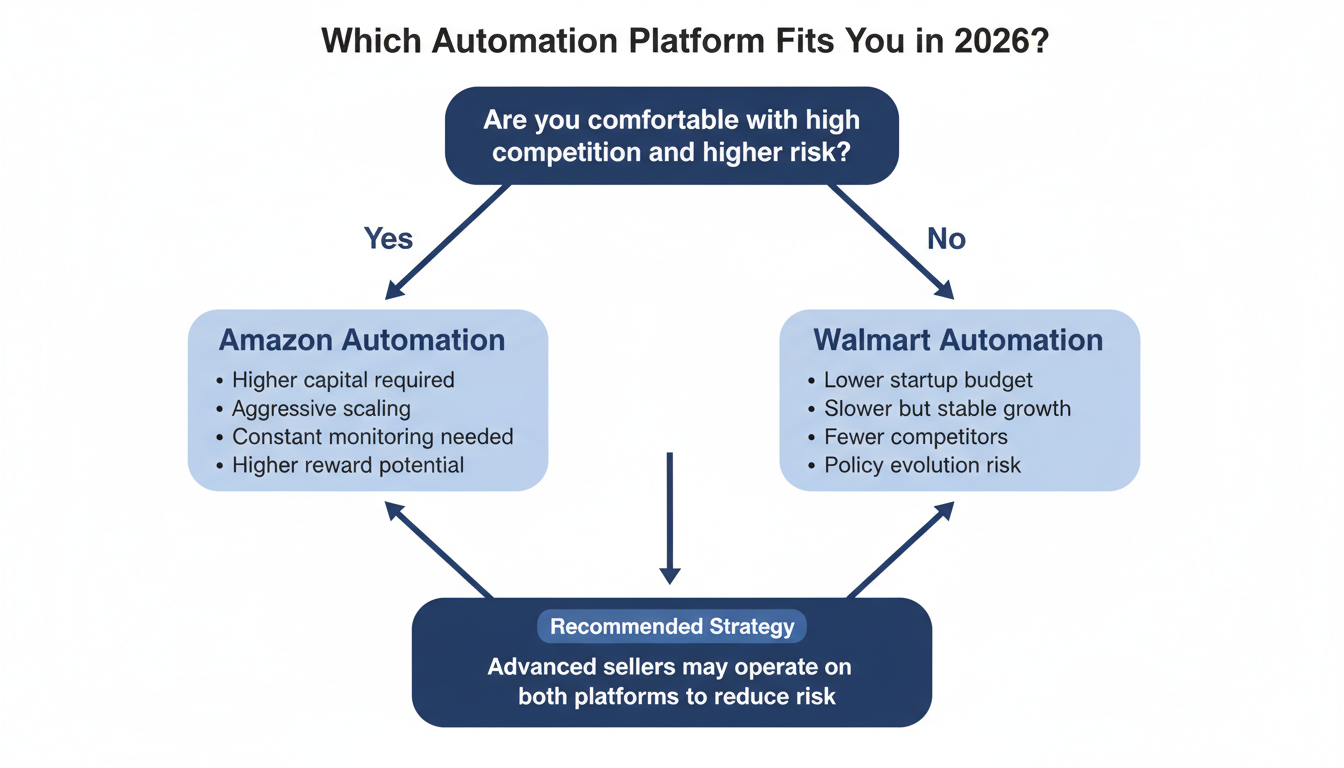
Amazon’s fast-paced environment suits aggressive sellers comfortable with high risk and high reward. In contrast, Walmart’s slower growth appeals to conservative sellers who prioritize stability over rapid scaling.
If you hate uncertainty, Walmart might frustrate you with its evolving policies. Similarly, if you can’t handle intense competition, Amazon will drain your resources fighting price wars. Therefore, understanding Walmart vs Amazon automation risk profiles helps align platform choice with personality.
Common Mistakes That Destroy Profits
Avoiding these errors saves thousands in lost revenue. Consequently, learning from these mistakes improves your Walmart vs Amazon automation success.
Over-Relying on Automation
Automation handles repetitive tasks, but it doesn’t replace strategy. Moreover, sellers who set up automated systems and walk away often find themselves in trouble. Prices might drop too low, inventory might run out, or customer complaints might go unanswered.
Monitor your automation daily, at least initially. Specifically, check that repricers aren’t destroying margins, inventory systems are reordering correctly, and customer service bots are providing helpful responses.
Ignoring Customer Service
Automated responses feel robotic and frustrate customers. Additionally, buyers want real help, not canned replies. Balancing automation with human touch keeps customers happy and protects your account health.
Response time matters more than ever in 2026. Both platforms penalize slow responses, so ensure your systems can handle inquiries quickly without sacrificing quality.
Neglecting Compliance
Both Amazon and Walmart have strict rules about product listings, customer communication, and business practices. Furthermore, automation can accidentally violate these policies if configured incorrectly.
For instance, automated listing software might use prohibited keywords or make claims that violate platform guidelines. Therefore, review all automated content before publishing to avoid violations that could result in your account being suspended.
Putting All Eggs in One Basket
Relying on a single platform is dangerous. Moreover, policy changes, account suspensions, or market shifts can wipe out your income overnight. Diversifying across both platforms creates a safety net.
Managing multiple platforms requires more effort, but it significantly reduces business risk. Additionally, if Amazon suspends your account, you still have Walmart income to cover expenses while you resolve the issues.
What 2026 Looks Like for Walmart vs Amazon Automation
The e-commerce landscape continues evolving rapidly, and both platforms are adapting. Therefore, understanding future trends in Walmart vs Amazon automation helps you plan strategically.
Amazon’s Focus on Speed and AI
Amazon is investing billions in faster delivery and AI-powered tools. Furthermore, same-day delivery is expanding to more areas, raising customer expectations. Sellers who can’t keep up with fulfillment speed will lose Buy Box eligibility.
AI tools are also becoming more sophisticated. Moreover, Amazon’s recommendation engine is learning from billions of data points, which helps sellers with strong conversion rates but hurts those with mediocre listings. According to McKinsey’s research on AI in retail, AI-driven personalization is reshaping customer expectations across all platforms.
Walmart’s Aggressive Expansion
Walmart is pouring resources into growing its marketplace. Specifically, new fulfillment centers are opening nationwide, and the company is aggressively recruiting sellers. This expansion creates opportunities for sellers who join now before saturation hits.
The platform is also improving its technology stack. Moreover, better APIs, more automation tools, and enhanced seller support are rolling out throughout 2026. These improvements should make Walmart competitive with Amazon’s infrastructure. Forbes reports on Walmart’s technology investments highlight the company’s commitment to modernizing its marketplace.
The Rise of Multi-Platform Selling
More sellers are operating on both platforms simultaneously. Therefore, this strategy captures customers regardless of where they shop and protects against platform-specific risks. Tools that sync inventory across marketplaces are becoming essential.
Multi-platform selling requires more sophisticated systems but offers better long-term stability. If you’re ready to scale across both marketplaces, exploring comprehensive solutions through Amz Art’s automation services can significantly simplify the process.
Making Your Final Decision on Walmart vs Amazon Automation
Choosing between Walmart vs Amazon automation comes down to honest self-assessment. Therefore, evaluating your capabilities and goals is crucial.
Start with These Questions
What’s your actual budget? Don’t stretch yourself thin trying to compete on Amazon if you can’t afford proper inventory and advertising. Conversely, Walmart’s lower entry costs might serve you better initially.
How much time can you dedicate daily? Moreover, Amazon requires constant monitoring and optimization. In contrast, Walmart’s slower pace allows for a more relaxed management style, at least in the early stages.
What’s your exit strategy? If you want to build a brand and sell it eventually, Amazon offers better valuation multiples. However, if you want a steady income without planning an exit, Walmart’s stability might appeal more.
Test Before Committing Fully
Consider starting small on one platform before going all-in. Specifically, list a few products, run some ads, and see how the platform feels. This testing phase reveals whether the platform matches your working style and expectations.
Track every metric during testing. Moreover, calculate actual profit after all fees, measure time spent on management tasks, and assess stress levels. These real-world insights matter more than theoretical comparisons when evaluating Walmart vs Amazon automation.
Get Expert Guidance
Both platforms have learning curves that cost money if you’re figuring things out alone. Therefore, working with experienced professionals can compress months of trial and error into weeks of focused progress.
If you’re still uncertain which direction makes sense for your specific situation, reaching out through a contact form can provide personalized recommendations based on your goals, budget, and product niche.
Frequently Asked Questions
Q. What is Walmart vs Amazon automation in e-commerce?
Walmart vs Amazon automation refers to using software and professional services to manage sales tasks such as inventory tracking, pricing adjustments, and order fulfillment. Specifically, Amazon has more established automation tools, while Walmart offers less competition with growing automation options.
Q. How much does it cost to start a Walmart vs Amazon automation business in 2026?
Amazon automation typically requires $5,000 to $15,000 for inventory, fees, and software. Conversely, Walmart automation, especially dropshipping models, can start with $1,000 to $3,000. Your actual costs depend on product selection and business model when comparing Walmart vs Amazon automation.
Q. Is Walmart vs Amazon automation profitable for beginners?
Both can be profitable but suit different skill levels. Moreover, Amazon requires more capital and technical knowledge, making it challenging for complete beginners. In contrast, Walmart’s lower fees and reduced competition make it more accessible for newcomers in 2026.
Q. What tools automate Walmart and Amazon selling?
Amazon sellers use Helium 10, Jungle Scout, and RepricerExpress. Additionally, Walmart sellers rely on AutoDS, DSers, and inventory systems like SkuVault. The right tools depend on your chosen platform and whether you’re doing FBA, dropshipping, or wholesale.
Q. How does automation help small business owners in e-commerce?
Automation handles repetitive tasks like price updates, inventory tracking, and order processing. Therefore, this frees up time for strategy, customer relationships, and growth activities instead of daily operational tasks that don’t directly generate revenue when managing Walmart vs Amazon automation systems.
