
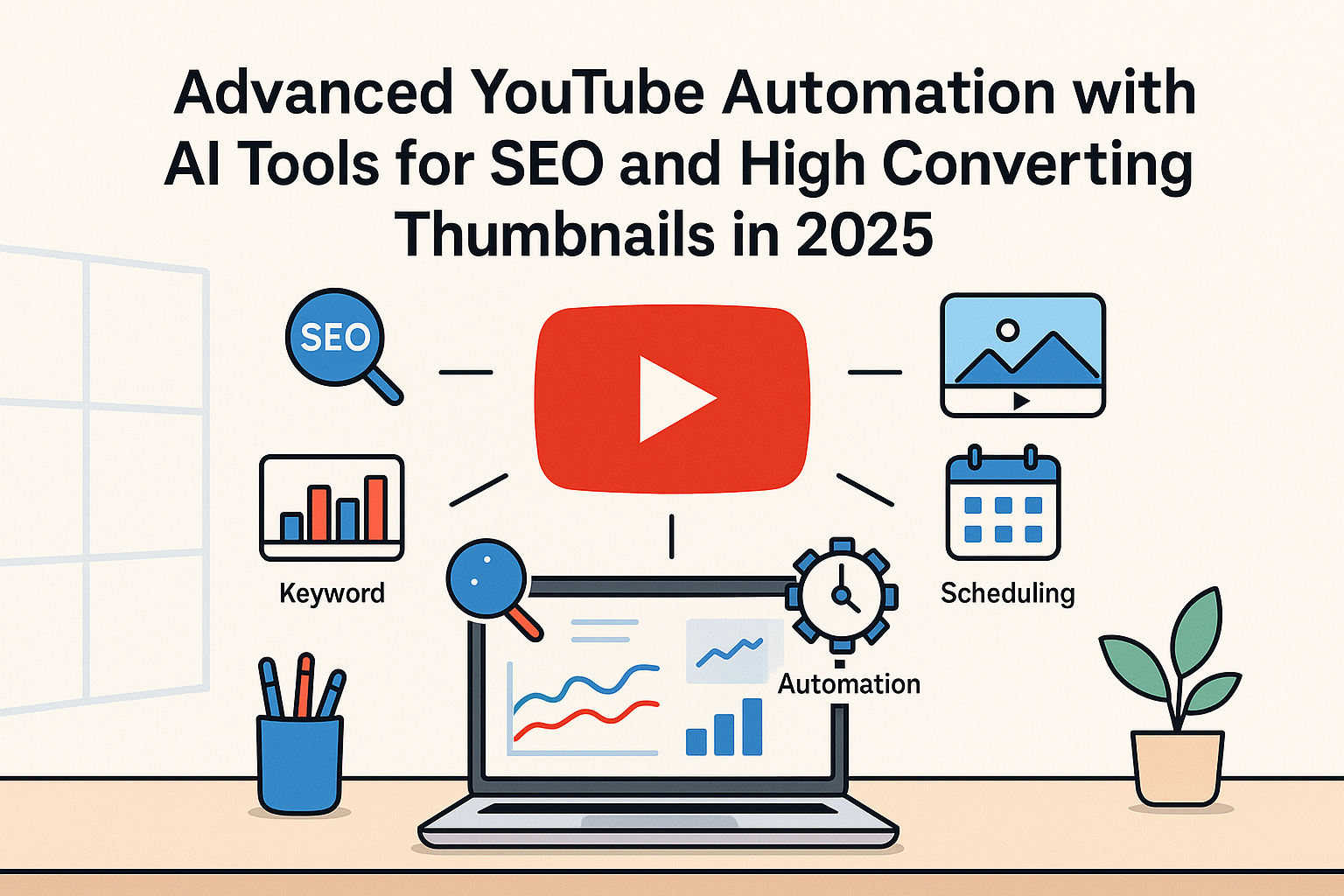
YouTube Automation with AI Tools for SEO and High-Converting Thumbnails
YouTube automation is now essential for creators. Moreover, it helps them gain stronger visibility. Additionally, it drives steady income growth in 2025. This shift matters greatly. In fact, YouTube has over 2.7 billion active users worldwide. Furthermore, it ranks just behind Google in overall traffic. Therefore, this huge audience gives businesses real chances to reach broader markets.
However, managing a channel takes constant attention. Tasks like keyword research take time. Similarly, SEO optimization demands effort. Meanwhile, thumbnail design requires skills. Additionally, content planning consumes hours. Fortunately, automation tools solve these problems. Consequently, they automate repetitive tasks. As a result, creators save long hours on manual work.
Understanding Youtube Automation Benefits
Many entrepreneurs feel overwhelmed by YouTube’s demands. Each video needs proper keyword targeting. Additionally, it requires a strong thumbnail. Furthermore, a clear description is crucial. Moreover, the right publishing time matters greatly.
However, AI tools reduce this pressure. Specifically, they optimize each step with accuracy. Therefore, creators achieve higher search rankings. Additionally, they attract more clicks. Furthermore, they maintain consistent upload schedules. Consequently, automation frees time for content quality. Moreover, it allows better audience engagement.
Why Youtube Automation Matters for Online Sellers
Automation matters greatly for online sellers. In fact, the platform has become a powerful sales channel. Furthermore, modern e-commerce brands rely heavily on it. Sellers use video to showcase products. Additionally, they demonstrate features clearly. Moreover, they build trust with tutorials.
The E-Commerce Content Challenge
Most business owners already manage inventory. Additionally, they handle customer service daily. Furthermore, they run ongoing marketing campaigns. Therefore, adding consistent content creation becomes overwhelming quickly.
However, automation tools remove repetitive work. For instance, they handle keyword research automatically. Similarly, they create thumbnails efficiently. Furthermore, they manage basic optimization tasks. As a result, sellers focus on strategy instead. Meanwhile, these systems handle technical steps smoothly.
ROI and Growth Metrics
The ROI appears quickly with these tools. In fact, automated channels grow three to four times faster. For context, manual channels gain 100 subscribers monthly. In contrast, automated channels reach 300 to 400 subscribers instead.
Moreover, consistent uploads strengthen algorithm signals. As a result, content stays discoverable longer. Furthermore, steady optimization improves rankings continuously.
Measurable Performance Improvements
Beyond subscribers, automated channels see better metrics. For instance, click-through rates jump from 2% to 5%. Similarly, watch time increases by 20-30%. Additionally, videos target the right keywords better.
Time Savings with Automation
Creators save 8 hours weekly through automation. Therefore, their workload drops from 10 hours to 2 hours. Specifically, they save time on technical operations. According to Social Media Examiner, consistent optimization drives measurable growth.
How AI Tools Transform Video Performance
SEO decides whether videos get discovered. However, AI SEO tools now manage this work. Specifically, they handle keyword research automatically. Additionally, they optimize titles efficiently. Furthermore, they write descriptions naturally. Consequently, this work completes in minutes instead of hours.
AI-Powered Keyword Research
These tools study millions of videos. Furthermore, they find trending keywords automatically. Additionally, they suggest balanced titles. Moreover, they write descriptions with relevant keywords. As a result, they help content reach right viewers. Therefore, keyword research happens automatically now.
Comparing Top Tools: TubeBuddy vs VidIQ
TubeBuddy and VidIQ lead the market. However, they serve different purposes. Therefore, understanding these differences helps greatly.
TubeBuddy for Beginners
TubeBuddy works well for beginners. Specifically, it suits budget-conscious creators perfectly. Pricing starts at $9 monthly. Consequently, it remains accessible for new channels. Moreover, the interface is intuitive. Additionally, it integrates directly into the platform.
Beginners benefit from its keyword explorer. Furthermore, it shows search volume clearly. Additionally, it displays competition scores simply. Moreover, its thumbnail analyzer gives instant feedback. As a result, you can update multiple videos simultaneously.
VidIQ for Advanced Users
VidIQ focuses on competitive analysis instead. Additionally, it provides advanced analytics features. Plans begin at $7.50 monthly. However, higher tiers cost $39 to $79. Furthermore, they unlock full functionality completely.
VidIQ offers deeper competitor insights. Specifically, it shows traffic-driving videos clearly. Moreover, its trending alerts notify you instantly. Additionally, the keyword score ranks opportunities precisely. However, it has a steeper learning curve. Therefore, it’s ideal for frequent uploaders.
Tool Comparison Chart
| Feature | TubeBuddy | VidIQ |
|---|---|---|
| Starting Price | $9/month | $7.50/month |
| Best For | Beginners & Budget Users | Advanced Analytics |
| Key Strength | Simple Interface | Competitor Analysis |
| Bulk Processing | Yes | Limited |
| Keyword Scoring | Basic | Advanced |
| Learning Curve | Easy | Moderate |
| Trending Alerts | No | Yes |
Which Tool to Choose
For new creators, TubeBuddy provides better value. In contrast, experienced creators prefer VidIQ instead. Moreover, many successful creators use both tools. Specifically, they combine TubeBuddy for workflow automation. Meanwhile, they use VidIQ for strategic planning.
How SEO Tools Analyze Competition
Both platforms use machine learning effectively. Specifically, they predict keyword traffic accurately. Additionally, they show competition levels clearly. Moreover, they track ranking over time. As a result, this removes guesswork completely.
These tools also analyze competitors thoroughly. For instance, they highlight top-performing videos. Additionally, they reveal competitor keywords clearly. Therefore, you can find market gaps easily. Consequently, you target underserved topics better.
Real-Time Optimization
Another benefit is real-time optimization. Specifically, SEO tools suggest improvements immediately. For instance, they flag missing keywords quickly. Similarly, they identify weak titles instantly. Additionally, they spot low-quality descriptions easily. Therefore, every video has better success chances.
For more insights, see Moz’s Video SEO Guide. Additionally, explore comprehensive automation solutions for advanced strategies.
Creating High-Converting Thumbnails with AI
Thumbnails decide whether viewers click. In fact, strong thumbnails double click-through rates. Moreover, they can even triple them. However, designing effective thumbnails needs graphic skills. Fortunately, AI thumbnail tools solve this challenge easily.
How AI Thumbnails Work
These tools use machine learning effectively. Specifically, they design attention-grabbing thumbnails. Furthermore, they analyze millions of examples. Additionally, they see what works best. You simply enter your video topic. Then, the tool generates multiple options instantly.
Canva for Thumbnails
Canva leads the AI thumbnails market. Additionally, it offers extensive template libraries. Moreover, it has a user-friendly interface. The free plan covers basic needs. Meanwhile, Canva Pro costs $13 monthly. Furthermore, it unlocks AI-powered features completely.
Canva’s AI suggests color schemes automatically. Additionally, it adjusts text size perfectly. Moreover, templates maintain consistent branding. As a result, they build audience recognition quickly.
Thumbnail Blaster Features
Thumbnail Blaster specializes in video thumbnails. Moreover, it offers pre-tested designs. Specifically, these designs increase clicks proven. Pricing starts at $47 one-time. Additionally, the software runs locally. Furthermore, it includes split-testing capabilities. However, its interface feels less modern.
A/B Testing Thumbnails
Some platforms provide A/B testing features. Specifically, they compare different designs. Additionally, they show which versions perform better. Moreover, they track clicks and engagement. As a result, you refine your strategy. Therefore, you understand audience preferences better.
CTR Improvement Results
Creating thumbnails once took 30 to 60 minutes. However, AI automation now takes under 5 minutes. Moreover, you get professional results instantly. Additionally, you avoid heavy time investment.
Typical improvements boost CTR from 2-3% to 5-7%. Consequently, this increases video visibility dramatically. For more guidance, check Canva’s Design School. Furthermore, Neil Patel’s blog offers excellent tips.
Mastering Scheduling and Publishing
Consistency drives success greatly. Furthermore, regular uploads grow channels faster. However, maintaining consistency seems challenging. Fortunately, scheduling tools solve this efficiently.
Benefits of Automated Publishing
These platforms let you upload videos in advance. Specifically, you can schedule weeks ahead. Moreover, you can plan months in advance. Then, the system publishes content automatically. Additionally, it chooses optimal moments perfectly. Therefore, you never miss deadlines. Consequently, you maintain consistency during busy periods.
Timing Optimization Tools
Advanced upload planner tools consider time zones. Specifically, they publish when audiences are active. As a result, initial engagement increases immediately. Moreover, this signals quality to the algorithm. Therefore, higher early engagement improves long-term performance.
Hootsuite for Scheduling
Hootsuite offers robust scheduling features. Plans start at $99 monthly for teams. Furthermore, it integrates with analytics platforms. Additionally, it recommends optimal publishing times. Moreover, its dashboard manages multiple platforms. Therefore, it’s efficient for cross-platform marketers. See Hootsuite’s resource center for details.
Buffer for Simple Automation
Buffer offers a simpler alternative instead. Additionally, it’s more affordable overall. Specifically, it costs $6 per channel monthly. Moreover, its interface focuses solely on scheduling. However, it has no complex analytics. Therefore, Buffer works well for solo creators. Additionally, the browser extension allows quick scheduling.
Batch Content Creation
Many creators adopt batch content creation. Specifically, they record multiple videos in one session. Then, they schedule them across the month. Moreover, they use an upload planner.
For example, filming four videos in one day works well. Then, scheduling them weekly maintains consistent presence. Meanwhile, this frees three weeks for other tasks. Buffer’s blog provides excellent strategies.
Step-by-Step Workflow: Building Your System in 30 Days
Creating an effective workflow needs planning. Moreover, it requires clear structure. This plan takes you from zero to full automation. Additionally, it completes in one month only.
Week One: Foundation Setup
Day 1-2: First, install TubeBuddy or VidIQ. Then, complete the initial setup. Next, connect the tool to your channel. Additionally, explore the dashboard thoroughly. Furthermore, set up keyword tracking. Finally, identify three competitor channels.
Creating Thumbnail Templates
Day 3-4: Next, create thumbnail templates in Canva. First, design three variations. Moreover, reflect your brand colors. Then, test each template. Therefore, you can see which fits best.
Keyword Research Phase
Day 5-7: Now, conduct keyword research. Specifically, find ten video topics. Furthermore, focus on keywords with 1,000 to 10,000 searches. Additionally, lower competition keywords work better. Typically, keywords under 40 suit new channels.
Week Two: Content Development
Day 8-10: Next, build a content calendar. Specifically, plan for 90 days ahead. Furthermore, base topics on your keyword research. Moreover, group related topics together. Therefore, you enable efficient batch creation.
Recording Your First Batch
Day 11-14: Now, record your first batch. Specifically, film four videos in one session. Moreover, this approach reduces setup time. Additionally, it keeps energy consistent. Meanwhile, focus on delivering core content. Therefore, save detailed editing for later.
Week Three: Optimization
Day 15-17: First, edit your four videos. Additionally, use basic software only. Then, add intros and outros. Furthermore, include necessary B-roll. However, keep edits simple initially. Therefore, you avoid overwhelming yourself.
Video Optimization Process
Day 18-21: Next, optimize each video thoroughly. First, use your SEO tool. Then, write titles with primary keywords. Additionally, create descriptions of 200 to 300 words. Furthermore, include secondary keywords naturally. Moreover, add 8 to 10 relevant tags. Finally, upload custom thumbnails.
Week Four: Launch and Monitor
Day 22-24: Now, set up automated publishing. Specifically, use Hootsuite or Buffer. Then, schedule videos to publish weekly. Additionally, choose optimal times from analytics. Most channels perform best between 2 and 4 PM.
Performance Monitoring
Day 25-28: Next, monitor your automated content performance. Specifically, check click-through rates. Additionally, review watch time carefully. Furthermore, track engagement within 48 hours. Moreover, make notes about successful thumbnails. Therefore, you learn what works best.
System Review and Planning
Day 29-30: Finally, review your entire workflow. First, identify bottlenecks clearly. Then, research additional tools. Additionally, address remaining challenges. Finally, plan your next batch session.
30-Day Implementation Timeline
| Week | Days | Task | Time Required |
|---|---|---|---|
| Week 1 | 1-2 | Install & Setup SEO Tools | 2 hours |
| 3-4 | Create Thumbnail Templates | 3 hours | |
| 5-7 | Keyword Research (10 videos) | 4 hours | |
| Week 2 | 8-10 | Build Content Calendar | 2 hours |
| 11-14 | Batch Record 4 Videos | 6 hours | |
| Week 3 | 15-17 | Edit Videos | 8 hours |
| 18-21 | Optimize & Upload | 4 hours | |
| Week 4 | 22-24 | Schedule Publishing | 2 hours |
| 25-30 | Monitor & Review | 3 hours |
For professional support, visit AmzArt Solutions for expert guidance.
Realistic Limitations and Risks
Automation offers significant benefits. However, it also carries limitations. Additionally, it involves certain risks. Therefore, understanding these challenges helps greatly. Moreover, it helps you avoid mistakes.
Algorithm Changes and Breakage
YouTube updates its algorithm frequently. Consequently, this can disrupt automated workflows. In recent years, recommendation algorithms changed significantly. As a result, scheduled content performed differently. Therefore, tools relying solely on timing lost effectiveness.
Mitigation Strategies for Algorithm Changes
Mitigation strategy: First, avoid depending on one tool entirely. Additionally, maintain manual oversight for key videos. Furthermore, monitor updates through the YouTube Creator Blog. Moreover, build flexibility into your system. Therefore, you can adapt quickly.
The Risk of Sounding Robotic
AI-generated content can feel formulaic. Specifically, titles may sound repetitive. Similarly, descriptions may lack personality. Additionally, scripts may seem generic. Moreover, viewers notice these patterns. Consequently, over-automation makes content lose personality. Therefore, channels see lower engagement. Additionally, they experience higher unsubscribe rates.
Maintaining Authentic Voice
Mitigation strategy: First, use tools for drafts only. Then, add your personal voice. Additionally, rewrite content to match your style. Moreover, record genuine reactions. Furthermore, share real opinions. Therefore, automation boosts efficiency. However, it shouldn’t replace your perspective.
When Automation Actually Hurts Engagement
Automated replies can backfire easily. Specifically, generic responses feel impersonal. Moreover, viewers expect authentic answers. However, AI may respond inappropriately. Consequently, this undermines trust quickly.
Similarly, scheduled content needs context awareness. For instance, posting promotions during sensitive events seems tone-deaf. Therefore, this damages brand reputation.
Balancing Automation and Authenticity
Mitigation strategy: First, limit automation to repetitive questions. Additionally, engage personally for meaningful interactions. Furthermore, review your content calendar weekly. Therefore, you ensure posts remain timely. Moreover, you keep content appropriate always.
For strategies, check HubSpot’s guide to social media automation. Additionally, Sprout Social’s research provides valuable insights.
YouTube’s Official Stance
YouTube prohibits artificial manipulation strictly. Specifically, using bots to inflate metrics violates policies. Similarly, fake accounts to boost subscribers breaks rules. However, legitimate SEO tools are allowed. In fact, they’re even recommended by the platform.
Understanding Acceptable Automation
The distinction lies in authenticity clearly. Specifically, automation that streamlines creation is acceptable. However, methods that deceive viewers risk termination. Moreover, fake engagement puts channels in danger. Additionally, Creator Studio confirms this. Therefore, automated publishing is permitted appropriately.
Safe Practices
Safe practices focus on workflow enhancement. Specifically, they don’t manipulate metrics artificially. Additionally, avoid services promising instant subscribers. Moreover, avoid guarantees of viral views. Furthermore, established tools comply with policies. Therefore, they help creators optimize responsibly.
Consequently, this approach ensures efficient growth. Moreover, it stays fully compliant always.
Combining Multiple Tools for Maximum Impact
Using individual tools provides valuable benefits. However, combining multiple tools creates powerful ecosystems. Consequently, it automates every channel operation. Moreover, it maximizes overall efficiency.
Building a Workflow Ecosystem
First, begin with keyword research tools. Specifically, uncover trending opportunities. Then, use AI scriptwriters next. Additionally, generate video outlines. Moreover, employ AI thumbnail generators. Finally, schedule videos using platforms. Therefore, publish at optimal times.
Each tool performs its specialized role. Meanwhile, it contributes to overall strategy. Consequently, your growth strategy improves dramatically.
Integration Between Tools
Integration removes redundant work effectively. For instance, keyword research feeds description generators. Similarly, thumbnail tools pull brand elements automatically. Additionally, scheduling platforms access AI analytics. Therefore, they determine best publishing windows. Consequently, this seamless workflow keeps everything connected.
Scalability of Systems
A structured system transforms operations. Specifically, it changes from time-consuming task to scalable asset. Moreover, you focus on strategy instead. Meanwhile, automation handles repetitive execution smoothly.
Scalability offers major advantages. In fact, managing ten channels takes slightly more effort. Therefore, this opens new revenue streams. Moreover, many entrepreneurs run multiple niche channels. Consequently, they use frameworks simultaneously.
Choosing the Right Tools
Choosing right tools is critical always. Specifically, look for strong API connections. Additionally, check integration capabilities thoroughly. Moreover, build your tech stack gradually. Furthermore, test each tool before adding another. Therefore, this prevents overwhelming yourself. Consequently, it ensures smooth operation.
For professional guidance, explore AmzArt Solutions services.
Specific Metrics and Benchmarks for Success
Automation isn’t set-and-forget solution. Instead, monitoring results regularly ensures performance. Moreover, understanding clear benchmarks helps greatly. Therefore, you determine if ROI justifies investment.
Expected Time Savings
Managing channels manually takes 10 to 12 hours weekly. Specifically, this includes 3 to 4 hours for keyword research. Additionally, 2 to 3 hours for thumbnail design. Furthermore, 4 to 5 hours for uploading. Finally, 1 to 2 hours for analytics review.
Automated Workflow Time Requirements
With automation, time drops to 2 to 3 hours. Specifically, automated keyword research takes 30 minutes. Additionally, AI thumbnail generators need 20 minutes. Furthermore, batch content creation cuts uploading to 1 hour. Moreover, analytics tools generate reports automatically. Therefore, review requires only 30 minutes.
Annual Time Savings Calculation
This adds up to 8 hours saved weekly. Consequently, that equals 416 hours annually. Additionally, at $50 hourly value, this represents $20,800 in recovered time.
Click-Through Rate Improvements
Most channels average 2 to 4% CTR. However, implementing AI-generated thumbnails boosts this significantly. Additionally, optimized titles increase CTR to 5 to 8%.
For example, consider 100,000 monthly impressions. At 2% CTR, this gets 2,000 views. However, improving to 6% increases views to 6,000. Therefore, this creates 200% traffic boost. Moreover, this requires no additional content.
Ranking Optimization Results
Automated SEO tools rank videos in top 20 results within 30 to 60 days. In contrast, manual methods take 90 to 120 days. Additionally, average positions move from page 3 to 4. Moreover, they reach page 1 to 2 instead. Therefore, this improves medium-competition keywords significantly.
Subscriber Growth Acceleration
Channels manually gaining 100 to 200 subscribers monthly see changes. Specifically, they reach 300 to 600 subscribers after implementing automation. Moreover, this three to four times growth comes from consistency. Additionally, better SEO helps. Furthermore, optimized thumbnails work together.
Channels under 1,000 subscribers reach monetization 6 to 9 months faster. Think with Google confirms these patterns.
Revenue and ROI Timeline
Basic tools cost $50 to 100 monthly. Meanwhile, advanced systems cost $150 to 250 monthly. Specifically, these include SEO tools. Additionally, they have AI thumbnails. Furthermore, they include scheduling platforms. Most creators see positive ROI within 60 to 90 days. Moreover, this comes through time savings.
Furthermore, e-commerce channels break even within 30 to 45 days. Specifically, better product visibility drives direct sales.
Performance Benchmarks
| Metric | Before Automation | After Automation | Improvement |
|---|---|---|---|
| Weekly Time Investment | 10-12 hours | 2-3 hours | 8 hours saved |
| Click-Through Rate | 2-4% | 5-8% | 200% increase |
| Monthly Subscribers | 100-200 | 300-600 | 3-4x growth |
| Ranking Timeline | 90-120 days | 30-60 days | 50% faster |
| Monthly Tool Cost | $0 | $50-250 | ROI in 60-90 days |
For guidance, check AmzArt Solutions’ comprehensive services. Additionally, Shopify’s guide offers insights.
Advanced Strategies for 2025
As technology evolves, new opportunities emerge. Moreover, staying current maintains competitive edge. Therefore, understanding these developments helps greatly.
AI Analytics
One emerging trend is AI analytics. Specifically, these predict video performance before publishing. Moreover, these tools analyze your content thoroughly. Additionally, they compare it to successful videos. Furthermore, they suggest improvements. Therefore, they increase success likelihood.
Automated Community Management
Another advancement involves community management. Specifically, AI chatbots respond to common comments. Additionally, they answer frequent questions. Moreover, they maintain engagement while you focus elsewhere. Furthermore, these bots learn from your responses. Therefore, they provide increasingly accurate answers.
Automated Video Editing
Automated editing is becoming sophisticated. Specifically, tools cut awkward pauses automatically. Additionally, they add transitions smoothly. Moreover, they generate B-roll suggestions. However, human editors still deliver higher quality. Therefore, automated editing suits high-volume channels. Consequently, it supports scaling strategies.
Dynamic Thumbnail A/B Testing
Dynamic A/B testing is powerful strategy. Specifically, advanced tools rotate thumbnail designs automatically. Moreover, they base this on performance data. Additionally, they identify which designs work best. Furthermore, they segment by audience type. Therefore, this optimization happens continuously.
AI-Assisted Content Creation
Furthermore, AI assists with batch content creation. Specifically, tools generate video scripts. Additionally, they suggest talking points. Moreover, they create entire content calendars. Therefore, they base this on trending topics. Consequently, this transforms e-commerce applications.
E-Commerce Integration
Integration with e-commerce improves rapidly. Specifically, videos trigger automated recommendations. Moreover, these base on viewer behavior. Therefore, this connects content and commerce seamlessly. Consequently, this increases monetization rates. Wistia’s research shows analytics drive better decisions.
The Future of Automation and AI
Automation will get smarter. Specifically, artificial intelligence advances rapidly. Moreover, understanding upcoming trends helps. Therefore, creators and businesses stay ahead.
Fully Automated Content Creation
Fully automated creation is coming. Specifically, AI will generate entire videos. Moreover, it will work from simple prompts. However, early versions exist today. Therefore, future systems will be more refined. Nevertheless, human creativity remains essential. Consequently, crafting engaging content still matters. Moreover, making the platform a strong tool needs human touch.
Personalization
Personalization will improve significantly. Specifically, future AI systems could create different versions. Moreover, each version targets different audience segments. Therefore, each viewer sees tailored content. Consequently, this boosts engagement dramatically. Additionally, it potentially increases monetization.
Predictive AI Analytics
Predictive analytics will become standard. Specifically, tools will forecast which topics succeed. Moreover, they’ll predict best formats. Therefore, they work before you create content. Consequently, this data-driven approach reduces guesswork. Moreover, it helps plan effective growth strategy.
Cross-Platform Integration
Cross-platform integration will deepen. Specifically, your system could connect seamlessly. Moreover, it will link Instagram and TikTok. Additionally, it will reach emerging platforms. Furthermore, batch systems adapt videos automatically. Therefore, this saves time. Consequently, it maximizes every content piece impact.
Regulations and Compliance
Regulations around AI may evolve. Specifically, as tools grow more powerful, platforms may require transparency. Additionally, legal frameworks may demand disclosure. Therefore, staying informed ensures compliance. Moreover, it builds trust with audience.
The Human Element
Despite advances, human element remains irreplaceable. Specifically, authentic personality cannot be automated. Moreover, genuine expertise matters greatly. Additionally, real audience connection is crucial. Therefore, use AI to enhance strengths. However, don’t replace them entirely.
For tools and guidance, explore AmzArt Solutions for practical strategies. Additionally, Forrester’s research on AI provides insights.
Frequently Asked Questions
Q. What is YouTube automation in e-commerce?
Automation uses AI-powered tools. Specifically, it handles repetitive tasks automatically. Moreover, these include keyword research. Additionally, thumbnail creation happens automatically. Furthermore, content scheduling works efficiently. For e-commerce sellers, it makes management easier. Moreover, it improves video performance. Therefore, content ranks higher. Consequently, you handle fewer steps manually.
Q. How much does it cost to start in 2025?
Basic tools cost $20 to $50 monthly. Specifically, these cover essential features. Moreover, they include SEO tools. Additionally, they offer simple scheduling. However, more advanced setups cost $100 to $300 monthly. Furthermore, these include AI thumbnails. Additionally, they have analytics platforms. Moreover, cost depends on channel size. Therefore, most creators see ROI quickly.
Q. Is automation profitable for beginners?
Yes, beginners can benefit greatly. Specifically, when tools are used correctly. Moreover, it reduces learning curve. Additionally, it streamlines ranking optimization. Furthermore, it simplifies thumbnail creation. Therefore, it makes publishing easier. However, success still depends on quality content. Moreover, it requires solid growth strategy. Therefore, start with simple scheduling first. Then, move to advanced tools.
Q. What tools automate SEO and content scheduling?
TubeBuddy and VidIQ are popular. Specifically, for keyword research. Additionally, for optimization tasks. Meanwhile, Canva and Thumbnail Blaster create thumbnails. Furthermore, Hootsuite and Buffer handle publishing. Moreover, combining these tools allows full workflow automation. Therefore, this includes batch content creation. Additionally, it enables scheduling across videos.
Q. How does automation help small business owners?
Automation saves time for small business owners. Specifically, by managing repetitive tasks. Moreover, these include optimization work. Additionally, thumbnail creation happens automatically. Furthermore, publishing runs on schedule. Consequently, they focus on core operations. Meanwhile, they maintain consistent uploads. Moreover, automated systems support e-commerce strategies. Therefore, they increase monetization. Additionally, improved SEO boosts engagement.
For actionable strategies, check out AmzArt Solutions. If you have questions, feel free to contact our team for expert assistance.
